Choosing a place to trade futures is really two decisions rolled into one: The software you'll use and the regulated firm that actually holds your money. This guide explains futures trading platforms, with a checklist for weighing your options, as well as details around margin requirements and regulatory rules.
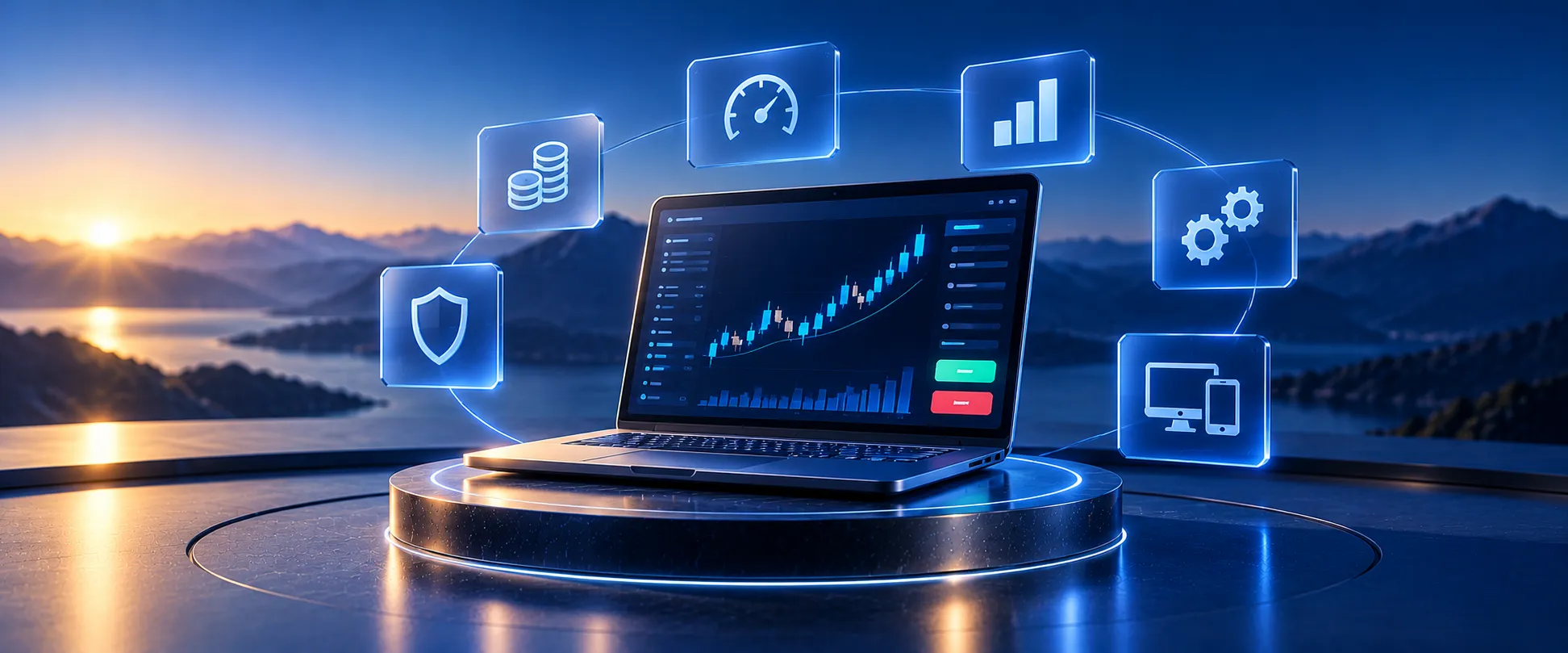
A futures trading platform is the software and brokerage setup used to access futures markets. It gives traders a way to view available contracts, check prices and charts, enter and manage orders, monitor open positions and track margin requirements.
Depending on the provider, a futures trading platform may also include features such as real-time market data, depth-of-market views, different order types, technical analysis tools, account balances, margin information and trade history. Some platforms are offered directly by a broker, while others are separate front-end tools connected to the firm that only holds the account and clears the trades.
The products accessed through these platforms are futures contracts. A futures contract is a standardized agreement to buy or sell an underlying asset at a set price and on a predetermined date. Trading one doesn’t give you direct ownership of the underlying asset; you’re trading the contract itself.
Read about derivatives in finance
Execution software and a clearing broker do different jobs in futures trading. The execution software is the platform you use to view markets, analyze prices and place orders. The clearing broker, typically a Futures Commission Merchant (FCM), is the regulated firm that holds customer funds and handles the clearing and settlement of futures trades.
Put simply, the software is where you trade and the FCM is the firm that handles the account and money behind those trades.
Execution software can include charts, market data, order-entry tools, depth-of-market views and position monitoring. Some brokers provide their own software, while other traders use a separate third-party platform connected to their brokerage account.
An FCM sits on the brokerage side of the relationship. Under the Commodity Futures Trading Commission (CFTC) framework, an FCM can accept futures orders and customer funds related to those trades. Whether you open an account directly with an FCM or through an introducing broker, customer funds for futures trading are generally held with the FCM.
Because these are distinct services, some traders pay a separate subscription for charting or execution software on top of the commissions their FCM charges to clear trades.
Front-end software | FCM clearing broker | |
Primary role | The interface for viewing markets and placing orders | The regulated intermediary that accepts orders and payment |
Holds funds | No | Yes, customer funds are ultimately held here |
Clearing and settlement | No | Handles clearing and settlement |
Regulatory registration | Not necessarily a registered entity | Registered and subject to compliance obligations |
A single futures trade can include several different costs. Typical fees include, but aren’t limited to:
Futures margin is money set aside in your account to support an open futures position. It’s not a down payment on the underlying asset. There are two main exchange-set margin levels to understand:
These requirements are set by the exchange and generally apply to positions carried beyond the trading session, including overnight positions.
Intraday margin works differently. Some platforms have lower margin requirements for positions opened and closed during the same trading session. These requirements are set by the broker and can change, especially during periods of high volatility.
Margin requirements also affect what happens when a position moves against you. If losses cause the money in your account to drop below the required level, the broker may either ask you to add additional funds or they may close your position.
Learn more about leverage and margin in futures trading
Intraday (day-trading) margin | Exchange margin | |
Set by | Clearing broker discretion | The exchange |
When it applies | Active session hours | Positions held overnight |
Stability | Can change on short notice during volatility | Exchange-mandated initial and maintenance levels |
When comparing futures trading software, useful features can include order-entry tools, charting, platform access, automation support and information about market liquidity. The importance of each feature depends on how the platform is used.
Discover Crypto.com’s futures trading platform
Regulation and the way customer funds are handled are important considerations when choosing a futures trading platform. In the US, futures brokers and intermediaries operate under a specific regulatory framework.
Firms that conduct futures business with the public are generally required to register with the CFTC as a FCM or introducing broker and to maintain membership with the National Futures Association (NFA).
Customer funds are also subject to segregation rules. Money deposited with an FCM to trade US futures and options must generally be kept separate from the firm’s own operating funds. This means the broker can’t treat customer trading funds as part of its normal business cash.
Segregation doesn’t mean customer funds are insured or guaranteed. If an FCM becomes insolvent, traders may receive preferential treatment in bankruptcy, but full recovery isn’t assured if there is a shortfall in segregated assets.
If you want to research the regulatory status of a futures broker, you can use the NFA BASIC database. It provides public information about registration status, NFA membership, disciplinary history and certain financial information for FCMs.
The best futures platform for you depends on your capital, experience and how hands-on you want to be. The platform you choose can also affect which contracts are available, how much margin is required, what fees apply and which trading tools you can use.
Some platforms focus on a broad range of futures contracts, while others may offer a smaller selection through a mobile app or web interface. Available products can include equity-index futures, commodity futures, currency futures and other exchange-listed contracts, depending on the provider.
Explore traditional futures vs. perpetual futures
Futures contracts are standardized by the exchange, but some markets offer smaller versions like mini and micro contracts. A smaller contract size reduces notional exposure, but it doesn’t remove the risks of futures trading.
Futures platforms can also differ in the tools they provide. Some offer depth-of-market ladders, Level 2 data, advanced charting, APIs, desktop software or mobile access. Others may be more basic.
In the US, futures brokers can be researched through the NFA BASIC database, which shows registration and membership information. Fees may include brokerage commissions, exchange and clearing charges, market data subscriptions and platform fees.
Crypto.com is one example of a futures trading venue. Our CFTC-regulated derivatives products, including futures, are available on the Crypto.com App and Crypto.com Exchange App.
Services, features and other benefits referenced in this article may be subject to eligibility requirements, token holdings, and may change at the discretion of Crypto.com.
Sometimes the opportunity is up. Sometimes it’s down. And sometimes it’s when TradFi markets are closed.
With Crypto.com Perpetuals, you can go long or short on supported crypto and stocks, with up to 5x leverage, no expiry date and built-in tools to manage risks.
See what you can trade with Crypto.com Perpetuals
With Crypto.com, you can get exposure to changing market conditions using futures. Choose from a range of assets, with up to 5x leverage and isolated margin settings.
Where can I trade futures contracts as a retail trader?
Retail traders can access futures through a broker registered with the CFTC that holds an NFA membership. Before funding your futures account, always confirm the broker’s status in the NFA BASIC database and review its full fee schedule. The right futures venue for you depends on things like your available capital, your trading style and the contracts you want.
What is the best futures trading platform for advanced charting?
There's no universal answer, because it depends on your needs. You can weigh up platform tools like charting depth, indicator range, multi-timeframe support and backtesting ability. Always confirm any subscription costs and the broker’s regulatory standing before deciding on a futures trading platform.
Where can you trade futures on mobile?
You can trade CFTC-regulated derivatives like futures on the Crypto.com App or the Crypto.com Exchange App. Availability may differ by region.
What is the difference between Level 1 and Level 2 market data?
In general terms, Level 1 data shows top-of-book pricing – the best bid and offer – while Level 2, or depth-of-market data, shows resting orders across multiple price levels. Depth data typically carries its own subscription fee, which varies by exchange and schedule.
How do I verify if a futures broker is regulated by the CFTC and NFA?
You can confirm a specific futures broker’s registration status, membership and disciplinary history – and, for FCM members, certain financial reports – for free using the NFA's BASIC database.
Important information: This is informational content sponsored by Crypto.com and should not be considered as investment advice. Trading cryptocurrencies carries risks, such as price volatility and market risks. Past performance may not indicate future results. There's no assurance of future profitability. Before deciding to trade cryptocurrencies, consider your risk appetite.
This article is for informational purposes only and should not be construed as financial or investment advice. Past performance does not guarantee future results.
Services, features and other benefits referenced in this article may be subject to eligibility requirements, token holdings, and may change at the discretion of Crypto.com.
Foris DAX Inc. (“Crypto.com”) introduces customers to Foris DAX FCM, LLC, a CFTC-registered Futures Commission Merchant, for the purpose of opening accounts to trade perpetual futures contracts (“Perpetual Futures”) offered by Crypto.com | Derivatives North America (CDNA), a CFTC-regulated exchange. Crypto.com is a guaranteed introducing broker of Foris DAX FCM, LLC. All customer accounts related to Perpetual Futures are carried by and held at Foris DAX FCM, LLC.
Trading Perpetual Futures on CDNA involves significant risk, including the risk of loss in excess of your initial margin deposit due to the use of leverage, and may not be appropriate for all. Perpetual Futures do not have an expiration date and positions may be held indefinitely, which can result in ongoing funding rate charges and amplified losses. You should carefully consider whether trading Perpetual Futures is appropriate for you in light of your investment experience, financial resources, and risk tolerance. Any trading decisions you make are solely your responsibility and at your own risk.
To trade Perpetual Futures, customers may fund their Foris DAX FCM, LLC account directly via credit card, debit card, ACH, wire, and other payment methods, or use their USD Account with Crypto.com to fund their Foris DAX FCM, LLC account. As an introducing broker, Crypto.com does not hold customer funds or margin. All customer funds are held by Foris DAX FCM, LLC, the clearing Futures Commission Merchant and guarantor of Crypto.com.