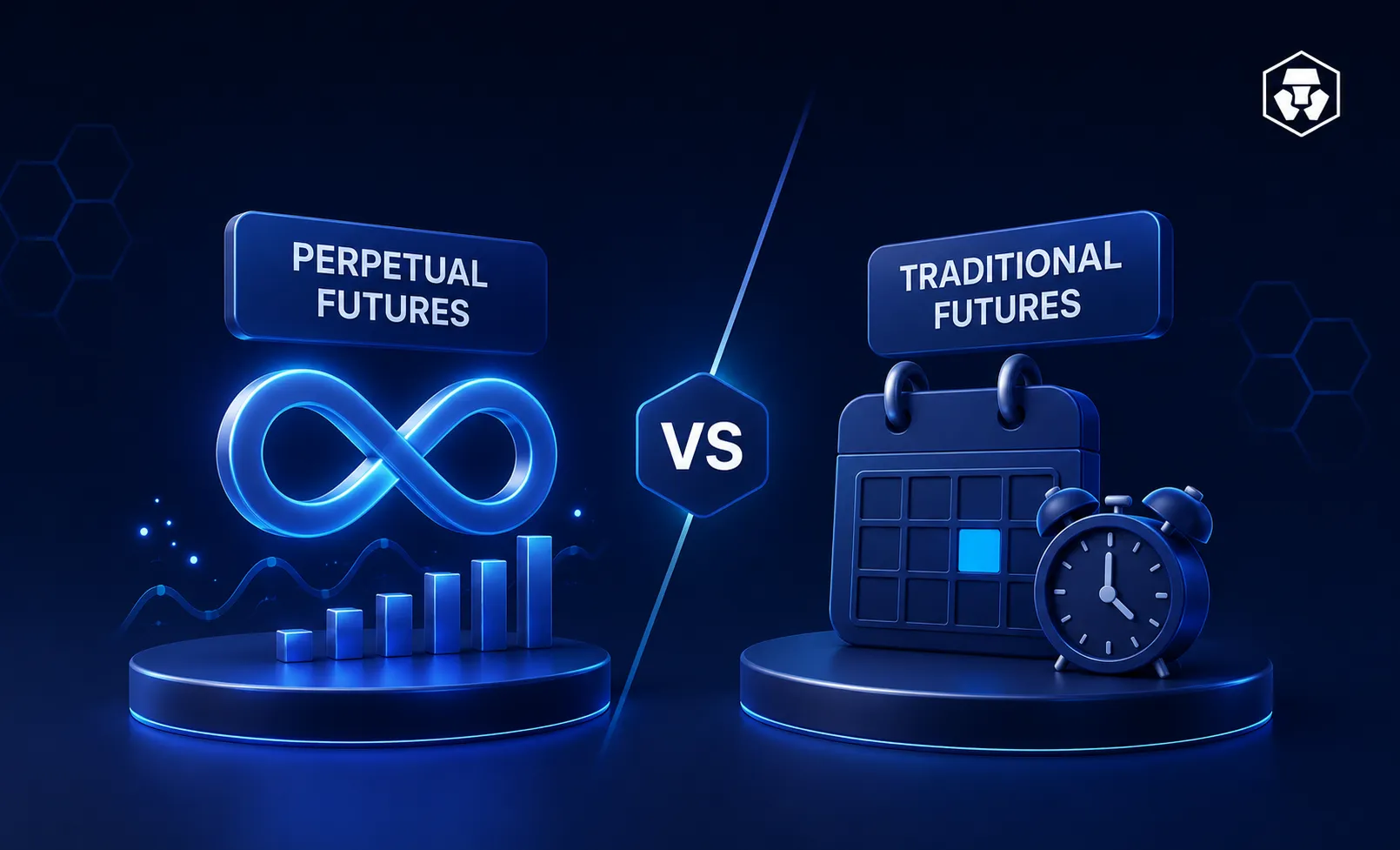
One never expires, one does. That changes everything about pricing and cost. Here's how perpetual and traditional futures compare on funding rates, expiration, leverage.

Derivatives let traders take positions on an asset's price without holding the asset directly.
Two types come to mind: traditional dated futures and perpetual futures. They solve the same basic problem in different ways; the difference comes down to one thing: whether the contract has an end date.
This guide walks through what that means for expiration, pricing, holding costs and market hours.
A short notePerpetual futures are a leveraged product built for traders who already have some derivatives experience. If you're newer to trading, treat this as a casual read on how the instrument works, not a signal to jump in. |
Availability: US availability works differently depending on which Crypto.com platform you’re on. The global Crypto.com Exchange, including its Equity Perpetual Contracts, remains off-limits to US persons under Crypto.com's geo-restrictions.
But Crypto.com's US affiliate, Crypto.com | Derivatives North America (CDNA), holds a full set of CFTC licenses; it can legally offer margined crypto derivatives, including perpetuals, to eligible US customers through the regulated US version of the Crypto.com app, a separate onboarding path from the global Exchange.
A traditional futures contract is like a reservation: you agree today to buy or sell an asset at a set price on a specific future date. The exchange fixes the quality, quantity and delivery terms in advance, which is exactly what makes every contract identical and easy to trade on an open market instead of a one-off private deal.
Every contract carries an expiration date (i.e., the last day it can be traded), which is usually (but not always) the third Friday of the contract month. As that date nears, traders have to decide what to do with an open position.
What settlement looks like depends on the contract. Some deliver the physical asset; most, like equity-index and interest-rate futures, settle in cash instead, a simple credit or debit reflecting the contract's value on the final day.
Either way, the futures price and the spot price tend to converge as expiration nears, a pattern traders call the basis narrowing.
Rolling is how you keep exposure going past expiration: you close the expiring contract and open an equivalent one further out. Cycles vary by product; CME equity-index futures, for instance, roll quarterly (June to September and so on), with the roll date landing the Monday before the expiring month's third Friday.
Perpetual futures, sometimes called perpetual swaps, remove the fixed end date.
According to the CFTC, a perpetual contract has no fixed expiration date and therefore relies on a substitute mechanism – a funding rate, for instance – to help maintain price alignment with the underlying spot market. Because there is no expiry, a trader can hold a position without scheduling a roll.
The funding rate is what stands in for expiration-driven convergence, keeping the contract's price anchored to its underlying asset without a delivery date to force the issue.
Think of the funding rate as a small, recurring payment that nudges the contract price back toward spot. Funding payments flow between long and short position holders; when a perpetual contract trades above the spot price, longs generally pay shorts and vice versa.
On Crypto.com, mark price is what calculates margin requirements and triggers forced liquidation, a safeguard meant to reduce manipulation-driven or unnecessary liquidations. The bandwidth around it can widen for lower-liquidity or more volatile instruments.
Mark price is a reference value used to gauge whether a position is healthy, rather than the most recent trade tick. For supported Crypto.com perpetual contracts, the index price is calculated as a weighted average across multiple data feeds.
Each constituent exchange in the data feed contributes a ‘market price’ to the calculation of the weighted median. If any one exchange's price strays more than 0.1% from the group median, it gets capped at that 0.1% divergence before it counts, which keeps a single outlier venue from skewing the liquidation price.
Profit-and-loss pays out in the contract's designated settlement stablecoin.
Note: These mechanics apply to Crypto.com's crypto perpetuals generally, which eligible US traders can access through CDNA on the regulated US app, as noted above. The global Exchange remains off-limits to US users.
Dimension | Traditional futures | Perpetual futures |
Expiration | Fixed date, usually near the third Friday. Varies by product. | No fixed expiration date |
Price alignment | Basis convergence toward spot as delivery approaches | Funding rate designed to track spot |
Holding costs | Roll-related two-leg transactions when moving to a later month | Recurring funding payments that can vary |
Rollover friction | Offset, roll or settle before expiry | Generally continuous, with exceptions |
Market hours | Vary by product and venue | Listed as continuous on Crypto.com |
Key takeaways:
|
Neither structure is ‘better’ than the other. The right fit depends on your time horizon and how you want to manage positions.
Quarterly futures reach a date. Perpetuals keep going.
Rolling a quarterly contract recurs roughly every three months for a trader who wants continuous exposure, using the same offset-and-reopen mechanics covered above. Perpetuals replace that calendar event with an ongoing funding payment instead.
Funding cadence isn't standardized across the industry, though. Research on crypto perpetual futures markets describes eight-hour funding intervals as a common, if not universal, practice.
Crypto.com runs on a tighter schedule: funding rates are calculated every four hours, then split into hourly payments settled at the end of each hour, faster than the eight-hour standard used on some other crypto venues.
A faster cadence doesn't change the total cost, but it does make it more visible sooner. Funding is recurring and market-driven, so holding a perpetual position over an extended period can accumulate meaningful variable costs during high-volatility regimes.
Risk | Details | Traditional or perp futures? |
Leverage | Borrowed capital multiplies your exposure, gains and losses alike. | Both |
Liquidation | Position can be closed automatically if account amount falls below the required margin, often at a loss of the margin committed. | Both |
Market volatility | Prices can move sharply and fast, especially around news events. With leverage, those moves hit your capital harder. | Both |
Liquidity | In thin markets, you may not be able to enter or exit at the price you want. ‘Stop Loss’ or ‘Take Profit’ orders can execute at a worse price than expected. | Both |
Funding cost | Funding payments accumulate for as long as you hold the position and can erode returns during high-volatility, high-funding regimes. | Perp futures |
Expiration and rollover | If you don't actively manage a position before expiry, it’ll settle or require a roll, potentially at a time or price you didn't choose. | Traditional |
With the risks laid out, here's how Crypto.com's built-in tools help manage them.
Leverage is where any risk conversation starts: borrowed funds that increase your market exposure, where multiples like 5x, 10x or 20x show how many times your capital gets multiplied into total position size.
An example of leverage With 10x leverage, a 1% move in the underlying asset produces roughly a 10% gain or loss relative to your committed capital. That amplification runs in both directions. |
A margin refers to when a position can close against you. Maintenance margin is the minimum account value required to keep a leveraged position open; if account equity falls below this threshold, the position can be automatically liquidated, which would leave you in a loss of the margin committed to that position.
Isolated margin is one way to contain exposure. Only the margin allocated to a specific position is at risk, so liquidating that position doesn't draw on other funds in your account or affect other open positions, under current platform rules.
These are conditional orders that become active once the mark price hits a trigger level you set. They can be pre-configured before a position is even opened, though a ‘Stop Loss’ only becomes active once the underlying trade has executed.
Neither is a guaranteed exit, though: both can be rejected for insufficient funds, margin or notional-limit reasons. The actual execution depends on available liquidity and slippage at the time of trigger.
They reduce risk; they don't remove it.
Sign up here to get started.
What is the main difference in perpetual futures vs traditional futures?
Traditional futures contracts are standardized agreements to buy or sell an asset at a predetermined price on a specific future date or during a specific contract month. A futures contract's expiration date is the last day it can be traded. By contrast, a perpetual contract has no fixed expiration date and relies on a substitute mechanism, usually a funding rate, to help maintain price alignment with spot.
How do standard futures and perpetual futures handle expiration dates?
For standard futures, the expiration date is the last day the contract can be traded, often near the third Friday of the contract month but varying by product. Perpetual futures have no fixed expiration date, so a position can remain open without a scheduled settlement.
What are the major differences when comparing crypto perpetuals and quarterly futures?
Quarterly futures reach a defined roll, such as CME equity-index contracts moving from June to September. Perpetuals replace that event with a recurring funding rate designed to track spot. Long-horizon perpetual holding can accumulate significant variable funding costs, as BIS research found annualized carry exceeding 40% at times in the markets it studied.
Why do perpetual futures rely on funding rates while standard futures don’t?
Standard futures use basis convergence, the tendency for physical and futures prices to move toward one another as delivery approaches. Perpetuals have no fixed expiration to force that convergence, so the funding rate mechanism is designed to keep the contract price aligned with its underlying asset instead.
Can perpetual futures and standard futures be held indefinitely?
Yes, for perpetuals: no fixed expiration date means no scheduled settlement forcing you out. A standard futures contract has an expiration date; before that date you can offset, roll or let it settle. Perpetuals trade indefinite holding for recurring funding costs instead.
How does leverage work in perpetual futures trading?
Leverage is the use of borrowed funds to increase market exposure, with multiples such as 5x, 10x or 20x showing how many times initial capital is multiplied into total exposure. With 10x leverage, a 1% price move can produce roughly a 10% gain or loss relative to the initial capital, amplifying both.
What is an isolated margin in crypto perpetual futures?
Under Crypto.com's isolated margin setting, only the margin allocated to a specific position is at risk. Liquidation of that position is designed not to draw on other funds in the main account or affect other open positions, per current platform rules. It contains exposure but does not remove risk.
How do pre-entry ‘Take Profit’ and ‘Stop Loss’ orders protect perpetual positions?
Take-profit and stop-loss orders are conditional orders that activate when the mark price reaches a set trigger and they can be pre-configured before a position opens. However, they are not guaranteed exits; they can be rejected for insufficient funds or margin and execution can depend on liquidity and slippage at trigger time.
Important information: This is informational content sponsored by Crypto.com and should not be considered as investment advice. Trading cryptocurrencies carries risks, such as price volatility and market risks. Past performance may not indicate future results. There's no assurance of future profitability. Before deciding to trade cryptocurrencies, consider your risk appetite.
This article is for informational purposes only and should not be construed as financial or investment advice. Past performance does not guarantee future results.
Services, features and other benefits referenced in this article may be subject to eligibility requirements, token holdings, and may change at the discretion of Crypto.com.


