Compare Tether (USDT) and USD Coin (USDC). Learn about their reserves, regulatory compliance (MiCA) and which stablecoin might fit your trading or DeFi needs.

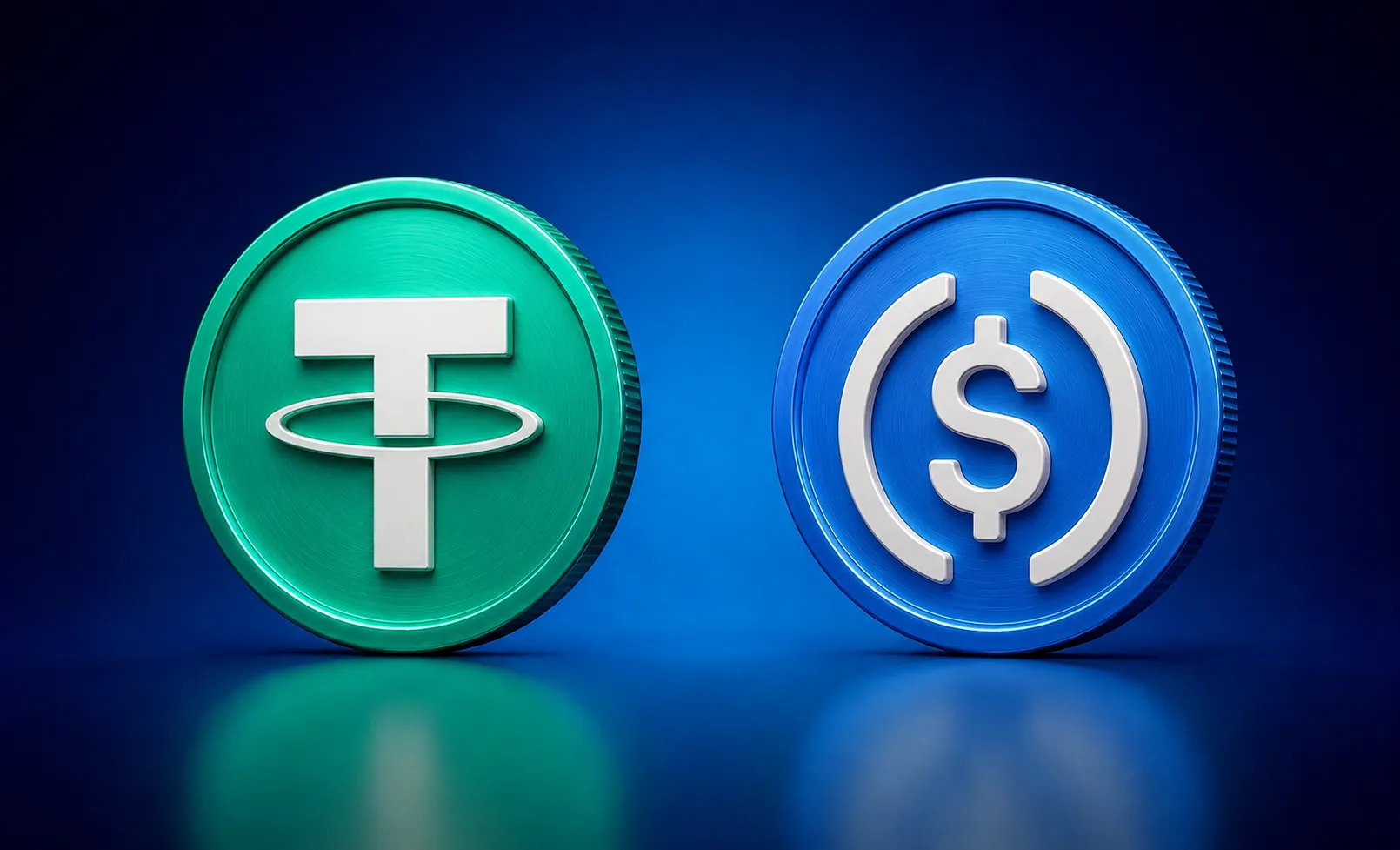
Stablecoins can be seen as workhorses that bridge traditional finance and the digital asset market. Pegged to fiat currencies like the US dollar, they offer (relative) price stability against the volatility of assets like Bitcoin and Ether. This article explains the key differences between the top stablecoins by market cap, Tether (USDT) and USD Coin (USDC).
The choice between USDT and USDC may depend on your geographic location and your specific need for market depth versus regulatory certainty.
USDT remains a dominant source of global liquidity, while USDC is generally seen to be the preferred choice for institutions and users prioritizing strict compliance with frameworks like the European Union's Markets in Crypto-Assets (MiCA) framework.
Feature | Tether (USDT) | USD Coin (USDC) |
Issuer | Tether International Ltd. | Circle Internet Group |
Launch year | 2014 | 2018 |
Primary backing | US Treasuries, gold, Bitcoin | Cash and US Treasuries |
Audit and attestation | Quarterly (BDO) | Monthly (Deloitte) |
MiCA status | Subject to regional restrictions | Regulated E-Money token |
Top networks | TRON, Ethereum | Solana, Ethereum |
Launched in 2014, Tether is the oldest and largest stablecoin currently in circulation. It functions as a digital dollar that could move across blockchains with the same ease as BTC, while being deeply integrated into global stablecoins in DeFi protocols and centralized exchange trading pairs.
A prime utility of USDT is its liquidity. When you buy USDT or USDC, you’ll find that USDT tends to offer the highest number of trading pairs. This makes it a ‘default’ currency for traders needing to move in and out of positions quickly, particularly in emerging markets and offshore trading environments.
USDT is available on more than a dozen blockchains – including Ethereum, Tron, Solana and Cronos – and is minted or burned based on redemptions.
While USDT has long dominated the market, its lack of regular, independent audits has raised transparency concerns and led to scrutiny from regulators.
USDC was launched in 2018 by the Centre Consortium. Like USDT, USDC maintains a 1:1 peg with the US dollar, but it differentiates itself through audited reserves held in a dedicated SEC-regulated money market fund, overseen by BlackRock.
Issued natively across more than 18 blockchains — including Ethereum, Solana, Avalanche and Polkadot — USDC powers everything from on-chain payments to institutional DeFi. Its Cross-Chain Transfer Protocol (CCTP) enables native burning and minting of USDC across supported chains, reducing (but not eliminating) bridge risks.
USDC may be favored by fintech platforms, regulators and institutional traders for its compliance-first approach, plus how it has become a publicly listed company. However, it lags behind USDT in total volume and global market penetration, especially in jurisdictions where decentralized issuance models are preferred.
Stablecoins maintain their value through reserves that back the tokens in circulation. The composition and reporting of these reserves are where the two assets differ most.
Tether’s approach is one of a diversified reserve. While a significant portion is held in US Treasury bills, Tether also allocates a percentage of its backing to other assets like physical gold and Bitcoin. Tether provides quarterly ‘attestations’ conducted by BDO, which offer a snapshot of the assets backing the tokens.
In early 2026, Tether completed its first-ever full financial audit conducted by a ‘Big Four’ accounting firm.
The exact composition may change over time. You can check Tether’s reserve reports for the latest updates.
Circle (USD Coin’s issuer) maintains a more traditional reserve composition for USDC. Its reserves consist almost exclusively of cash and short-duration U.S. Treasuries.
USDC’s reserves are held in the Circle Reserve Fund (managed by BlackRock), which has short-term maturity periods. The reserve strategy is conservative and transparent, optimized for capital preservation and liquidity.
Circle publishes monthly reports through Deloitte, which makes for a higher frequency of transparency compared to USDT.
Maintaining a 1:1 peg is the central requirement for these assets, yet both have faced moments of market stress.
USDC reached an all-time high of above $1.10 in January 2021 amid a broader market surge. However, it faced its greatest test in March 2023, falling to $0.88 after the collapse of Silicon Valley Bank (SVB), where a portion of its cash was held.
The peg was restored quickly after the US government stepped in to protect depositors, but it highlighted ‘banking risk’ within compliant structures.
In March 2015, USDT reached an all-time low of approximately $0.57 during its early, less liquid years. Conversely, in July 2018, USDT experienced a rare spike, briefly trading above $1.70 on some exchanges due to a sudden imbalance in demand.
Both issuers maintain stability through ‘mint and burn’ mechanics. If the price on an exchange fluctuates, market participants can buy the undervalued token and redeem it for exactly $1 from the issuer. This profit motive keeps the price anchored to the dollar.
At the time of writing, the 2026 landscape is heavily influenced by the MiCA regulation in the European Union. This framework sets strict rules for ‘asset-referenced tokens’ and ‘E-Money tokens’.
Under these laws, issuers must be authorized within the EU to offer their stablecoins to retail users. Circle has positioned USDC as a regulated ‘E-Money Token’, allowing EU-regulated exchanges to continue offering it.
In contrast, some exchanges have restricted or delisted USDT for EU residents because it doesn’t currently carry the same MiCA-compliant status. This has created a geographical split where USDC is the standard for European retail users, while USDT remains the liquidity leader in other global regions.
Product | Description |
Tether Gold (XAUt) | A stablecoin where each token represents ownership of one troy fine ounce of physical gold held in a Swiss vault. It combines the stability of gold with the mobility of a digital token. |
tether.wallet | Launched in 2026, this is a unified financial platform. It enables users to manage USDT, XAUt and BTC in one application, supporting human-readable names and direct cross-asset swaps. |
Product | Description |
Circle Arc | A production-ready Layer-1 blockchain launched in 2026 designed as an ‘economic operating system’ for institutions. It handles large-scale settlement and treasury operations natively. |
Cross-Chain Transfer Protocol (CCTP) | A native utility that allows USDC to be moved between dozens of blockchains without traditional bridges, reducing the risk of ‘bridge hacks’. |
Adoption and integration | Details |
Visa | Visa expanded its pilot program in 2023, using USDC and the Solana blockchain to settle fiat-denominated cross-border payments. |
Mastercard | USDC is being tested as part of Mastercard’s Multi-Token Network, a framework exploring tokenised commercial banking and settlement rails. |
Meta | USDC is offered as a means of payout for eligible Meta creators who connect their Solana or Polygon compatible crypto wallets. |
Sony | In 2025, Sony’s electronics division in Singapore integrated USDC payments on its official online store via a partnership with Crypto.com. |
Nubank and Mercado Pago | USDC is used by these Latin American fintech giants to power stablecoin rails for millions of users. |
Adoption and integration | Details |
Agricultural firm acquisition | In 2025, Tether acquired a 70% stake in South American agriculture firm Adecoagro, planning to tokenise agricultural commodities and use renewable energy for stablecoin-powered infrastructure and Bitcoin mining. |
LINE NEXT and Kaia integration | In May 2025, Tether partnered with LINE NEXT Corp. to deploy native USD₮ on the Kaia blockchain, which underlies LINE’s Mini Dapp platform. It opened USDT up to nearly 200 million monthly LINE users in Asia, enabling in-app payments and cross-border transfers within the messenger ecosystem. |
Bitcoin Lightning Network via Taproot assets | In January 2025, Tether launched USD₮ on Bitcoin’s Taproot-enabled Lightning Network, co-developed with Lightning Labs. This move enables fast, low-cost USDT transactions leveraging Bitcoin’s security and scalability layer. |
Georgia’s sovereign stablecoin | Tether partnered with the Government of Georgia to develop and launch GEL₮, a stablecoin pegged to the Georgian Lari. |
Investment in LemFi to support remittances among immigrant populations | USDT can be used by diaspora communities in major jurisdictions to send low-fee, instant remittances to cross-border markets in Africa and Asia. |
Is USDT or USDC safer?
Safety depends on your priorities. USDC offers more frequent reporting and higher regulatory compliance. USDT has a much longer history of maintaining its peg through various market cycles. All cryptocurrencies, including stablecoins, carry risk.
Can I use USDT in the European Union (EU)?
Access for retail users in the EU may be restricted depending on the exchange you use due to 2026 MiCA requirements.
What are the fees for sending these stablecoins?
Fees are determined by the network (blockchain) used, not the coin itself. Sending USDT on TRON or USDC on Solana is generally much cheaper than using the Ethereum network.
Where can I check USDT and USDC prices?
You can monitor live peg stability and market data on the Crypto.com Price page.
What is an attestation vs. a full audit?
An attestation is a snapshot of reserves at a specific time provided by an accounting firm. A full audit is a more comprehensive and frequent financial review.
Do these stablecoins pay interest?
The coins themselves don’t pay interest, but users may earn rewards by choosing to lock up rewards via various DeFi or centralized platforms.
Important information:
This article is for informational purposes only and should not be construed as financial or investment advice. Trading cryptocurrencies involves risks, including price volatility and market risk. Past performance may not indicate future results. There is no assurance of future profitability. Before deciding to trade cryptocurrencies, consider your risk tolerance.
Services, features, and other benefits referenced in this article may be subject to eligibility requirements and may not be available in all markets. They may also be subject to change at the discretion of Crypto.com.
Although the term "stablecoin" is commonly used, there is no guarantee that the asset will maintain a stable value in relation to the value of the reference asset when traded on secondary markets or that the reserve of assets, if there is one, will be adequate to satisfy all redemptions.