Prediction markets often act as a lens that harnesses the collective information of many into a single, actionable price signal. This guide breaks down the most popular prediction market categories, such as sports, politics and economics.

Think of an event contract as a way to trade your knowledge about a future occurrence, e.g., the US Presidential election winner. These are simple contracts where you choose ‘Yes’ or ‘No’ on a specific occurrence.
Pricing in these markets is a direct reflection of probability. For instance, if a ‘Yes’ contract is priced at $0.65 for a $1 payout, the market sees a 65% chance of that occurrence happening. This transparent link allows you to interpret market prices as the crowd's collective forecast in real time.
Behind the scenes, these platforms use sophisticated systems to manage every trade. Some exchanges use an electronic order book to match buyers and sellers directly. This mechanism works best when there’s a high volume of participants trading at once, ensuring that prices update instantly as new information arrives.
For markets with fewer participants, an automated market maker provides a guaranteed price. This system uses a formula to ensure the probabilities of all occurrences always add up to exactly 100%. It also protects the platform by setting a clear limit on the most money the system could lose.
Learn how to choose your first event contract
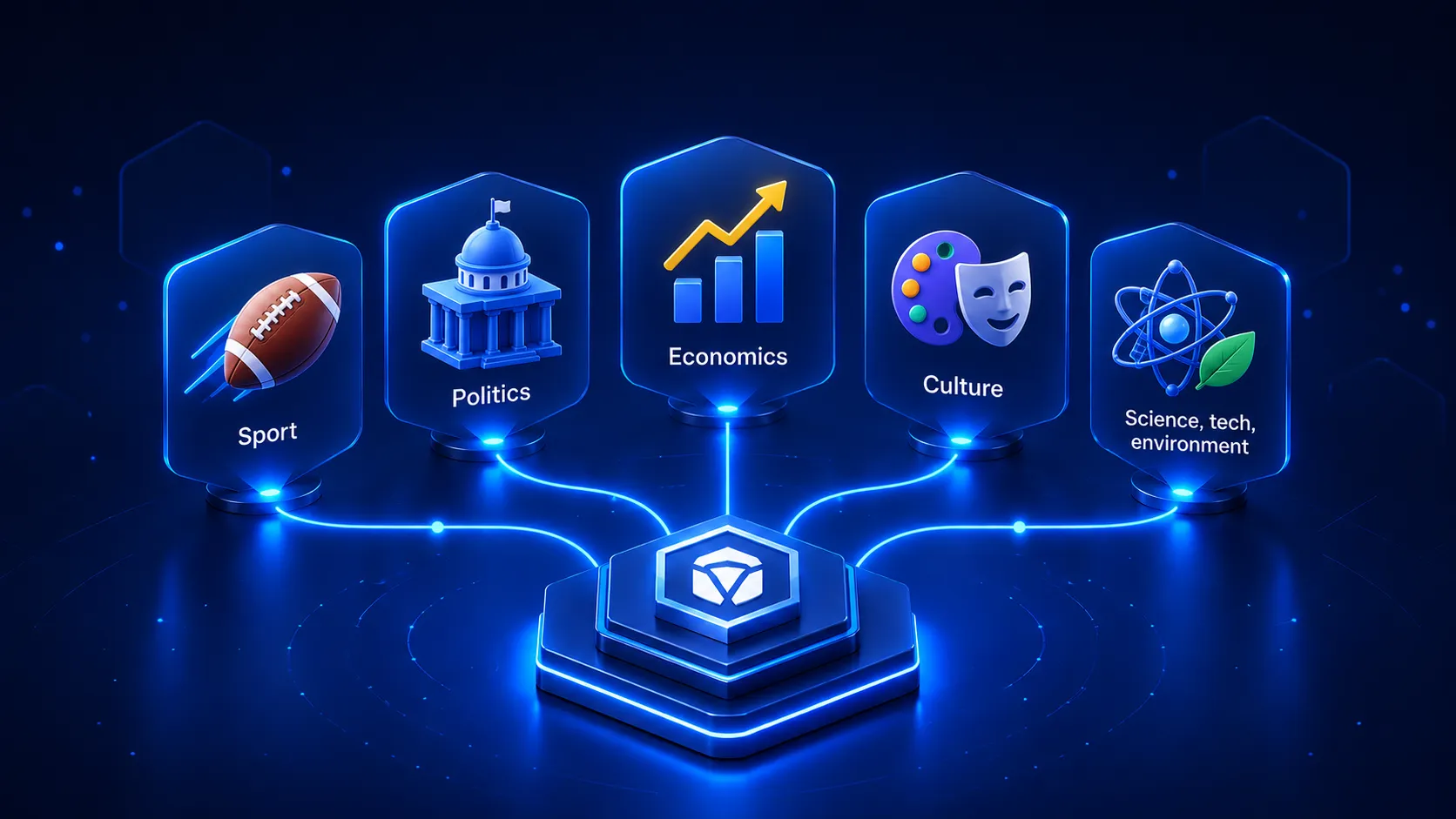
The world of event trading is vast, spanning a huge range of sectors. These prediction market categories enable you to trade on almost any verifiable future occurrence you can imagine. From shifts in the global economy to major cultural milestones, these markets transform raw information into a tradable asset class.
In the US, sports prediction markets command a massive share of the action. These markets move beyond traditional sportsbooks by operating as true financial exchanges. You can trade event contracts on specific games, championship victories or even individual player awards.
These markets rely on verifiable data for every resolution. To keep the environment fair and transparent, exchanges often work closely with sports governing bodies. This includes using official league data for settling contracts, which helps keep the trading environment sharp and reliable while mitigating any risks of manipulation.
Expert platforms tend to focus on broad occurrences to maintain high credibility. Some categories, like contracts based on a single official's call or specific player injuries, are flagged for having a higher potential for price distortion. By sticking to major results, these platforms ensure their price signals remain trusted barometers of the sporting world.
In political prediction markets, you can forecast the occurrences of major elections, party nominees and legislative breakthroughs. This sector has deep academic roots; for over 30 years, tools like the Iowa Electronic Market have helped researchers study these dynamic price signals and their accuracy.
Historical data shows that these markets are excellent at incorporating new info. In many instances, these forecasts have actually outpaced traditional opinion polls. This efficiency comes from traders interacting in real time, creating a collective consensus that keeps price signals sharp as political events unfold.
The regulation of these markets is a hot topic for discussion. The Commodity Futures Trading Commission reviews these contracts using a ‘public interest’ test. Certain occurrences, especially those involving unlawful activities or gaming, face specific prohibitions. This means platforms must certify that their political contracts meet high federal standards.
Economics prediction markets serve as a high-frequency benchmark for some of the world's most important data. These markets focus on occurrences like Federal Reserve interest rate moves and GDP growth. Meanwhile, financial prediction markets track essential indicators such as inflation data, currency fluctuations and realized stock price returns.
You can follow these signals just as institutional investors do to gauge overall market sentiment. For example, data tied to the federal funds rate helps analysts build probability paths for interest rate targets. This provides a quantitative alternative to qualitative guessing and is now a staple in professional research frameworks.
In the business world, corporate prediction markets allow for speculation on company-specific events. This includes things like earnings announcements or major project deadlines. Enterprises can use these tools to aggregate internal knowledge and sharpen their strategic forecasting, proving the value of prediction markets extends far beyond the public news cycle.
The entertainment world offers plenty of excitement via culture prediction markets. You can weigh in on the occurrence of major cultural milestones, such as Oscar winners or box office results. These markets transform subjective popularity into a measurable, tradeable probability signal that anyone can participate in.
These contracts can also dive into celebrity news or major reality TV plot twists. Just like other event contracts, these settle based on specific, objective resolution sources. This gives you a clear and reliable basis for every trade, bridging the gap between trending social media topics and financial forecasting.
Environmental prediction markets allow you to track occurrences tied to the planet’s future. This includes trading on climate events, such as peak temperatures, storm paths or even global carbon credit prices. These markets offer a unique way to hedge against or speculate on the impacts of our changing world.
In the world of innovation, scientific prediction markets focus on the next big breakthrough. You can trade on things such as space exploration milestones or highly anticipated tech product launches.
Choosing between centralized and decentralized prediction markets means weighing specific advantages like regulatory peace of mind versus total control. Centralized platforms are managed by a single entity and usually offer easy fiat onramps. They’re registered as Designated Contract Markets (DCMs) and follow rigorous federal oversight.
These platforms act as the first line of defense for market integrity. They perform real-time monitoring of all trading activity to catch any anomalies before they become issues. In the US, these exchanges are responsible for investigating disorderly trading and providing curated listings that are resistant to manipulation.
On the flip side, decentralized platforms run on blockchain technology and smart contracts. These markets offer on-chain settlement and allow you to maintain custody of your assets. They often use decentralized, third-party services to verify the occurrence of events, creating a permissionless environment where you have direct control over your funds.
Regulation is the biggest differentiator here. The Commodity Futures Trading Commission views event contracts as swaps, a status designed to provide a unified federal framework. However, some state regulators still view these platforms as gambling by another name, which has led to ongoing legal battles across the country. Make sure to verify that event contracts are permitted where you live.
The resolution of these jurisdictional disputes will define the future of event trading. Federal authorities are actively prosecuting fraud and insider trading on these platforms to protect users. A high-profile 2026 case involving the ‘Eddie Murphy Rule’ proved that authorities are serious about preventing the misuse of non-public information.
Crypto.com is one of the world’s premier destinations for event trading, trusted by more than 150 million users globally. Our Predict platform provides a regulated environment where you can trade on the world’s biggest events.
Our platform is built for speed and simplicity. It also covers a wide range of markets, from massive sports tournaments to significant political and economic shifts.
You can start your predictions journey with as little as $10 per contract, enabling you to participate in different markets without needing large amounts of capital. Our platform is designed to be accessible for everyone, whether you are a complete beginner or a seasoned trading professional.
We also give you the tools you need for risk management. You have the flexibility to exit a contract before the event resolves to lock in your profits or cut your losses. Plus, you can open multiple contracts for the same position, giving you more control over your strategy.
When an event is finalized, we make sure you get your results fast, with real-time payouts. You can expect to see your funds shortly after the event is resolved.
What is an event contract?
An event contract is a tradable derivative based on the occurrence of a specific future event. These assets let you speculate on whether an event will happen or not, usually through a ‘Yes’ or ‘No’ choice.
How are prediction market prices determined?
Prices are set by the collective actions of traders. As people buy or sell based on what they expect to happen, the price moves to show the market-implied probability. For example, a $0.60 price means the crowd sees a 60% chance of that occurrence.
What are the most popular prediction market categories?
Politics, economics and sports generally lead the way. However, culture and environmental markets are growing fast as more people look to trade on their specific areas of interest and expertise.
Are prediction markets legal in the US?
Yes, as long as you use platforms registered with the Commodity Futures Trading Commission. These exchanges operate as Designated Contract Markets (DCMs). They must follow strict federal rules regarding market fairness, active surveillance and the protection of every person trading on the platform.
Can I trade on macroeconomic indicators?
Yes, depending on the platform, you can trade on a variety of occurrences – from inflation data and GDP growth to Federal Reserve interest rate shifts. These markets are a popular way to gain financial exposure to broad economic trends based on your own analysis.
What is the difference between centralized and decentralized prediction markets?
Centralized markets offer regulatory oversight and curated protections. Decentralized markets use blockchain for self-custody and on-chain settlement. Your choice depends on whether you value the structure of a regulated exchange or the permissionless freedom of a decentralized network.
How do I get started with prediction markets on Crypto.com?
Download the Crypto.com App and head to the Predict section. Browse the live event contracts and pick what you want to trade. You can start with just $10 and we offer real-time payouts as soon as the event is settled.
Is there a minimum amount to start trading event contracts?
On Crypto.com you can get started with just $10 per contract. This low entry point makes it easy to test out different markets. You also have the flexibility to enter and exit positions whenever your view on the occurrence changes.
Important information: This content is for informational purposes only and does not constitute financial advice. Cryptocurrency markets are volatile and carry risk. Please consult a financial adviser before making investment decisions.
Prediction is an event contract that is a derivatives product offered by Crypto.com | Derivatives North America (CDNA), a CFTC-regulated exchange. Trading on CDNA involves risk and may not be appropriate for all. By trading you risk losing your cost to enter any transaction, including fees. You should carefully consider whether trading on CDNA is appropriate for you in light of your investment experience and financial resources. Any trading decisions you make are solely your responsibility and at your own risk.


