Prediction markets offer a way to follow the elections beyond traditional polling. Here are the key dates for the 2026 midterms, the seats at stake and how prediction markets price the possible results.

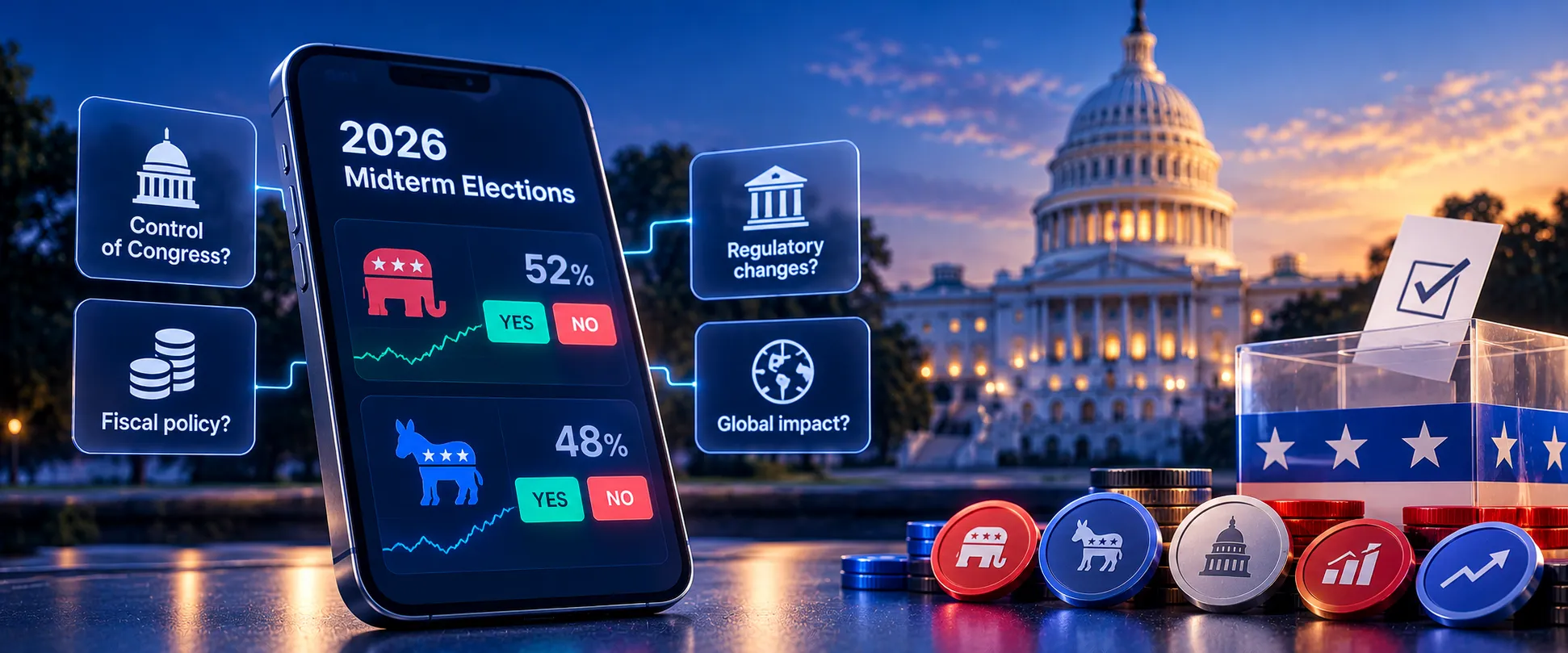
The next US midterm elections are scheduled for Tuesday, November 3, 2026.
Midterm elections take place halfway through a US president's four-year term. Under federal law, congressional elections are held on the Tuesday following the first Monday in November in even-numbered years.
Although November 3 is the main election date, the process starts months earlier with primary elections, where political parties select their candidates. Voter registration deadlines and early voting arrangements vary by state.
March to September 2026 | Most state primary elections |
September to November 2026 | Absentee and mail-in voting periods, depending on state rules |
October to November 2026 | Early in-person voting in states that offer it |
November 3, 2026 | US midterm Election Day |
November to December 2026 | Vote counting, certification, and any required runoff elections |
January 3, 2027 | Start of the 120th Congress |
The Federal Election Commission provides links to official state voting resources.
The 2026 elections will determine the makeup of the US House of Representatives and part of the Senate. Many states will also elect governors and other public officials.
Office | Seats or offices contested | Term length |
US House of Representatives | 435 | 2 years |
US Senate | 35 | 6 years for regular terms |
State governors | 36 | 2 or 4 years, depending on the state |
Territorial governors | 3 | 4 years |
Special Senate elections may fill only the remaining portion of an existing term.
All 435 voting seats are up for election. House members serve two-year terms, which means the entire chamber is contested during every regular congressional election cycle. Each representative serves a district within their state. The number of districts assigned to each state depends on its population.
There are 35 Senate seats scheduled for election in 2026, including special elections. The Senate has 100 members, with two representing each state. Senators serve six-year terms, but their elections are spread across different years. As a result, only about one-third of the Senate is contested during each election cycle.
A total of 36 states and three US territories will elect governors in 2026. Governors lead their respective governments and oversee the implementation of state or territorial laws. These contests are separate from congressional elections and don't directly determine which party controls Congress.
Other positions on the ballot will depend on where voters live, with many states also holding legislative and local elections.
While Americans won't be choosing a president in November 2026, their votes will help determine which political party controls Congress and how much support the administration may have for its policies.
Congress consists of two chambers: the House of Representatives and the Senate. Both participate in passing federal legislation, but each also has separate powers.
The House can introduce tax legislation and bring impeachment charges against federal officials. The Senate votes on presidential appointments, including federal judges and Cabinet members, and considers treaties.
Every bill must pass both chambers before reaching the president.
When the president's party controls Congress, it may be easier to advance the administration's proposals. If the opposing party wins control of either chamber, legislation may face greater resistance.
However, a congressional majority doesn't mean every proposal will pass. Lawmakers within the same party can disagree, while some Senate legislation requires support beyond a simple majority.
Congress also oversees the federal government through investigations and committee hearings. A change in control can therefore affect which issues receive attention and how closely lawmakers examine the administration's activities.
Control of the House requires a majority of its 435 voting seats. When all seats are filled and voting, that means at least 218.
In the Senate, 51 seats provide a majority without relying on a vice-presidential tie-breaking vote. When the chamber is divided 50/50, the vice president can cast deciding votes in certain circumstances.
The number of seats a party needs to gain depends on the balance going into the election. Where the margin is narrow, relatively few closely contested races can change control.
The president's party has often lost House seats during midterm elections, although this historical pattern doesn't determine what will happen in 2026.
Congress has considerable influence over the direction of federal policy. Lawmakers decide which proposals move forward and approve government spending. Changes in congressional leadership can also affect the priorities of committees responsible for examining proposed legislation and overseeing federal agencies.
For example, lawmakers may take different approaches to financial regulation depending on their policy priorities. Congressional control can influence whether proposals receive hearings or progress toward a vote.
However, an election result doesn't automatically lead to a change in law. Proposals still need to move through the legislative process, and the president generally has the power to sign or veto legislation.
Prediction markets enable participants to trade event contracts based on whether specific future events will happen or not. For the 2026 midterms, a market might ask whether a particular political party will control the House of Representatives following the election.
Participants take positions based on what they believe is likely to happen. As they trade, prices change to reflect current market expectations.
Many political event contracts use a ‘Yes’ or ‘No’ structure, with two possible settlement values: $1.00 if the specified event happens or $0.00 if it doesn't. Each contract has rules explaining what determines its settlement value. For election contracts, these may refer to officially certified results or another specified source.
Consider a hypothetical contract asking whether a political party will gain control of the House.
Your next read: How to trade prediction markets
A ‘Yes’ contract priced at $0.65 suggests a 65% market-implied probability that the event will happen. However, this isn't a scientifically measured probability. Prices are affected by trading activity and an event considered highly likely can still fail to happen.
If participants become more confident in a particular result, demand for the corresponding contracts may increase. If expectations change, prices may fall.
Prediction market prices are driven by supply and demand. When more participants want to buy a contract at higher prices, its price may rise. When sellers are willing to accept lower prices, it may fall.
On an exchange, participants submit orders showing what they're willing to pay or accept. These orders appear in an order book, which brings together available buying and selling offers. For example, imagine buyers are offering $0.60 for a ‘Yes’ contract, while sellers are asking for $0.64. The difference of $0.04 is called the bid-ask spread.
A trade happens when a buyer and seller agree on a price. If new information makes traders more confident that the event will happen, buyers may offer higher prices, pushing the market upward.
The number of available orders also affects trading. In a less active market, wider spreads can make it more expensive to enter or close a position.
Prediction markets and political opinion polls both provide information about elections, but they measure different things.
Neither prediction markets nor political polls are consistently more accurate. Research from the University of Iowa's Iowa Electronic Markets has shown that prediction markets can provide useful election forecasts, although their accuracy varies.
The two also serve different purposes. Polls measure voter preferences, while prediction markets reflect what traders expect to happen.
Traditional polling | Prediction markets | |
What they measure | Voter preferences and opinions | Expectations about a future event |
Information source | Surveys | Buying and selling activity |
Updates | When new survey results are published | As trading activity changes prices |
Financial involvement | Respondents don't need to commit money | Participants commit money to positions |
Main limitations | Sampling errors and inaccurate responses | Limited trading activity and sudden price changes |
Pollsters need time to collect responses and publish their findings. As a result, a newly released poll may reflect opinions collected several days earlier.
Prediction market prices can change as soon as participants respond to new information during trading hours. This responsiveness doesn't necessarily make the market more accurate. Prices can move based on rumors or a relatively small number of trades.
Trading political event contracts involves financial risk, even when market prices suggest a result is highly likely. Some key risks to understand include:
Eligible US users can explore event contracts linked to politics and other real-world events through Predict in the Crypto.com App or Predict Pro on the Crypto.com Exchange. Predict Pro offers additional trading features, including real-time probability charts and more detailed order controls.
Here’s how to get started.
On the Crypto.com App
On Crypto.com Exchange
Visit our Learn Hub for more educational content on prediction markets and event contracts.
The elections are scheduled for Tuesday, November 3, 2026. Early voting dates and registration deadlines vary by state.
Midterm elections allow voters to choose congressional representatives halfway through a president's term. The results can change which party controls Congress and influence which policies move forward.
Yes, different parties can hold majorities in the House and Senate. This is known as divided control of Congress and can make passing legislation more difficult when the parties disagree.
Certain political event contracts are available through CFTC-regulated exchanges. However, federal and state authorities continue to dispute which rules apply to some contracts. Availability also varies by location.
Some platforms allow participants to close positions before settlement, provided trading is available and there are buyers or sellers willing to trade. The price received may be higher or lower than the original purchase price.
Some participants may use event contracts to offset financial exposure to political developments. However, an election result doesn't guarantee a particular policy change, so a contract may not provide the protection expected.
All 435 voting seats in the US House of Representatives are contested. House members serve two-year terms, so the entire chamber is elected every two years. There are 35 Senate seats scheduled for election, including regular and special elections. The Senate has 100 members, but their terms are staggered.
Important information: This content is for informational purposes only and does not constitute financial advice. Prediction is an event contract that is a derivatives product offered by Crypto.com | Derivatives North America (CDNA), a CFTC-regulated exchange. Trading on CDNA involves risk and may not be appropriate for all. By trading you risk losing your cost to enter any transaction, including fees. You should carefully consider whether trading on CDNA is appropriate for you in light of your investment experience and financial resources. Any trading decisions you make are solely your responsibility and at your own risk.