Learn what exactly a crypto winter entails, how it differs from a regular bear market and a history of digital asset market contractions.

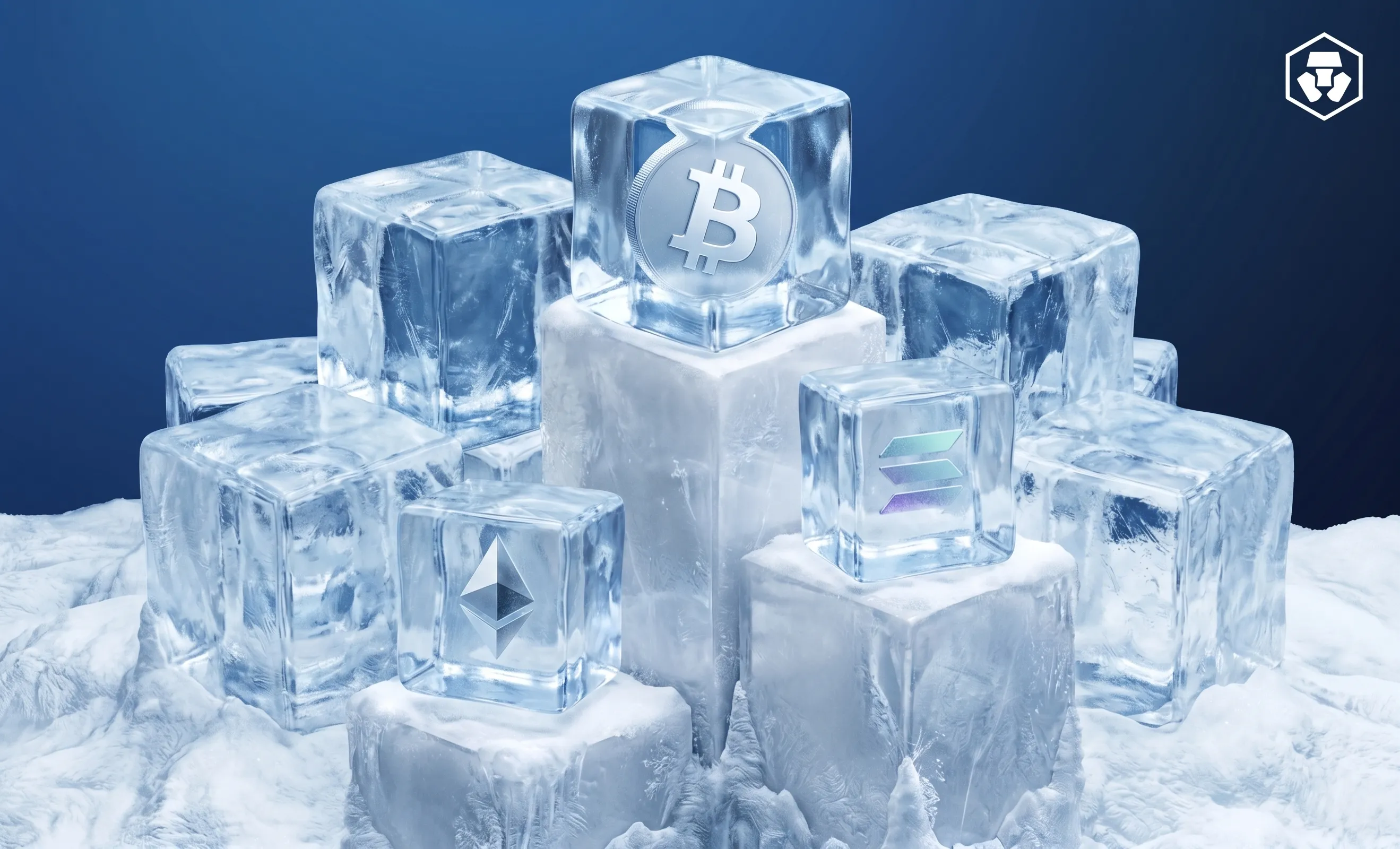
The digital asset market is defined by its cycles. Periods of rapid expansion tend to be followed by long, quiet stretches of consolidation. These cooling-off phases, while anxiety-inducing, have historically served as the foundation for the industry’s most significant breakthroughs.
Read this guide to understand how these cycles work, how to spot the coming of a cold snap and how past winters have influenced the crypto and blockchain industry today.
A crypto winter is a period of sustained price contraction and diminished trading activity, as the digital asset market transitions from high-momentum growth to a phase of consolidation and market re-evaluation.
A regular market dip, or a ‘flash crash’ as some would call it, usually lasts days or weeks. A crypto winter is more pronounced and severe: Asset prices stay significantly below their previous peaks for months or years, accompanied by a broad exhaustion of market enthusiasm.
The ‘freeze’ may extend beyond price to impact everything from venture capital funding to the speed of new protocol launches.
We can view these periods as the market’s version of a structural reset. When the adrenaline of a bull run fades, the industry is forced to shift its focus from price action to actual utility.
A winter then acts as a filter, separating projects built on sustainable technology from those that only existed based on cheap capital and retail hype.
You can check live prices on our Crypto.com price page to see how current cycles compare to historical data.
People use these terms interchangeably, but they represent different levels of market severity.
A bear market is a technical price drop: Analysts and schools of thoughts cite it as a 20% decline from recent highs. A crypto winter is more about the ‘climate’ of the industry, where the negative sentiment lasts for a sustained period and impacts venture capital, hiring and development.
Feature | Crypto bear market | Crypto winter |
Duration | Short to medium term (months) | Long term (usually 12 to 18+ months) |
Sentiment | Pessimism or panic | Apathy and low engagement |
Focus | Driven by price action | Driven by macro factors and lack of catalysts |
Industry impact | Temporary drop in trading | Slowdown in hiring and project funding |
History shows that these cycles are a recurring part of how the market matures. Every winter has a different trigger, but they all share a similar pattern of correction followed by a slow consolidation phase.
Event | BTC peak-to-trough | Description |
Post-Mt. Gox (2014 to 2015) | 85% | Triggered by the collapse of the world's largest exchange at the time. Bitcoin prices dropped significantly and the industry spent years improving security standards. |
Post-ICO bubble (2018 to 2019) | 84% | BTC’s crash followed the 2017 boom where many Initial Coin Offerings (ICOs) failed to deliver. This era eventually gave birth to the first major DeFi protocols. |
The FTX and CeFi lender contagion (2022 to 2023) | 77% | Caused by rising global interest rates and the collapse of major ecosystems like Terra (LUNA) and the FTX exchange, leading to a call for greater transparency. |
While nobody can call a market top with absolute certainty, several signals often appear before the market settles into a long-term freeze. We track these metrics to gauge broader health.
A decline in trading activity may tell you that both retail and institutional buyers are moving to the sidelines.
When central banks raise interest rates, investors may move away from risk-on assets like crypto and toward traditional cash-equivalent holdings.
When the ‘Fear and Greed’ index stays in the ‘extreme fear’ zone for months, it’s a strong indicator that the market is in a winter phase.
When the hype around new sectors (e.g., DeFi, NFT) cools without a new catalyst to replace it, momentum tends to stall.
Increased global scrutiny or restrictive policies may coincide with market cooling as the industry adjusts to new compliance standards.
A significant sign of a winter is when major crypto firms begin reducing their workforce to preserve capital during low-revenue periods.
Historical data suggests that a crypto winter usually lasts between 12 and 18 months. However, every cycle is unique and influenced by different global factors. Many participants look to the Bitcoin halving as a primary signal for a cycle shift. This event occurs roughly every four years and reduces the supply of new Bitcoin, which has historically helped lead the market out of its cold phase.
During these sideways periods, some use a strategy known as Dollar-Cost Averaging (DCA). Instead of trying to find the bottom of a winter, DCA involves buying a fixed amount at regular intervals. This helps lower the average purchase price and removes the stress of trying to time a volatile market.
Is it possible to predict when a winter will end?
There’s no exact formula for predicting the end of a cycle. Factors like regulatory clarity, institutional adoption and macroeconomic stability all play a role in the market’s recovery.
Why do these cycles keep happening?
Markets can move in extremes. Periods of rapid, speculative growth are usually followed by corrections that bring prices back in line with the actual utility of the technology.
Does every project survive the winter?
No. Prolonged winters can act as a stress test. Projects with weak fundamentals or unsustainable models have higher chances of failure, while those building real-world technology tend to survive.
Is it safe to buy crypto during a crypto winter?
Buying during a winter is a strategy used by some who believe in the long-term potential of the technology. However, it involves significant risk, as there’s no guarantee that prices will recover to previous highs.
Can I still earn rewards during a crypto winter?
Although prices may be lower, some protocols still offer rewards for those who lock up their assets. However, the value of these rewards is subject to the same market volatility as the underlying asset.
Important information:
This article is for informational purposes only and should not be construed as financial or investment advice. Trading cryptocurrencies involves risks, including price volatility and market risk. Past performance may not indicate future results. There is no assurance of future profitability. Before deciding to trade cryptocurrencies, consider your risk tolerance.
Services, features, and other benefits referenced in this article may be subject to eligibility requirements and may not be available in all markets. They may also be subject to change at the discretion of Crypto.com.