Learn the key differences between Bitcoin and Solana, such as consensus and real-world uses. Also compare BTC’s store-of-value model with SOL’s rapid smart contract engine.

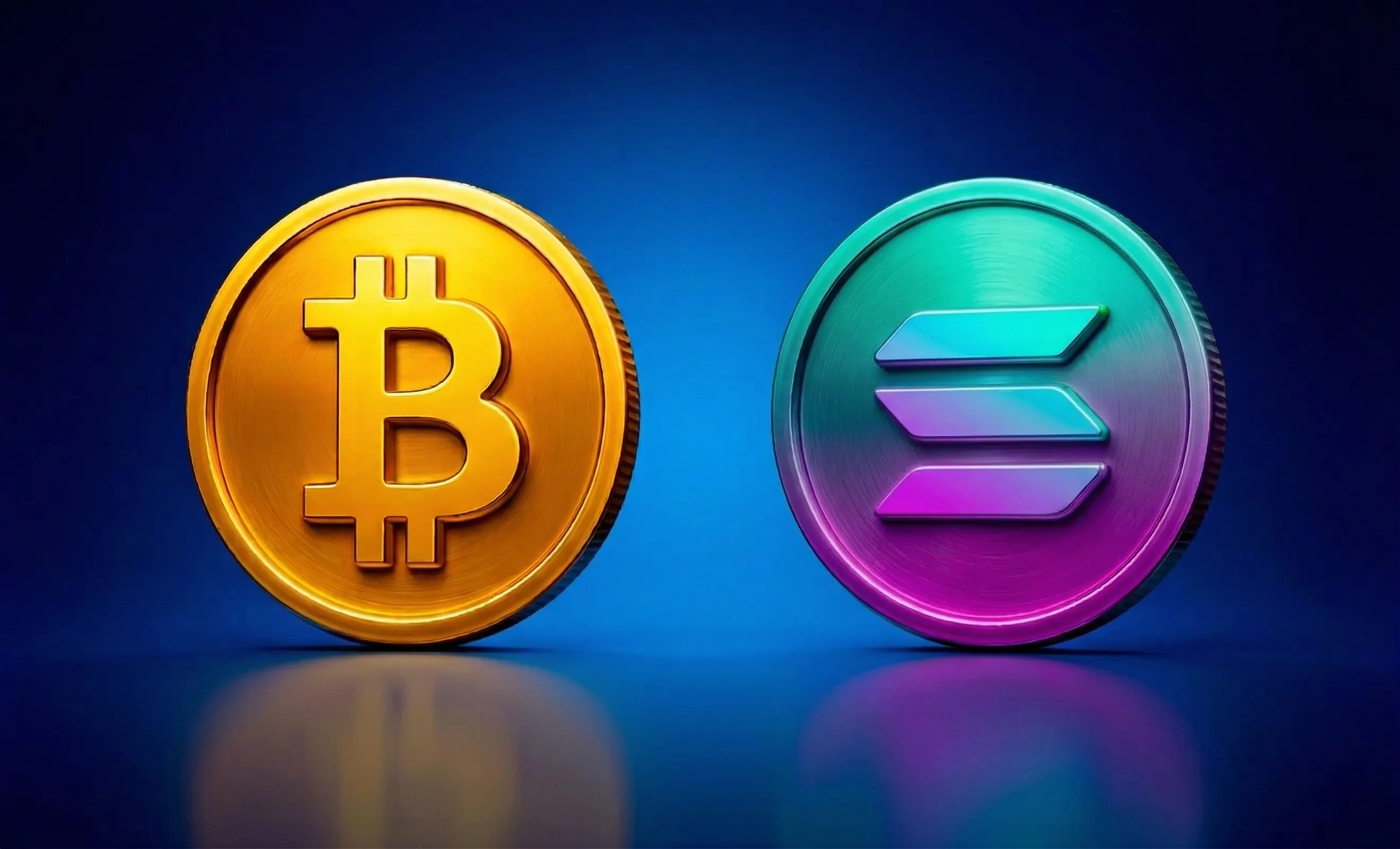
Bitcoin prioritizes a secure, decentralized store of value, while Solana focuses on high-speed scalability for global applications.
For both users and developers, the choice between them depends on whether you value the potential capital appreciation of ‘digital gold’ or a platform for building. Learn more about the differences between Bitcoin and Solana.
Bitcoin (BTC) is the first decentralized cryptocurrency, launched in 2009 by the mysterious Satoshi Nakamoto,. In theory, it stripped away the need for banks, replacing them with a public, transparent ledger. Its core mission is simple: Provide a peer-to-peer way to move value that no single government can control.
Many now treat BTC as ‘digital gold’ because its supply is hard-capped at 21 million coins. It doesn't try to be the fastest network; it tries to be the most secure. By focusing on a slow and steady approach, BTC has become the industry's ‘market leader’.
Solana arrived in 2020 with a very different goal: Pure performance. It’s built to handle complex smart contracts and decentralized apps (dApps) without the lag or high costs found on older chains. If Bitcoin is the vault, Solana is the high-frequency trading floor of the crypto world.
The network is engineered for speed. While other blockchains can get clogged when traffic spikes, Solana uses a unique cryptographic clock to process thousands of transactions each second. The developer community build anything from fast-paced games to global decentralized finance (DeFi) tools.
Bitcoin is built to be a reliable, unchanging base for value. Solana is built to move fast, acting as an engine for thousands of apps that need instant response times.
Feature | Bitcoin (BTC) | Solana (SOL) |
Primary use | Store of value ‘Digital gold’ | ‘Global computer’ dApp platform |
Max supply | 21 million (fixed) | Uncapped (inflationary and deflationary mix) |
Transaction speed | About 7 transactions per second | 3,000+ transactions per second (real-world) |
Average fee | Variable ($0.10 to $10+) | Fractions of a cent (about $0.00025) |
Consensus | Proof of Work (PoW) | Proof of History (PoH) and Proof of Stake (PoS) |
Bitcoin’s base layer processes about seven transactions per second (TPS), with blocks taking roughly 10 minutes to clear. This slowness is a deliberate choice to keep the network secure and decentralized, but it means fees can spike when the network gets busy.
Solana takes the opposite approach. It can handle thousands of transactions per second, with fees that are usually just a fraction of a cent. This makes it possible to build things like high-speed trading platforms or social media apps where paying several dollars for a single interaction just wouldn't work.
The Bank for International Settlements (BIS) has noted that scalability remains a significant technical challenge for early blockchain adoption.
Their research highlights that limited block capacity is often a trade-off for security; as a network reaches its limit, congestion can cause transaction costs to rise exponentially, a hurdle Solana aims to solve through its high-capacity architecture.
Bitcoin uses Proof of Work (PoW), where miners use powerful hardware to solve complex puzzles. This process is energy-intensive but makes Bitcoin the most secure and tamper-resistant network in existence.
Solana uses a hybrid model led by Proof of History (PoH). While it still uses Proof of Stake (PoS) to secure the network, PoH acts like a ‘cryptographic clock’. It timestamps transactions as they happen; the network can then order them without nodes having to constantly talk to each other.
By locking up assets in a PoS system, Solana’s validators can confirm transactions almost instantly. This removes the need for the massive energy consumption seen in PoW while maintaining a high level of security, even if it requires more specialized hardware for the validators themselves.
Bitcoin’s primary design is simplicity. It was built to move value securely rather than to run complex software. While it supports basic scripting, it lacks the native complex smart contracts found on other chains. This makes the network more stable and less prone to the bugs that can plague more complex systems.
If you want to build advanced applications on Bitcoin, you usually look to Layer-2 solutions like the Lightning Network. These are secondary networks built on top of the main blockchain that handle faster, more complex tasks. This modular approach keeps the foundation of Bitcoin clean and focused solely on its role as a secure digital asset.
Solana, by contrast, is a programmable playground. It was built from day one to host thousands of dApps. Its native support for smart contracts enables developers to build everything from complex financial tools to entire virtual worlds. This versatility is why many see it as the ‘operating system’ for Web3.
As Solana handles this complexity on its main layer, developers can create apps that interact with each other seamlessly, leading to a massive ecosystem of high-speed trading platforms, NFT marketplaces and gaming protocols. It’s one of the go-to networks for projects that require high performance and low friction.
Bitcoin is famous for its hard cap. There will only ever be 21 million BTC in existence. This scarcity is enforced by code, making it a powerful hedge against the inflation often seen in traditional fiat currencies.
Bitcoin’s supply enters the market through a process called ‘halving’. Every four years, the amount of new BTC given to miners is cut in half. This predictable, declining issuance schedule reinforces its status as a digital store of value, as well as its defining characteristic of increasing scarcity.
Solana doesn’t have a fixed maximum supply. Instead, it uses a controlled inflation model. New SOL tokens are released to reward those locking up assets to secure the network. This inflation rate is designed to decrease over time until it reaches a stable, low percentage, ensuring the network remains secure.
To balance this inflation, Solana also uses a ‘burn’ mechanism. A portion of every transaction fee is permanently removed from the supply. If the network becomes busy enough, the amount of SOL burned can potentially offset the new tokens being issued. This creates a dynamic economic system that scales with actual network usage.
Bitcoin is one of the most decentralized networks powered by millions of miners across the globe, making it nearly impossible for any single entity to attack or shut down.
Solana’s security model is built for speed, which requires more specialized, high-performance hardware for its validators. While this allows for incredible throughput, it also means there are fewer people who can afford to run a node compared to Bitcoin.
This is a common blockchain dilemma: Trading extreme decentralization for extreme performance.
Over time, Solana has focused on increasing its stability by growing its validator set and introducing upgrades like Firedancer to improve resilience. However, Bitcoin remains an industry benchmark for long-term security, when users think about an asset positioned to remain unchanged and accessible for the future.
Are you looking to HODL the scarce nature of a ‘digital gold’ or are you looking to participate in a rapidly expanding ecosystem of apps, DeFi and NFTs? As the market matures, participants find that both assets serve a distinct purpose in a diversified portfolio.
Feature | Bitcoin (BTC) | Solana (SOL) |
Smart contract programmability | Limited (Basic scripting; uses L2s) | High (Native support; built for dApps) |
Tokenomics | Deflationary (21M hard cap) | Disinflationary (Uncapped; burn mechanism) |
Security | Unmatched (Proof-of-Work mining) | High (Proof of Stake; evolving history) |
Decentralization | Maximum (Global, diverse miner base) | High (Validator hardware requirements) |
All-time high | $126,296 (Oct 2025) | $260.06 (Nov 2021) |
All-time low | $0.048 (July 2010) | $0.505 (May 2020) |
Whether you’re a fan of Bitcoin’s slow and steady security or Solana’s blink-and-you’ll-miss-it speed, having the right tools (on a right platform) can turn market volatility into smart building.
Crypto.com functions as a single home for your digital assets needs. Join over 150 million users worldwide who enjoy the convenience and simplicity of buying BTC, SOL and over 400 other cryptocurrencies.
Which has lower transaction fees, Bitcoin or Solana?
Solana has significantly lower fees, usually costing a fraction of a cent per transaction. Bitcoin fees are variable and can rise to several dollars or more when the network is busy, as its limited block space is prioritized for security over low-cost high-volume trading.
Do Bitcoin and Solana use the same consensus mechanism?
No. Bitcoin uses Proof of Work (PoW), where miners solve puzzles to secure the network. Solana uses a hybrid of Proof of History (PoH) and Proof of Stake (PoS), which timestamps transactions to achieve much higher speeds without the heavy energy consumption of mining.
What are the main use cases for Bitcoin vs. Solana?
Bitcoin is primarily used as a peer-to-peer currency and a long-term store of value. Solana is designed for developers to build decentralized applications (dApps), including high-speed DeFi platforms, NFT marketplaces and blockchain-based games that require near-instant transaction speeds.
Does Solana have a maximum supply cap like Bitcoin?
No. Bitcoin has a hard supply cap of 21 million. Solana has an uncapped supply but follows a disinflationary schedule, where the rate of new tokens issued decreases over time. It also ‘burns’ a portion of transaction fees to help manage the overall supply.
Can I buy both Bitcoin and Solana on the Crypto.com App?
Yes. You can buy BTC, SOL and over 400 cryptocurrencies directly through the App. We provide an easy-to-use platform to manage your digital assets, offering zero-fee* bank transfers to fund your account and get started.
* Other fees and spread may apply.
Important information:
This article is for informational purposes only and should not be construed as financial or investment advice. Trading cryptocurrencies involves risks, including price volatility and market risk. Past performance may not indicate future results. There is no assurance of future profitability. Before deciding to trade cryptocurrencies, consider your risk tolerance.
Services, features, and other benefits referenced in this article may be subject to eligibility requirements and may not be available in all markets. They may also be subject to change at the discretion of Crypto.com.