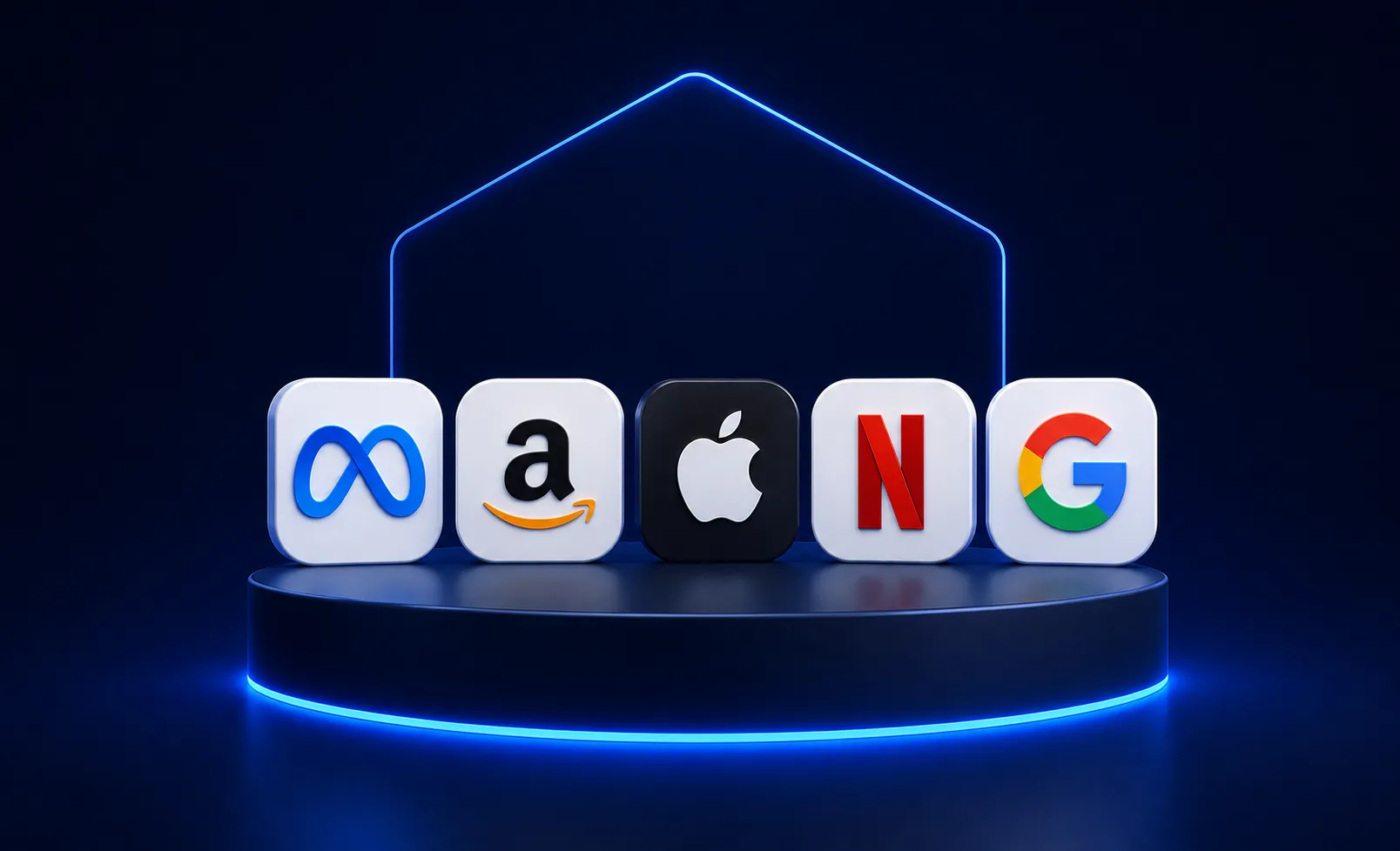
Big tech regularly leads market headlines, and five companies come up again and again in that conversation: Meta (formerly Facebook), Amazon, Apple, Netflix and Google. Together they're known as FAANG stocks, a term that has stuck around even after some of these companies changed their corporate names. This guide breaks down what FAANG means, profiles each company and walks through practical ways to add these stocks to a portfolio.

This article is for informational purposes only and should not be construed as financial or investment advice.
FAANG is an acronym representing five prominent American technology companies: Facebook (now Meta Platforms), Amazon, Apple, Netflix and Alphabet (formerly Google). Each has grown into one of the largest publicly traded companies in the world, known for continuous innovation and a combined market capitalization and index weighting detailed below.
The five FAANG companies trade under distinct ticker symbols: META (Meta Platforms), AMZN (Amazon), AAPL (Apple), NFLX (Netflix) and GOOGL or GOOG (Alphabet). All five stocks are listed and traded on the Nasdaq stock exchange.
As of late 2025, the combined market capitalization of the five FAANG companies was approximately $12 trillion. That scale helps explain why analysts and financial media discuss these names so frequently.
FAANG stocks also carry real weight within major indices. As of November 2025, they accounted for roughly 20% of the S&P 500 index by weight. Because of that concentration, their price movements can materially influence the broader index's overall returns.
It's worth noting that FAANG itself isn't a formal index, an ETF or a product you can buy directly. It's an informal acronym used by financial media and commentators to describe a group of influential technology companies.
The term was originally coined as "FANG" by Bob Lang of Chaikin Analytics and popularized by CNBC host Jim Cramer in 2013 to describe fast-growing tech companies. Apple was later added to create "FAANG." Despite corporate name changes at Meta and Alphabet, the acronym remains widely used today.
Other groupings have emerged over the years, including MAMAA (Meta, Apple, Microsoft, Amazon, Alphabet). Still, FAANG has remained the most recognizable shorthand for this cluster of companies.
Each FAANG company operates in a different corner of the tech industry, from social media to cloud computing and streaming entertainment. Here's a closer look at what each one does.
Meta Platforms operates some of the world's most widely used social media platforms, including Facebook, Instagram and WhatsApp. The company generates the majority of its revenue from digital advertising sold across these platforms, making ad demand a key driver of its business.
Amazon started as an online bookstore and grew into one of the world's largest e-commerce platforms. Beyond retail, its cloud computing division, Amazon Web Services (AWS), has become one of the company's largest sources of operating profit.
Apple built its business around a consumer electronics ecosystem that includes the iPhone, Mac and iPad. In recent years, its services division – which includes the App Store, Apple Music, iCloud and Apple TV+ – has become an increasingly important revenue stream alongside hardware sales.
Netflix pioneered the subscription-based streaming entertainment model, moving the industry away from cable and DVDs. The company's growth depends heavily on expanding its global subscriber base and continuing to invest in original content production.
Alphabet, the parent company of Google, dominates internet search and digital advertising. The company has also made significant investments in cloud computing and AI, extending its reach well beyond its original search business.
You can invest in FAANG stocks by opening an account with a regulated brokerage platform. Once funded, you can purchase individual shares, buy fractional shares with a smaller budget or invest in exchange-traded funds (ETFs) that hold significant positions in these major technology companies.
When you buy a stock, you're buying a small ownership stake in that company. As a common stockholder, you may receive dividends when the company's board declares them, and you typically get to vote at shareholder meetings.
Most investors purchase stocks through a brokerage account. Opening one typically means providing some identifying information, including:
In a standard cash brokerage account, you'll need to pay for purchases in full by the settlement date – generally one business day after the trade date under current US settlement rules.
Once your account is funded, buying a FAANG stock works the same as buying any other stock: search for the ticker symbol, decide how many shares (or dollars) you want to allocate and place a market or limit order.
Broadly, investors have three practical routes to FAANG exposure: buying individual shares directly, investing in broad index funds that hold these companies as major constituents or using thematic products built around indices like the NYSE FANG+ Index.
Modern trading apps have made this more accessible. One option is the Crypto.com App, which offers access to US stocks and ETFs, including all five FAANG companies. As with any platform, it's worth checking current fees and terms before you start trading.
Some FAANG stocks trade at high per-share prices, which can put a full share out of reach for smaller budgets. Fractional shares solve this by letting you purchase a portion of a single share rather than the whole thing.
This means you can build the portfolio you want regardless of your budget, allocating a fixed dollar amount toward a FAANG stock instead of waiting until you can afford a full share. It's a practical way of investing in tech stocks without needing a large amount of capital upfront.
There's no ETF that exclusively holds only the five FAANG stocks, so dedicated FAANG ETFs don't exist in that strict sense. However, broad-market index funds, including those tracking the S&P 500 or the NASDAQ 100, hold FAANG stocks as major constituents, with each company's weight determined by its market capitalization.
Technology-focused and broad-market ETFs that track indices like the NASDAQ 100 provide meaningful exposure to all five FAANG companies without requiring you to pick individual stocks. These funds are regulated under the same framework as mutual funds – the Investment Company Act of 1940.
The marketplace offers multiple options for ETF exposure: the NYSE FANG+ Index, a rules-based benchmark that includes 10 large-cap technology and media stocks, including the original FAANG names. It's equal-weighted and rebalanced quarterly, unlike the informal FAANG label, which has no defined methodology or weighting scheme.
The MicroSectors FANG+ ETN is another. It's worth noting this is an exchange-traded note, not an ETF. That means it's a debt instrument issued by a financial institution and carries the issuer's credit risk – a different risk profile than a fund that directly holds the underlying stocks.
The Invesco QQQ Trust is a widely recognised fund that tracks the Nasdaq-100 Index, holding over 100 of the largest non-financial companies listed on the Nasdaq stock exchange. This vehicle uses a modified market-capitalisation-weighting model, meaning the largest companies by market valuation command the highest weights. As a result, all five FAANG equities are represented as major constituents within the fund.
The Communication Services Select Sector SPDR Fund offers a highly concentrated path to specific FAANG components. This passive fund tracks the S&P Communication Services Select Sector Index, which includes S&P 500 companies classified within the telecommunications, media and interactive entertainment industries. By focusing strictly on this sector, the fund maintains a narrow portfolio of only 23 to 26 holdings.
Due to its sector-specific mandate, this fund completely excludes Apple and Amazon, but allocates over 40% of its total assets to Meta Platforms, Alphabet, and Netflix.
The Vanguard Mega Cap Growth ETF provides another route, tracking the CRSP US Mega Growth Index. Rather than categorising assets by market size alone, the underlying index applies a multi-factor methodology to select constituents. It screens the US large-cap universe using six distinct growth parameters, such as historical earnings-per-share growth and sales growth.
This multi-factor approach yields a highly liquid portfolio, with Apple, Alphabet, Amazon and Meta Platforms occupying core positions.
While FAANG defined the tech boom of the 2010s, the "Magnificent Seven" is a newer grouping reflecting the rise of AI and EVs. It includes Apple, Microsoft, Amazon, Alphabet, Meta Platforms, Nvidia and Tesla. This classification drops Netflix and adds Microsoft, Nvidia and Tesla.
The Magnificent Seven is a market commentary term attributed to Bank of America analyst Michael Hartnett in 2023. Like FAANG, it's an informal label rather than a formal index.
The Magnificent Seven shares four members with FAANG – Alphabet, Amazon, Apple and Meta Platforms – but excludes Netflix and adds Microsoft, Nvidia and Tesla. FAANG doesn't represent the entire US technology sector; companies like Microsoft, Nvidia and Tesla were never part of the original grouping.
The two groupings also differ in scope. FAANG was primarily associated with consumer technology and digital media platforms. The Magnificent Seven broadens that scope to include semiconductor hardware (Nvidia), enterprise software and cloud computing (Microsoft) and EV manufacturing (Tesla).
Market acronyms tend to evolve as different sectors and themes gain prominence. The shift from FAANG toward the Magnificent Seven reflects the growing market influence of AI and EV industries – though both groupings remain informal, and neither is a guarantee of how any individual stock will perform.
Whether you're researching FAANG companies or the broader Magnificent Seven, the Crypto.com App is one option for finding, researching and buying shares or fractional shares of each. Past performance does not guarantee future results.
Big tech stocks offer high liquidity, diverse revenue streams and exposure to ongoing innovation in areas like AI and cloud computing. They also face regulatory scrutiny, potential overvaluation and the risks that come with concentrated, single-stock positions.
What does FAANG stand for?
FAANG stands for Facebook (now Meta Platforms), Amazon, Apple, Netflix and Alphabet (formerly Google) – five prominent American technology companies.
Are FAANG stocks a good investment?
Whether FAANG stocks fit your portfolio depends on your individual financial goals, time horizon and risk tolerance. Past performance does not guarantee future results, and any decision should reflect your own circumstances.
Is Microsoft a FAANG stock?
No. Microsoft is not a FAANG stock, though it's frequently grouped alongside FAANG companies in alternative classifications such as MAMAA (Meta, Apple, Microsoft, Amazon, Alphabet) and the Magnificent Seven.
Can I buy fractional shares of FAANG companies?
Yes. Fractional shares let you purchase a portion of a single share, making it possible to invest in high-priced stocks with a smaller dollar amount. This applies to FAANG stocks as well as other companies with high per-share prices.
What percentage of the S&P 500 do FAANG stocks make up?
As of November 2025, FAANG stocks accounted for roughly 20% of the S&P 500 index by weight. That concentration means the group can have an outsized effect on the index's overall returns.
Are there FAANG-only ETFs?
No. There's no ETF that exclusively holds only the five FAANG stocks. However, broad tech-focused ETFs, including those tracking the NASDAQ 100, hold meaningful weightings of these companies.
Do FAANG stocks pay dividends?
Among the FAANG companies, Apple and Meta Platforms currently pay dividends to shareholders. Amazon, Netflix and Alphabet have traditionally chosen to reinvest profits into business growth rather than distribute dividends. Dividend policies can change at any time at the board's discretion.
This is informational content sponsored by Crypto.com and should not be considered as investment advice.
Foris Capital US LLC (“FCUL” or referred to herein as “Crypto.com Stocks”) is a broker-dealer registered with the U.S. Securities and Exchange Commission (SEC) and a Member of the Financial Industry Regulatory Authority (FINRA) and the Securities Investor Protection Corporation (SIPC). For further information about FCUL, please visit FINRA BrokerCheck.
FCUL is a subsidiary of Crypto.com. FCUL is a separate entity from Crypto.com, Foris DAX, Inc., and other affiliated Foris companies. FCUL does not engage in the sale, transfer or custody of crypto currencies or digital assets. Crypto.com is a separate entity from FCUL and does not engage in the securities business. Customer balances and crypto holdings held and transacted at Crypto.com and other entities outside of FCUL are not covered by SIPC insurance and are separate from securities transactions and holdings at FCUL.
Fractional shares are not available for all equities.
All investments involve risk, and not all risks are suitable for every investor. The value of securities may fluctuate and as a result, clients may lose more than their original investment. The past performance of a security, or financial product does not guarantee future results or returns. Keep in mind that while diversification may help spread risk, it does not assure a profit or protect against loss in a down market. There is always the potential of losing money when you invest in securities or other financial products. Investors should consider their investment objectives and risks carefully before investing.