Moving retirement money can look straightforward, but the details matter. We explain the difference between an individual retirement account (IRA) transfer and a rollover, including how each process works, when tax withholding or deadlines may apply and the forms used to report the movement of your retirement funds.

This content is for informational purposes only and isn’t tax advice. Crypto.com doesn’t provide tax advice. Tax rules can vary based on your circumstances, so consider consulting a qualified tax professional about your specific situation.
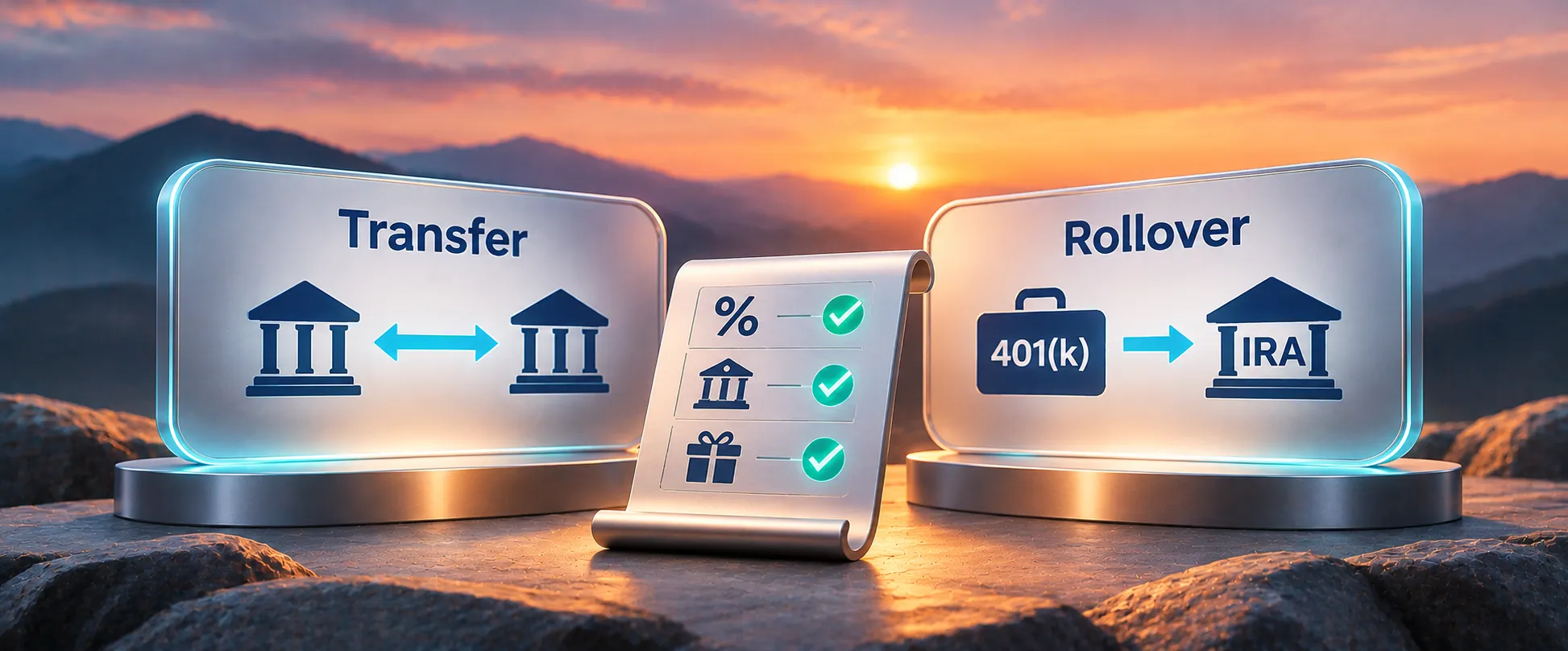
An IRA transfer moves assets directly from one custodian or trustee to another without the participant taking possession of the funds. A rollover involves moving an eligible distribution between retirement arrangements and can be completed either directly or, in some cases, through a 60-day rollover after the funds are paid to the account holder.
So, if you transfer the IRA, the money never passes through your hands. With a rollover, a distribution happens, even if the money ends up back in a retirement account.
Both approaches can preserve the tax-advantaged status of your retirement savings when handled correctly. However, they carry distinct operational rules and reporting requirements, which is exactly why the terminology matters. A misstep on a rollover can trigger taxes, while a transfer keeps things cleaner.
It also helps to know that IRA rollover rules can apply to distributions of cash or other assets, not only cash payments. Whether specific assets can move in kind depends on the plan sending them and the custodian receiving them.
The rest of this guide drills into each path: How transfers work, how direct and indirect rollovers differ, where the tax risks hide and how the reporting forms fit together.
A trustee-to-trustee IRA transfer (sometimes called a custodian-to-custodian transfer) is often the lowest-friction way to move individual retirement account assets. The defining feature is that it moves IRA assets directly from one custodian or trustee to another – you never hold the money.
That single fact drives much of the favorable treatment:
Standard eligible brokerage-account assets often move through an industry clearing system, but the exact process and timing depend on the custodians involved. Some transfers settle electronically within days; others, particularly those involving paper checks or less common asset types, can take longer.
When you leave an employer plan such as a 401(k) and decide to move the savings into a new plan or an IRA, there are two specific rollover paths:
A direct 401(k) rollover moves retirement funds straight from your old employer’s plan to another eligible retirement account, such as an IRA or a new employer plan. The money is typically made payable to the receiving custodian for your benefit, rather than paid to you personally.
Because the funds move directly between retirement accounts, mandatory federal income-tax withholding generally doesn’t apply to an eligible rollover distribution. The transfer is still usually reported by the old employer plan on Form 1099-R, even when no federal tax is withheld.
An indirect rollover happens when the retirement distribution is paid to you first, rather than sent directly to the receiving account. You then have a limited period to deposit the money into another eligible retirement account. Because the funds pass through your hands, additional tax and timing rules can apply.
For IRA-to-IRA indirect rollovers, you can generally complete only one 60-day rollover in any 12-month period, no matter how many IRAs you own. The limit applies across all of your IRAs combined, not separately to each account.
Learn about the best time to roll over a 401(k)
A rollover is only one of the choices available for a former employer’s 401(k). You may also be able to leave the money in the existing plan, move it to a new employer’s plan or take a cash distribution.
Each option has trade-offs: Keeping or consolidating funds in an employer plan can preserve plan-specific features but may limit investment choice, an IRA may offer more flexibility but has different fees and protections, while cashing out gives you immediate access to the money but triggers taxes.
An indirect rollover can create extra tax and timing issues because the retirement distribution is paid to you first. Two rules matter most: 20% federal tax withholding on many employer-plan distributions and the 60-day rollover deadline.
Tax warning: If an eligible rollover distribution from an employer-sponsored retirement plan is paid directly to you, the plan generally must withhold 20% for federal income taxes, even if you plan to roll the money over. A direct rollover to another eligible retirement account generally avoids this mandatory withholding. |
For example, if your plan distributes $100,000, it may withhold $20,000 and send you $80,000. To roll over the full $100,000, you’d generally need to deposit the full amount within 60 days, which means replacing the withheld $20,000 with other funds. The withheld amount may later count toward your federal tax liability when you file your return.
The second issue is the deadline. You generally have 60 days from the date you receive the distribution to deposit it into another eligible retirement plan or IRA.
Tax warning: Any amount that isn’t rolled over within the 60-day window may become taxable income. Depending on your age and circumstances, an additional tax on early distributions may also apply. The rollover may still need to be reported on your federal tax return even if the full amount is successfully rolled over. |
The IRS does allow limited relief for some late rollovers, including certain cases where self-certification is available. However, relief isn’t automatic and depends on the circumstances.
A direct rollover or trustee-to-trustee transfer generally avoids both the 20% mandatory withholding and the need to complete the transfer within 60 days.
This content is for informational purposes only and isn’t tax advice. Crypto.com doesn’t provide tax advice. Tax rules can vary based on your circumstances, so consider consulting a qualified tax professional about your specific situation.
Explore the pros and cons of 401(k) rollovers
The below comparison between a 401(k) transfer, direct rollover and indirect rollover is general and can depend on your specific plan, custodians and distribution type. When in doubt, confirm the expected treatment and forms with both the sending and receiving institutions before you initiate anything.
Transfer | Direct rollover | Indirect rollover | |
Payee name | Trustee to trustee; you don't take possession | New custodian/plan, for your benefit | Paid directly to you |
Mandatory tax withholding | Generally none when paid directly to another plan | Generally none when paid directly to another plan | Generally 20% on employer-plan distributions |
60-day deadline applies | Operationally different from a 60-day rollover | Operationally different from a 60-day rollover | Yes |
IRS frequency limits | Generally not subject to the one-per-12-month IRA-to-IRA limit | Direct rollovers from employer plans are treated differently from the IRA-to-IRA limit | One 60-day IRA-to-IRA rollover per 12 months |
Form 1099-R issued | Reporting can vary by custodian | Generally, yes, even without withholding | Generally reportable on your return |
Primary risk level | Lower administrative friction | Moderate; paperwork-driven | Higher; deadline and withholding risks |
Recommended read: What to do with an old 401(k)
When you move your retirement money, there are two forms that play a key role: Form 1099-R and Form 5498. Getting familiar with them helps you reconcile what happened at tax time.
Remember, a rollover transaction involving a distribution paid to you is generally reportable on the federal tax return, even when the rolled-over amount isn’t taxable. A nontaxable rollover still needs to appear correctly on your return. Second, for trustee-to-trustee transfers, reporting treatment can vary by custodian, so confirm with both institutions rather than assuming a form will or won't appear.
Understanding the tax implications of a 401(k) rollover
Scattered retirement accounts across old employers and multiple custodians can make it hard to see your full picture. Consolidating into a single self-directed Crypto.com Stocks IRA is one option for simplifying that view.
Keeping eligible retirement assets together in a tax-advantaged account can also make them easier to manage over time. Investment results will still depend on the assets held, contributions and market performance.
Crypto.com Stocks supports direct transfers and direct rollovers, which can help simplify the movement of retirement funds and avoid some of the withholding and 60-day deadline issues associated with indirect rollovers.
Eligible IRA rollovers and transfers may qualify for a cash match based on the user's Level Up tier and current program terms.
Within the Crypto.com platform, you can access both traditional securities and cryptocurrency.
Note that stocks and other securities are handled through Foris Capital US LLC, while digital assets are held through a separate Crypto.com affiliate. That means the assets may appear within the same platform experience, but they aren’t held in one combined account. Stocks, Recurring Buys and Whale Baskets are features only available in the IRA provided by Foris Capital US, LLC, not by Foris DAX Trust Company, LLC. Crypto Recurring Buys are features only available in the IRA provided by Foris DAX Trust Company, LLC.
Open an IRA with Crypto.com Stocks
* Eligible contributions, transfers and rollovers may qualify for a Crypto IRA match, paid in US dollars. Match rates vary by funding method and Level Up tier. Rewards are subject to a four-year holding period and program terms. Rewards aren’t guaranteed and may change.
A trustee-to-trustee IRA transfer moves assets directly between IRA custodians without the account holder taking receipt. A rollover moves eligible retirement assets between retirement arrangements and may be completed either directly or through a 60-day rollover, depending on the accounts involved.
In a direct rollover, the payer transfers the distribution directly to another eligible retirement plan, including an IRA, rather than paying it to the participant. Mandatory federal income-tax withholding generally doesn’t apply when an eligible rollover distribution is paid directly to another eligible retirement plan.
That said, a rollover isn’t necessarily tax-free; a rollover to a Roth IRA or designated Roth account from another type of retirement plan or account may create taxable income.
A trustee-to-trustee IRA transfer generally isn’t subject to the one-per-12-month limit that applies to 60-day IRA-to-IRA rollovers. Administrative or custodian-level considerations can still apply, so confirm the specifics with the custodians involved before initiating multiple moves, since processes and expectations vary by institution.
If you miss the deadline, the amount not rolled over is generally reportable on the federal tax return and can become taxable, with additional tax consequences possible depending on your age and circumstances. The IRS permits certain late 60-day rollovers to be addressed through self-certification or other limited relief procedures, where applicable, though relief is not automatic.
A taxable eligible rollover distribution paid directly to the participant from an employer-sponsored retirement plan is generally subject to mandatory federal income-tax withholding, generally at a rate of 20%, even if the participant intends to roll it over.
Eligible IRA rollover contributions may qualify for a cash match, but the amount, eligibility criteria and any holding requirements are governed by the official Crypto.com account disclosures. Because these terms can change and may depend on your account, review the current disclosures directly rather than relying on a quoted figure.
This is informational content sponsored by Crypto.com and should not be considered as investment advice.
Foris Capital US LLC (“FCUL” or referred to herein as “Crypto.com Stocks”) is a broker-dealer registered with the U.S. Securities and Exchange Commission (SEC) and a Member of the Financial Industry Regulatory Authority (FINRA) and the Securities Investor Protection Corporation (SIPC). For further information about FCUL, please visit FINRA BrokerCheck.
FCUL is a subsidiary of Crypto.com. FCUL is a separate entity from Crypto.com, Foris DAX, Inc., and other affiliated Foris companies. FCUL does not engage in the sale, transfer or custody of crypto currencies or digital assets. Crypto.com is a separate entity from FCUL and does not engage in the securities business. Customer balances and crypto holdings held and transacted at Crypto.com and other entities outside of FCUL are not covered by SIPC insurance and are separate from securities transactions and holdings at FCUL. Fractional shares are not available for all equities.
All investments involve risk, and not all risks are suitable for every investor. The value of securities may fluctuate and as a result, clients may lose more than their original investment. The past performance of a security, or financial product does not guarantee future results or returns. Keep in mind that while diversification may help spread risk, it does not assure a profit or protect against loss in a down market. There is always the potential of losing money when you invest in securities or other financial products. Investors should consider their investment objectives and risks carefully before investing.