What are One Piece manga cards? Learn how to read set codes and rarity marks and tell exactly which version of a card you're holding.

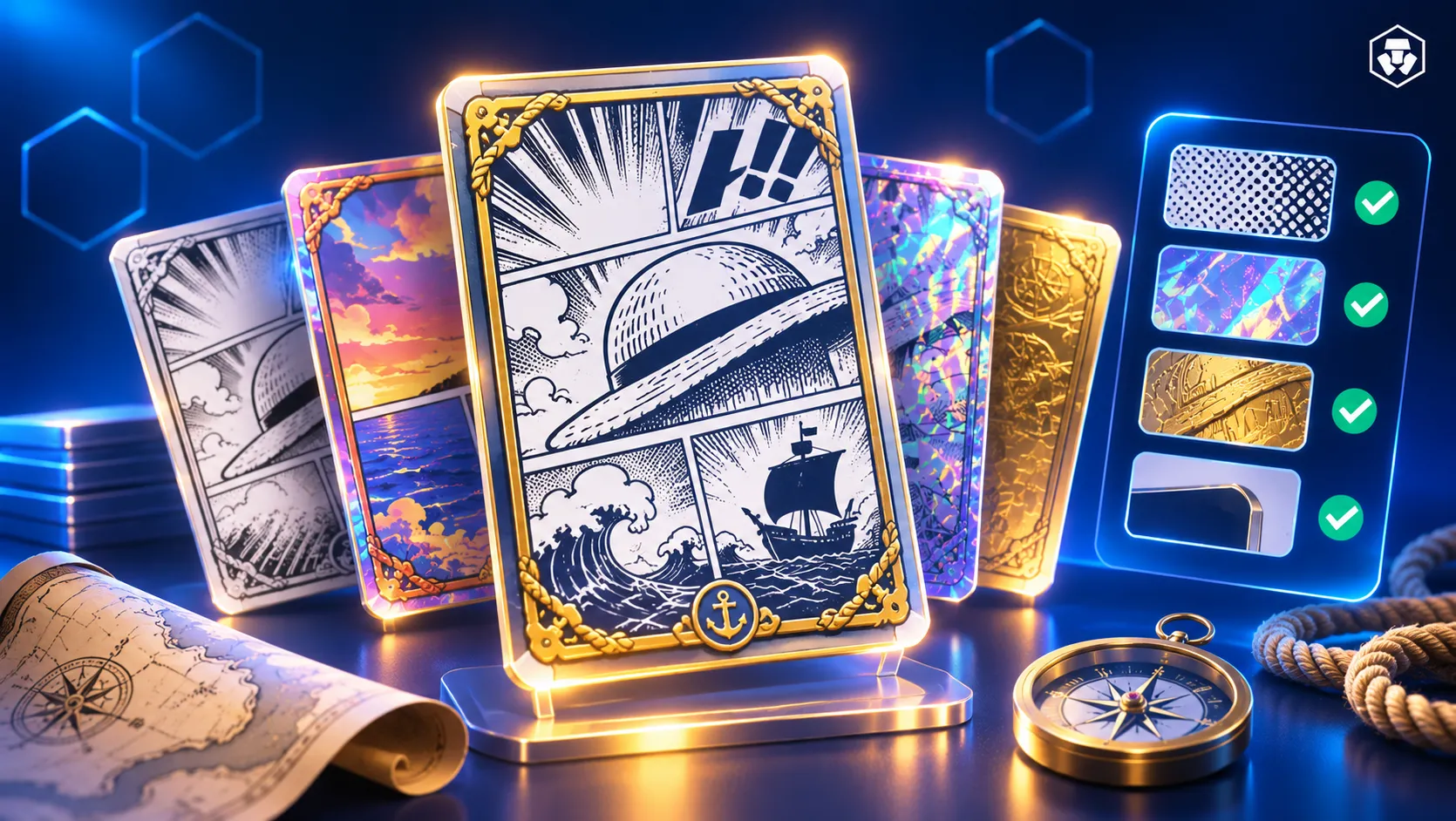
Two One Piece cards can share a name and a card number yet be entirely different prints. One Piece manga cards are alternate art versions that swap the usual artwork for manga panels, and the set code, rarity mark and artwork together show which one you hold.
One Piece manga cards are alternate art versions of existing cards, printed with artwork that reproduces manga panels. They keep the standard card's text and stats, so only the art and finish set them apart.
Collectors and shops call them manga rares, manga One Piece cards or simply a One Piece manga card. The grading company PSA files them as Manga Alternate Art and the official card list has an illustration type called Comic.
Collector guides such as TCGTalk's rarity guide place manga cards among the hardest pulls from standard booster packs. Rarity refers to how often a card appears in packs. It doesn't set a price.
Look in the lower right corner of the card. Most cards print the set code and card number there, next to the rarity mark.
Take ST01-001 as an example:
Booster sets follow the same pattern. Romance Dawn, the first booster set, released in 2022 and is OP01.
The rarity mark sits beside the card number and shows which tier a card belongs to. It doesn't show which version you hold, since a standard card and its parallel can carry the same mark.
The main marks are:
On newer sets, a star above the rarity mark flags a parallel, which is an alternate art version of a base card. Treat the star as a clue and confirm the card against the official list.
Pokémon prints rarity differently, with circles, diamonds and stars in place of letter codes. Our guide to Pokémon card rarity symbols shows the contrast.
Card collectibles have taken off as hobbyists and first-timers alike amass their collections or flip it for gains.
Try your hand at the Rips experience and get 5 online card packs free of charge. Find out more details.
Check the artwork first. A manga card shows manga panels, while a regular Alternate Art card shows uniquely revised artwork.
Both types share a few traits:
As those traits overlap, the artwork settles it. Alternate art can parallel a card of almost any rarity, including Leaders. Manga cards are a narrower group, built on high-rarity cards such as Secret Rares and Super Rares.
Match the set code, card number, rarity mark and artwork against the official list. A parallel keeps the original card's text and changes the art, so a name alone won't tell you which version you have. Work through these steps:
Reprints need one more check. Later sets bring back earlier cards in new finishes under their original set codes, so a code alone may not pin down the print. An SP marker beside the set code flags a special parallel, so compare the art and frame with each entry the list returns.
Language matters too. English and Japanese cards are catalogued separately, so match the list you search to your card's language.
Rarity, character popularity and condition may all play a part. None of them fixes a price on its own.
A price applies to one exact card. Comparing completed sales of the same card in the same condition gives a firmer reference than an asking price as a listing doesn't confirm that anyone paid it.
Our guide to basketball cards worth money walks through the method.
Values move over time, so treat any price you see as a snapshot. No pack promises a particular card.
Many collectors meet their first manga card through a pack. Online card ripping means opening trading card packs through an app or website instead of tearing foil in person. Formats vary: some platforms use virtual cards, some stream live breaks and some link a digital reveal to a physical card.
Since manga cards are among the hardest pulls, a reveal that looks like one deserves a careful look. The aforementioned checks work on screen too: read the set code, the rarity mark and the star, then compare the artwork with the official card list.
On platforms backed by physical inventory, the reveal shows a real card and you may be able to ask for delivery or accept a buyback offer. A buyback offer applies to one exact card and may come in below its resale price; confirming the version first can help you judge it. Packs are random, so set a budget you're comfortable with.
One option is Crypto.com Rips, in which eligible users can find inside of the Crypto.com App. After a reveal, you can sell the card back at the buyback price or keep it. A kept card is held for 2 days (48 hours) before it sells automatically at the buyback price shown when you chose to keep it.
Pack categories vary. Check what's on offer in the app.
Follow these steps to get started.
One Piece manga cards are alternate art versions of existing cards, with artwork that reproduces manga panels. They keep the same text as the standard card.
The official card list has an illustration type called Comic. PSA files these cards as Manga Alternate Art, and collectors call them manga rares.
Read the set code, card number and rarity mark in the lower right corner. Then compare the artwork with the entries in the official card list, since a manga card shares its text with the standard version.
A star above the rarity mark flags a parallel, which is an alternate art version of a base card. Check the card against the official list to confirm the exact version.
An alternate art card swaps in new artwork, while a manga card reproduces manga panels. Both carry the star and a richer finish, so the artwork is the deciding check.
An SP marker beside the set code flags a special parallel of an existing card. It reuses the original card's code, so check the art and frame to tell it from the original.
Not necessarily. A manga card is a different version of the same card, and its value may depend on rarity, character popularity, condition and recent sales. Our guide to football cards worth money shows how to check completed sales.
Yes. The two languages are catalogued separately, and some cards were printed in only one of them, so check the list that matches your card.
Yes. In the Crypto.com App you can sell a revealed card back at the buyback price or keep it to request shipping. A kept card that you don't ship or sell within 2 days (48 hours) sells automatically at the buyback price shown when you chose to keep it.
Important Information: This is informational content sponsored by Crypto.com and should not be considered as investment advice. Trading cryptocurrencies carries risks, such as price volatility and market risks. Before deciding to trade cryptocurrencies, consider your risk appetite. If you use a non-custodial wallet, you are responsible for securely storing your seed phrase. Losing it may result in loss of access to your assets.
Services, features and other benefits referenced in this article may be subject to eligibility requirements, token holdings, and may change at the discretion of Crypto.com.
The Crypto.com Rips service is provided by Foris Inc. subject to the Crypto.com Rips Terms and Conditions, eligibility, and jurisdictional limits.