Crypto futures are derivative contracts linked to cryptocurrency prices rather than direct ownership of the underlying token. See how crypto futures work and why leverage can increase the impact of market movements.

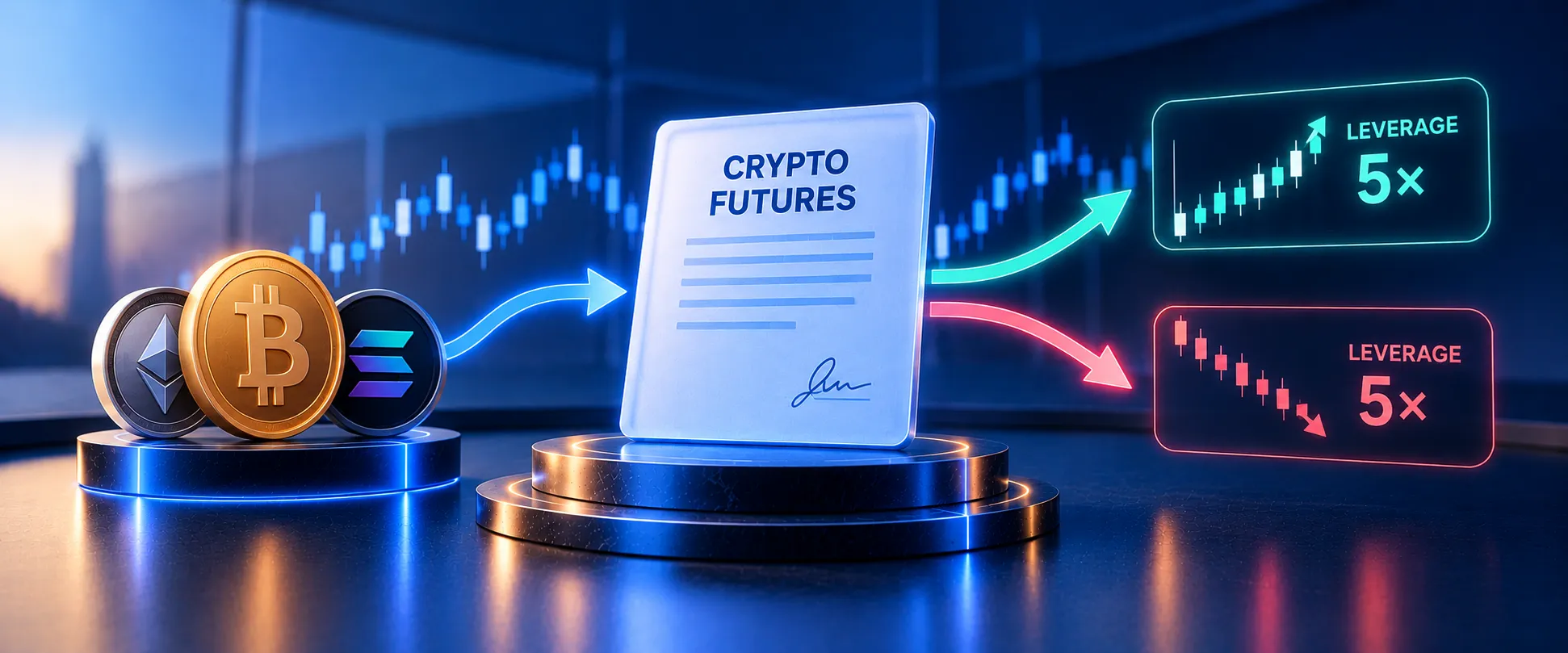
Crypto futures are standardized derivative contracts whose value tracks a cryptocurrency and whose terms set how the position will be settled. Traditional dated futures have an expiration date, while perpetual futures have no fixed expiry.
Holding a futures position doesn’t mean holding the underlying cryptocurrency. A trader can gain price exposure to Bitcoin, Ether or another supported asset without receiving the token itself. Depending on the contract, settlement may be in cash or another specified asset.
A long position generally gains value when the futures price rises relative to the entry price and loses value when it falls. A short position works in the opposite direction, gaining value when the futures price falls and losing value when it rises.
Taking a futures position means gaining exposure to a cryptocurrency’s price through a derivative rather than directly holding the token. Crypto futures trading can be used for hedging or directional market exposure.
A participant already exposed to an asset may use a short futures position to offset some price risk, while another participant may take a position based on an expected market move.
Crypto futures explained in simple terms are price-based contracts rather than direct token ownership. The position follows the contract’s rules for margin, settlement and expiration instead of the ownership rules that apply to a spot cryptocurrency balance.
Each contract has specifications covering the underlying reference asset, contract size, settlement method and any expiration date. The venue also sets rules for margin, pricing and position management.
Traditional dated futures expire on a defined date. Crypto futures may use monthly, quarterly or other expiration cycles depending on the contract. A position can be closed before expiry, rolled into a later contract or held through settlement, subject to the contract rules.
Perpetual futures work differently because they don’t expire. Instead, they use a funding mechanism designed to help keep the perpetual contract price close to the underlying spot or index price.
Funding payments move periodically between long and short position holders. When the perpetual trades above its reference price, longs will generally pay shorts. When it trades below the reference price, shorts will generally pay longs. The exact calculation and payment interval depend on the venue and contract.
The same mechanics apply to Bitcoin. So, how do Bitcoin futures work exactly? A dated Bitcoin futures contract has an expiry and settlement method, while a Bitcoin perpetual has no fixed expiry and relies on funding payments to help maintain price alignment.
The contract type changes what a position holder needs to monitor. Dated futures introduce expiration and possible rolling decisions. Perpetuals remove the expiration date but add recurring funding payments that can increase or reduce the cost of keeping a position open.
Leverage allows a trader to control a larger notional position with less collateral than the full value of that position. It doesn’t necessarily mean borrowing the underlying asset. In futures markets, leverage comes from the relationship between the position size and the margin supporting it.
If $1,000 of margin supports $5,000 of exposure, a 5% market move equals $250. That represents 25% of the original $1,000 margin before fees, funding or other adjustments. The same leverage that magnifies gains also magnifies losses.
Initial margin is the collateral required to open or support a position. Maintenance margin is the minimum margin level needed to keep that position open. Exact requirements vary by contract, position size and venue.
A futures position starts with an initial margin. If the market moves against the position, losses reduce the available margin. Once that balance reaches the maintenance margin threshold, the position may face liquidation unless the margin requirement is restored.
When losses push the available margin below the maintenance threshold, the platform may begin liquidation. That means some or all of the position is closed automatically to bring the account back within required margin levels. Fast price moves can make liquidation happen quickly.
Risk warning
Futures positions can be liquidated if the margin balance falls below the maintenance margin requirement. For perpetuals using isolated margin, liquidation is limited to that position and doesn’t use funds from the main account or affect other positions.
Isolated margin assigns a defined pool of collateral to one position rather than sharing collateral across multiple positions. This can limit how much of the account is allocated to that position, although the allocated margin can still be lost if the position is liquidated.
Spot, futures and options can all provide exposure to cryptocurrency prices, but they create different rights and obligations.
Feature | Spot trading | Crypto futures | Crypto options |
Asset ownership | The buyer directly holds the purchased crypto. | The position tracks an underlying crypto price without direct token ownership. | The option usually provides price exposure without direct ownership of the underlying token. |
Contract obligation | No derivative contract obligation. | Contract terms govern settlement and margin obligations. | The buyer has a right, not an obligation, to exercise. |
Expiration | None for the asset itself. | Dated futures expire; perpetual futures don’t. | Most options have an expiration date. |
Leverage | Not inherent in ordinary spot trading. | Common through margin. | Exposure can be leveraged through the option premium; sellers may also face margin requirements. |
Liquidation risk | Not inherent in an unleveraged spot holding. | Possible when margin falls below required levels. | Depends on the position structure and whether margin is required. |
Main price risk | The held asset can lose value. | Gains and losses can be magnified by leverage. | Buyers can lose the premium; seller risk can be substantially different. |
The crypto futures vs. crypto options distinction comes down partly to obligation. Futures positions are governed by the contract through settlement or until they’re offset. An option buyer pays a premium for the right, but not the obligation, to exercise under the option’s terms.
Spot trading is different again because the transaction results in direct ownership of the cryptocurrency. That removes futures-specific funding and liquidation mechanics when the spot position itself isn’t leveraged, although the token’s market value can still change quickly.
They’re futures contracts linked to the price of Bitcoin. They give market participants exposure to Bitcoin price movements without requiring them to hold BTC directly.
Settlement is one useful way to understand how these contracts differ. Some Bitcoin futures settle in cash, so no Bitcoin changes hands at expiration. Other contracts may provide for physical delivery, depending on the venue and product.
Market participants may use Bitcoin futures to hedge existing price exposure or take a directional view on Bitcoin. Someone concerned about a price decline may use a short futures position to offset part of that exposure, while a long position generally gains value when the futures price rises.
If you wonder what is the best way to trade Bitcoin futures, there’s no single approach that suits every trader or contract. Margin requirements, settlement terms, leverage and personal risk tolerance can all shape how a futures position behaves and how much risk it carries.
Anyone learning how to trade crypto futures will encounter margin, leverage and liquidation risk from the start. Crypto futures trading involves more than choosing whether a market will rise or fall.
A risk-aware approach generally includes the following steps:
A crypto futures exchange may be regulated differently depending on the jurisdiction and product. US availability also varies by platform, product and customer eligibility.
Futures positions require eligible collateral to support the margin account. The amount available affects position size, available leverage and how far the market can move before the position approaches its maintenance margin threshold.
A trader chooses the contract, long or short direction, position size and leverage level. Lower leverage creates less market exposure for the same amount of margin, while higher leverage makes the margin balance more sensitive to price moves.
Supported platforms may offer stop-loss and take-profit orders that can close a position when specified price conditions are met. These tools can help define an intended exit, although fast markets, gaps or limited liquidity can affect execution.
Sometimes the opportunity is up. Sometimes it’s down. And sometimes it’s when TradFi markets are closed.
With Crypto.com Perpetuals, you can go long or short on supported crypto and stocks, with up to 5x leverage, no expiry date and built-in tools to manage risks.
See what you can trade with Crypto.com Perpetuals
Crypto futures trading involves taking a position in a derivative contract linked to a cryptocurrency price rather than directly holding the token. Futures may be dated or perpetual and can involve margin and leverage.
In futures crypto markets, leverage allows a position’s notional value to exceed the margin supporting it. This magnifies both gains and losses as prices move.
Spot trading involves direct ownership of cryptocurrency. Trading crypto futures involves a derivative linked to the asset’s price and may also involve leverage, margin, funding payments and liquidation.
Cryptocurrency contracts are financial agreements linked to a digital asset or crypto market. Futures, perpetual futures and options are examples, with different settlement, expiration and margin rules.
A useful Bitcoin future review or beginner guide should explain the contract’s settlement method, expiration, margin requirements and risks. Product specifications can vary between venues.
Liquidation can occur when a futures position no longer has enough margin to meet its maintenance requirement. The exact threshold depends on the venue, contract and margin mode.
In the US, access depends on whether the venue and specific futures product are permitted for that customer. Eligibility and jurisdictional restrictions can also apply.
A funding rate determines periodic payments between long and short holders of a perpetual contract. It helps keep the perpetual price aligned with its underlying reference price.
Important information: This is informational content sponsored by Crypto.com and should not be considered as investment advice. Trading cryptocurrencies carries risks, such as price volatility and market risks. Past performance may not indicate future results. There's no assurance of future profitability. Before deciding to trade cryptocurrencies, consider your risk appetite.
This article is for informational purposes only and should not be construed as financial or investment advice. Past performance does not guarantee future results.
Services, features and other benefits referenced in this article may be subject to eligibility requirements, token holdings, and may change at the discretion of Crypto.com.
Foris DAX Inc. (“Crypto.com”) introduces customers to Foris DAX FCM, LLC, a CFTC-registered Futures Commission Merchant, for the purpose of opening accounts to trade perpetual futures contracts (“Perpetual Futures”) offered by Crypto.com | Derivatives North America (CDNA), a CFTC-regulated exchange. Crypto.com is a guaranteed introducing broker of Foris DAX FCM, LLC. All customer accounts related to Perpetual Futures are carried by and held at Foris DAX FCM, LLC.
Trading Perpetual Futures on CDNA involves significant risk, including the risk of loss in excess of your initial margin deposit due to the use of leverage, and may not be appropriate for all. Perpetual Futures do not have an expiration date and positions may be held indefinitely, which can result in ongoing funding rate charges and amplified losses. You should carefully consider whether trading Perpetual Futures is appropriate for you in light of your investment experience, financial resources, and risk tolerance. Any trading decisions you make are solely your responsibility and at your own risk.
To trade Perpetual Futures, customers may fund their Foris DAX FCM, LLC account directly via credit card, debit card, ACH, wire, and other payment methods, or use their USD Account with Crypto.com to fund their Foris DAX FCM, LLC account. As an introducing broker, Crypto.com does not hold customer funds or margin. All customer funds are held by Foris DAX FCM, LLC, the clearing Futures Commission Merchant and guarantor of Crypto.com.