Learn what a crypto market maker does, how crypto market making supports liquidity and spreads and how it differs from automated market makers.

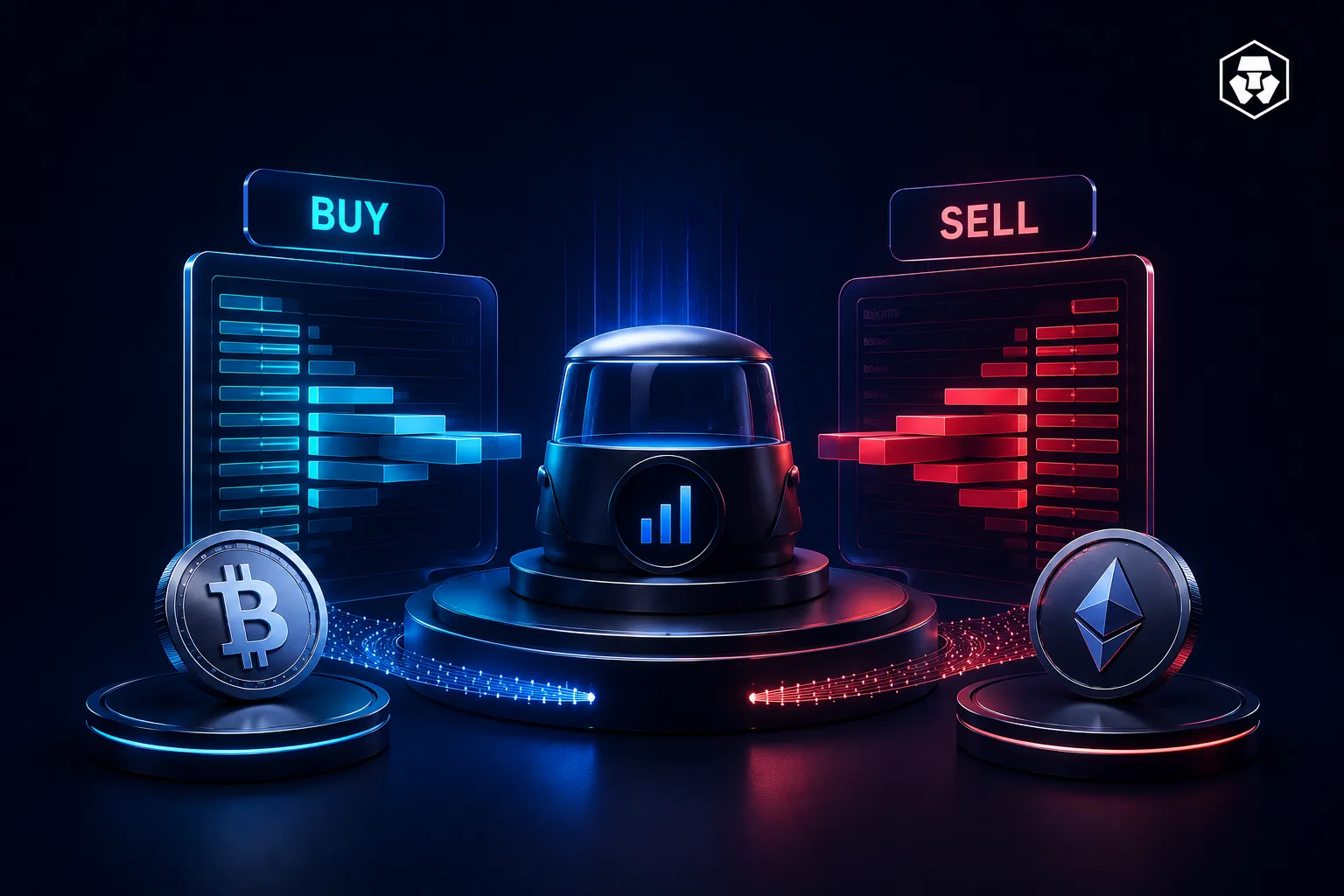
Market makers are specialized liquidity providers that keep digital asset exchanges running smoothly by constantly quoting buy and sell prices.
Market making is an imperfect, dynamic process that reacts to rapid market movements rather than controlling them. As these operations don’t always occur in real time, market makers must actively manage their own risk parameters — they operate to their own commercial advantage, which may not play to the advantage of the trader.
In plain terms, a crypto market maker is an entity whose primary job is to keep financial markets moving smoothly. Instead of trading based on where they think an asset's price will go tomorrow, they participate in crypto market making to profit from the immediate, localized difference between buying and selling prices.
They achieve this by continuously feeding orders into the exchange setup.
To understand their role in the ecosystem, it helps to look at what they actively do and what they don’t:
Centralized platforms rely on an order book, which is a live, digital ledger that organizes all open buy and sell requests for a specific trading pair.
The matching engine inside the order book relies on three core metrics:
Core market termsBid: The highest price a buyer is currently willing to pay for a digital token. Ask: The lowest price a seller is currently willing to accept to part with that same token. Spread: The mathematical gap between the highest bid and the lowest ask on the ledger. |
Example: Let’s say an asset’s highest buy order sits at $100 and the lowest sell order at $101. The gap between them creates a one-dollar spread. If an exchange lacks active participants to fill these levels, the spread can widen and make trading inefficient for regular users.
Crypto market making relies on automated systems that constantly post buy and sell orders on an exchange ledger. These entities don’t do single trades; they submit an interconnected web of limit orders on both sides of the order book simultaneously.
When a retail user executes a market order to buy a token, they immediately match with the market maker’s standing sell order (the ask).
Conversely, when a user sells a token, the transaction matches with the market maker’s open buy order (the bid). This happens thousands of times per second across the trading interface.
As market makers are constantly absorbing trades, their underlying token inventory changes constantly. If aggressive buying volume depletes their inventory, the automated system immediately rebalances by purchasing tokens elsewhere or adjusting their live bid prices.
Market depth refers to the cumulative volume of limit orders resting at various price points on the ledger. When an order book is deep, large trades are easily absorbed without moving the active price of the asset.
If market depth is thin, a large order will rapidly eat through the available limit levels, leading to trade slippage.
Slippage is the difference between the expected price of a trade and the actual price at which it executes. Robust algorithmic liquidity provision ensures that deep order books remain resilient against these sudden price distortions.
Without market makers, digital asset platforms would suffer from fragmented execution, excessive spreads and gaping price gaps during routine trades.
It’s the same as a day out at a physical marketplace. If you walk into a crowded, bustling market where hundreds of merchants are shouting competing prices, you can instantly swap your goods for cash at a fair rate. This would represent a deep, healthy market liquidity.
Conversely, if you walk into an empty, abandoned market square where only one merchant is sitting in a corner, you’re likely forced to accept whatever extreme price that single merchant dictates. This represents thin liquidity.
By acting as ‘always-on’ counterparties, market makers provide systemic benefits to digital asset environments:
A common point of confusion when studying market making in crypto is mixing up the role of a market maker with standard order types. They sound nearly identical, but they describe two completely different layers of exchange activity.
A market maker is a professional participant or firm whose entire business model centers on providing continuous liquidity across an entire trading platform.
On the other hand, ‘maker’ and ‘taker’ are technical labels assigned to individual orders placed by anyone using the platform.
Participant type | Order book interaction | Primary market role |
Market maker | Continuously posts resting limit orders on both sides of the ledger. | Dedicated institutional liquidity provider across the exchange. |
Maker order | Adds resting limit orders that don’t match immediately. | Any user whose order sits on the book and builds market depth. |
Taker order | Place market orders that cross the spread and execute immediately. | Any user whose order removes liquidity from the active book. |
To incentivize deep market depth, platforms use a tiered maker-taker fee model. Makers tend to get rewarded with lower trading fees as they add depth to the order book.
On the flip side, takers may be charged a higher transaction fee as they remove liquidity from the order book.
While exact rates vary by trading platforms, this fee matrix ensures that the platform's matching engine maintains a healthy supply of accessible orders.
As trading shifted into decentralized finance (DeFi), traditional order-book setups faced blockchain scalability constraints, which led to the creation of automated market makers.
Although both systems seek to provide liquidity, their underlying technical mechanisms are radically different.
Traditional market making:
Decentralized AMM protocols:
Benefits | Limitations |
Heavy competition between market makers shrinks the price gap (or the spread) between buying and selling, directly lowering costs for traders. | If a token’s price plummets dramatically, market makers are forced to keep buying it, which equates to major financial strain for them. |
They fill sudden gaps in volume, keeping market execution steady even during quiet hours. | Keeping liquidity consistent is tough because the crypto market is split across dozens of isolated platforms. |
By stacking deep buy and sell orders, they let traders execute larger volumes without triggering wild price spikes. | During extreme market crashes, automated systems might pause or pull back orders to shield themselves from losses. |
1. Create an account on the Crypto.com platform and start exploring real-time order books across global trading pairs.
2. Browse live price feeds to watch how buy and sell queues shift and compress under different market conditions.
3. Study order books and exchange fee structures to see how your own orders interact with resting liquidity.
4. Set custom watchlists and alerts to monitor high-volume trades and time your trade execution securely.
What is a market maker in crypto?
A crypto market maker is a specialized financial participant that provides continuous liquidity to an exchange by simultaneously placing buy and sell orders for a digital asset. Their presence ensures that other market participants can execute trades instantly at predictable prices.
What is crypto market making?
The term crypto market making refers to the active execution of a strategy where a participant simultaneously quotes a bid and an ask price for a specific trading pair. The primary goal is to capture the difference or ‘spread’ between these two prices rather than speculating on the asset's direction.
What do market makers do on exchanges?
Market makers maintain continuous limit orders on an exchange's order book, managing real-time inventory and absorbing localized risk. By continuously offering to buy and sell, they fill crucial structural price gaps and keep transaction routing clean.
Are market makers the same as automated market makers?
No. Traditional market makers place manual or algorithmic limit orders on a central limit order book. Automated market makers (AMMs) discard order books entirely, relying on hardcoded smart contracts and user-crowdsourced liquidity pools to determine token prices.
Who are the market makers in crypto?
The entities executing these roles may consist of specialized institutional quantitative trading firms, high-frequency algorithmic trading groups and the native trading desks of large centralized exchanges.
Who are the biggest or top market makers in crypto?
In the digital asset industry, the top market makers in crypto are categorized by their technical infrastructure and deep capital access rather than a single ranking. The scale of a market maker is determined by their capability to manage high-volume inventory and provide continuous quotes across multiple execution venues globally.
What is market making in crypto vs. market making cryptocurrency?
There is no difference between these terms; they describe the exact same underlying structural concept. Market making in cryptocurrency and market making cryptocurrency both refer to the practice of maintaining liquidity buffers and executing dual-sided limit orders on digital asset platforms.
What is a market maker strategy crypto template?
A market maker strategy crypto system relies heavily on delta-neutral algorithms that dynamically shift buy and sell grids based on fast-moving order book flows. These proprietary systems focus strictly on inventory rebalancing, structural volume pacing and dynamic spread adjustments to manage fast-moving market risk without picking directional sides.
Important information:
This article is for informational purposes only and should not be construed as financial or investment advice. Trading cryptocurrencies involves risks, including price volatility and market risk. Past performance may not indicate future results. There is no assurance of future profitability. Before deciding to trade cryptocurrencies, consider your risk tolerance.
Services, features, and other benefits referenced in this article may be subject to eligibility requirements and may not be available in all markets. They may also be subject to change at the discretion of Crypto.com.