Does a sideways market have to mean a boring one? Here's how grid trading bots automate buying low and selling high, differences between arithmetic and geometric spacing and the risk tools worth setting up.

Markets don't always trend. Sometimes they just drift, bouncing between two levels for days or weeks with nowhere to go, which is when traders get bored and start making avoidable mistakes.
Grid trading was built for that kind of market: an automated strategy that buys the dips and sells the bounces without active monitoring or intervention. Here's what grid trading is, how the mechanics actually work and what to weigh before setting one up.
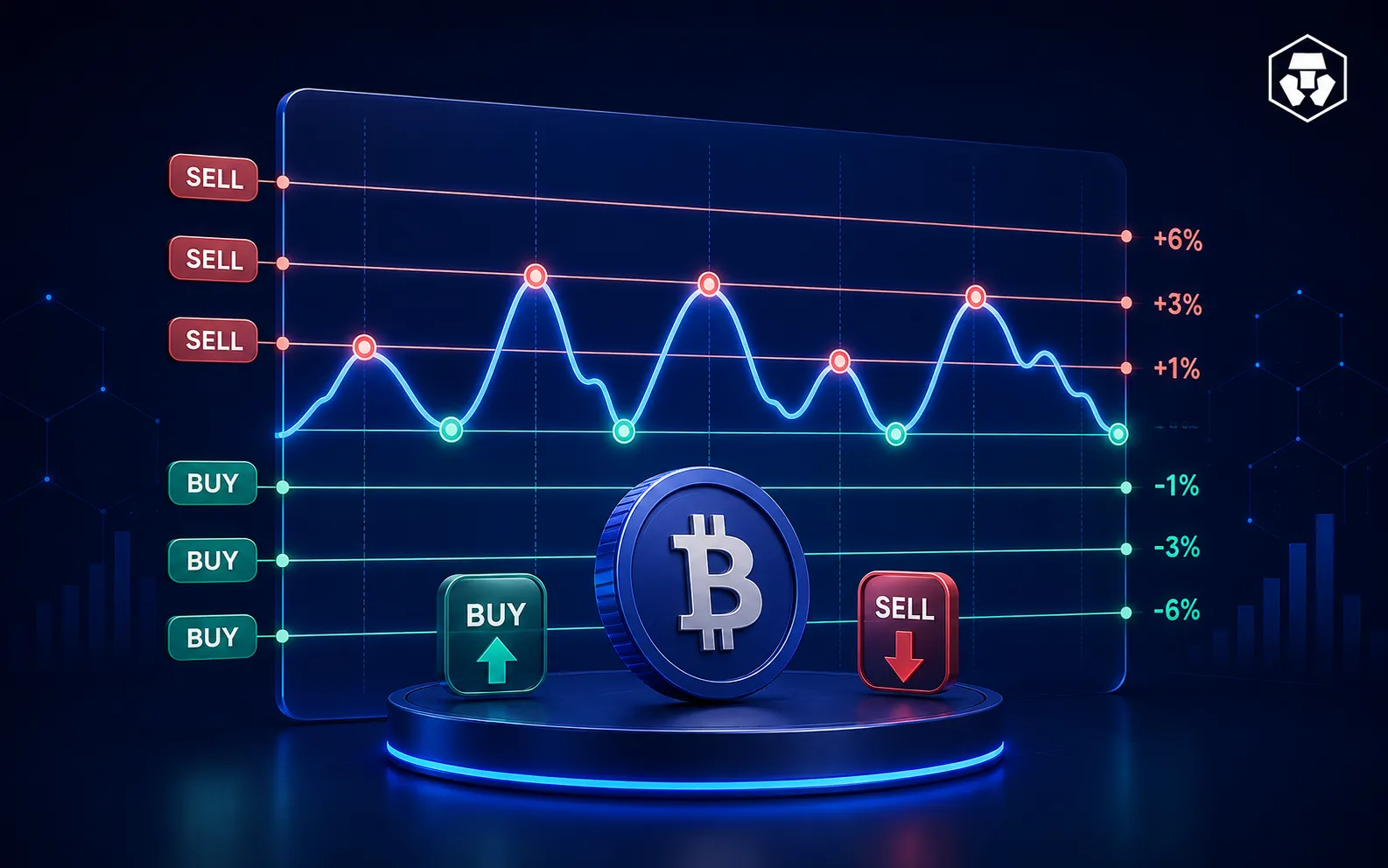
Despite the name, grid trading has nothing to do with sudoku or SWOT analysis. It's an automated trading strategy that places a series of buy and sell orders at set price intervals above and below a chosen price.
These orders are usually limit orders: instructions to buy or sell an asset only at a specific price or better, rather than at the current market price.
The name comes from the way these orders form a ‘grid’ across a price range. As the price moves up and down, the strategy aims to buy at lower levels and sell at higher ones. This captures small movements along the way.
Grid trading is usually associated with ranging markets: periods when an asset's price moves sideways within a relatively stable band, without a strong upward or downward trend.
Because the price tends to move between support and resistance levels, it may create repeated opportunities for a grid to execute.
A grid trading bot automates the process of placing and managing these orders, so you're not the one refreshing a price chart at 3 a.m. Here's how a cycle may play out.
The bot then places buy orders at the lower levels and sell orders at the higher ones.
If the price drops to a buy level, the bot executes the purchase. It then places a corresponding sell order at a higher level. If the price rises to that level, the sell order executes and the bot may place a new buy order lower down to repeat the cycle.
The difference between an executed buy and its matching sell is sometimes called ‘grid profit’. The goal is to accumulate many small gains from repeated price swings, rather than one large move, though outcomes are not assured.
As a form of automated crypto trading, the bot can monitor and act on price movements 24/7. This may help reduce the influence of emotional decisions, such as buying out of FOMO or selling out of FUD, though it doesn’t remove risk.
One catch: a bot follows its parameters to the letter. If market conditions change, the strategy won't adapt on its own unless you've configured it to.
When you set up a grid, you generally choose how the levels are spaced. The two common methods are arithmetic and geometric spacing.
It uses equal price differences between each level. For example, levels might be placed every $100 apart. This approach can suit narrower price ranges where fluctuations are relatively small.
It uses equal percentage differences between each level. For example, each level might sit about one percent above the previous one. This approach can suit wider ranges or more volatile conditions, where percentage-based steps keep the spacing proportional across the range.
Neither method is inherently better. The right choice depends on the asset, the range you select and your own preferences.
The table below compares the two using illustrative examples.
Feature | Arithmetic spacing | Geometric spacing |
Interval type | Fixed price difference | Fixed percentage difference |
Example (illustrative) | Every $100 | Every 1% |
May suit | Narrower ranges, smaller fluctuations | Wider ranges, higher volatility |
Spacing across range | Constant in dollar terms | Constant in percentage terms |
These figures are for illustration only and don’t represent recommended settings. Consider testing different configurations with care before committing capital.
Grid trading has demonstrated real-world advantages, but it's not a free lunch. Weigh both sides before you commit any capital.
Benefits | Risks |
Automation: The bot handles order placement and execution, which can save time and reduce manual effort. | One-sided trends: If the price breaks out of your grid range and keeps moving in one direction, the strategy can underperform or leave you holding an asset that continues to fall. |
Discipline: As the strategy follows preset rules, it may help you avoid impulsive decisions during volatile periods. | Opportunity cost: In a strong upward move, holding an asset outright may outperform a grid that keeps selling as the price rises. |
Capturing small moves. In a ranging market, the strategy aims to profit from repeated minor price swings that might otherwise be difficult to trade by hand. | Range dependence: The strategy generally relies on the price staying within your chosen band. But markets don’t always cooperate. |
To help manage these risks, many grid tools offer ‘stop loss’ and ‘take profit’ settings.
A ’stop loss’ can close positions if the price falls below a level you set, while a ‘take profit’ can close them once a target is reached. These features can provide guardrails, but they do not eliminate the possibility of losses.
You'll sometimes hear grid trading described as ‘set and forget’. Treat that as a description of the automation, not a promise of results. It's still worth reviewing your settings and market conditions periodically, and using our check prices page regularly to see how your chosen pair is behaving.
With the theory covered, here's what grid trading actually looks like in practice.
If you'd rather not build this from scratch, the Crypto.com Exchange's Spot Grid Trading Bot does the configuring and running for you.
There are two ways to set one up:
There's also a ‘Trailing Up’ option, which is worth understanding before you enable it: once switched on, it can't be turned off for that bot.
When the price breaks above your grid's upper limit by one grid interval, ‘Trailing Up’ cancels the lowest buy order and shifts the entire grid up by that same interval, so the bot keeps trading instead of sitting idle while the price runs. It's built for assets in a clear uptrend, where you'd rather keep participating than watch the price leave your range behind.
There's no extra charge for using the Grid Bot itself: you pay the same spot trading fees as a regular limit or market order, and you can opt to settle those in CRO. Minimum investment amounts and available pairs do vary and shift over time, so it's worth checking the specific pair on the Exchange before you commit funds.
You can refer to the Help Center guide for more details.
Services, features and other benefits referenced in this article may be subject to eligibility requirements, token holdings, and may change at the discretion of Crypto.com. |
Here's how to set up your first Grid Trading Bot on the Crypto.com Exchange:
Is grid trading profitable in a bear market?
There is no guarantee of profit in any market. In a sustained downtrend, a grid can keep buying as the price falls, which may lead to losses if the decline continues. Outcomes depend heavily on your range, settings, and market behavior.
What is the difference between spot grid and futures grid?
A spot grid trades the underlying asset directly, so you hold what you buy. A futures grid involves derivative contracts and can include leverage, which may amplify both gains and losses. This article focuses on the spot approach.
What happens if the price goes outside the grid range?
If the price moves beyond your defined range, the bot generally stops executing new orders in that direction. You may be left holding an asset while the price continues moving, which is why range selection and risk settings matter.
Can I use grid trading for any cryptocurrency?
Availability depends on the pairs supported on the Exchange. Not every asset may be eligible, so check the platform directly for the current list.
How many grids should I choose?
There is no single correct number. More levels can capture smaller moves but may spread your capital thinly, while fewer levels target larger swings. Consider the range width and volatility of your chosen pair.
Important information:
This article is for informational purposes only and should not be construed as financial or investment advice. Trading cryptocurrencies involves risks, including price volatility and market risk. Past performance may not indicate future results. There is no assurance of future profitability. Before deciding to trade cryptocurrencies, consider your risk tolerance.
Services, features, and other benefits referenced in this article may be subject to eligibility requirements and may not be available in all markets. They may also be subject to change at the discretion of Crypto.com.


