Compare Litecoin and Bitcoin Cash. Learn how they differ in origin, design goals, supply and how their respective transactions work.

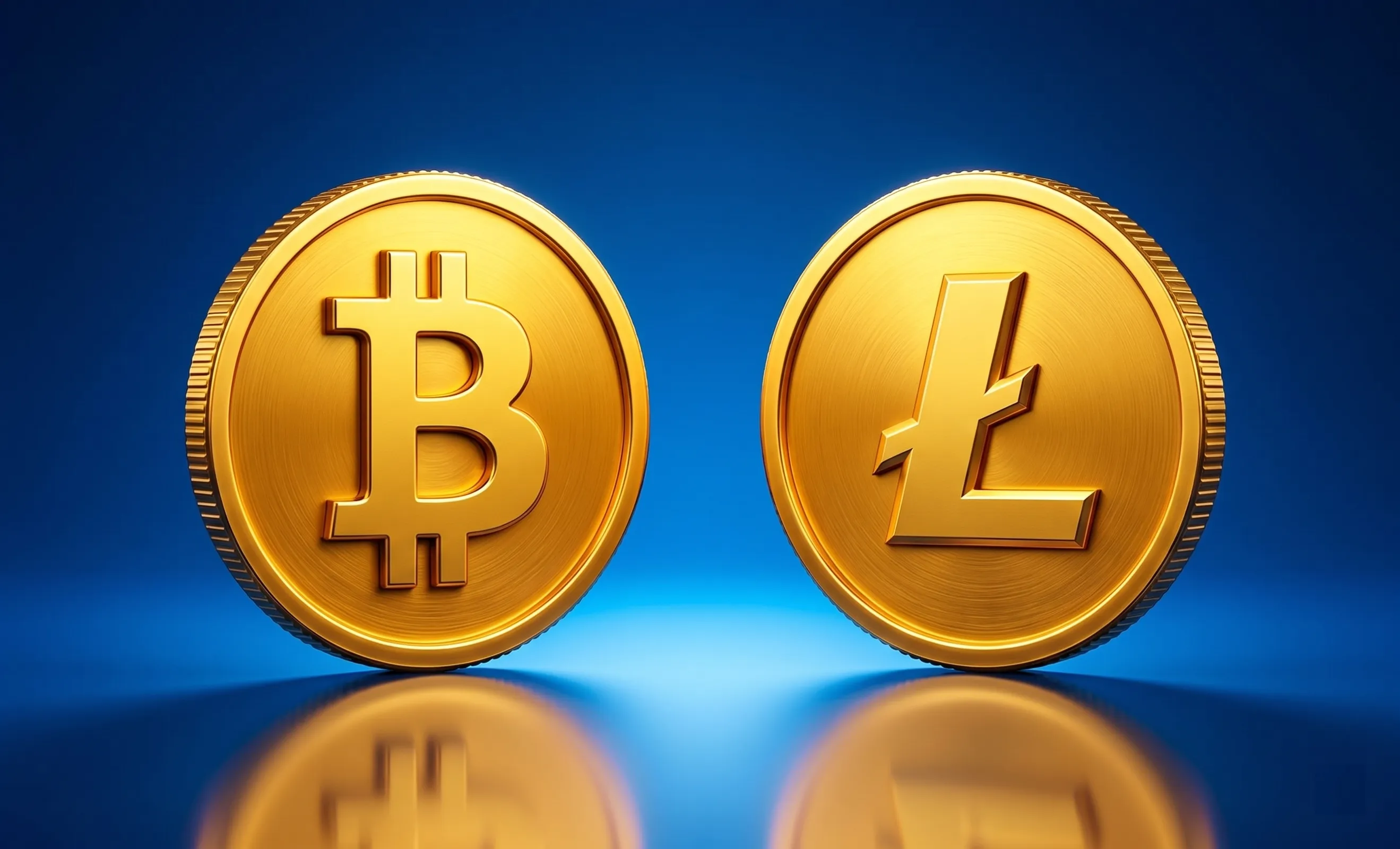
While Bitcoin remains the household name, Litecoin and Bitcoin Cash represent two attempts to refine its original blueprint. By looking at how these networks optimize for speed, fees and scaling, you can get a better understanding of their unique positioning.
This comparison breaks down the key differences between Litecoin and Bitcoin Cash.
|
At first glance, Litecoin (LTC) and Bitcoin Cash (BCH) seem to serve the same purpose: providing a faster, cheaper alternative to Bitcoin for everyday transactions.
However, the ‘why’ behind their existence diverge. Litecoin was launched in 2011 as a ‘lighter’ version of Bitcoin with a separate codebase, while Bitcoin Cash emerged in 2017 as a direct fork resulting from a community disagreement over how to scale the network.
Litecoin prioritizes faster block times and a different mining algorithm to increase transaction throughput.
Bitcoin Cash, meanwhile, focuses on increasing the ‘block size’ to fit more data into every transaction batch on the main chain. Both aim to reduce the congestion and high fees sometimes seen on the Bitcoin network, but they take different technical paths.
Feature | Litecoin (LTC) | Bitcoin Cash (BCH) |
Origin | Independent network (2011) | Bitcoin Hard Fork (2017) |
Primary goal | To function as a faster, cheaper and more accessible ‘lite’ version of Bitcoin. | On-chain scaling for payments |
Consensus type | Proof of Work (PoW) | Proof of Work (PoW) |
Mining algorithm | Scrypt | SHA-256 |
Supply cap | 84 million LTC | 21 million BCH |
Transaction experience | Faster block intervals | Larger block capacity |
Common use | Retail payments, transfers | Peer-to-peer electronic cash |
Litecoin is one of the earliest altcoins designed to complement Bitcoin. Creator Charlie Lee likened it as the ‘silver to Bitcoin's gold’. The project didn't seek to replace Bitcoin; rather, it offers a network that could handle a higher volume of smaller, frequent transactions with ease.
It reduced the block generation time to roughly 2.5 minutes, allowing the network to confirm transactions more frequently than Bitcoin's 10-minute average.
Additionally, it adopted a mining algorithm called Scrypt, which was initially intended to make mining more accessible to those using consumer-grade hardware.
Among its community, Litecoin is known for its endurance and steady growth; by the end of 2025, it boasted more than 360 million lifetime transactions processed and has had a history of zero network interruptions.
Bitcoin Cash first came about through a hard fork of the original Bitcoin blockchain. A fork occurs when a community decides to change the rules of a network, resulting in two separate paths. It was triggered by a long-standing debate within the Bitcoin community over scaling issues.
The proponents of Bitcoin Cash argued that by enlarging blocks, the network can process significantly more transactions per second on-chain. This design goal is centered on fulfilling the original vision of Bitcoin as a ‘peer-to-peer electronic cash system’, where fees remain low enough for buying a cup of coffee.
While it shares the same 21 million supply cap and mining algorithm (SHA-256) as Bitcoin, Bitcoin Cash operates as an entirely independent network with its own dedicated roadmap and community.
While both projects share Bitcoin’s DNA, they arrived through different paths. Litecoin was built as a ‘friendly fork’, a separate network using a modified version of Bitcoin’s code. Bitcoin Cash was a ‘hard fork’, born from a literal split in the Bitcoin blockchain.
Ticker symbol | LTC (Litecoin): Often paired with an ‘Ł’ symbol. BCH (Bitcoin Cash): Originally launched as BCC on some exchanges, but BCH is now the global standard. |
Naming convention | Bitcoin Cash is a direct descendant of the Bitcoin blockchain. Litecoin is a separate ‘cousin’ project. |
Wallet address | Litecoin addresses typically start with an ‘L’, ‘M’ or ‘3’. Bitcoin Cash uses a unique ‘CashAddr’ format that often starts with ‘q’ or the prefix ‘bitcoincash:’ to prevent users from accidentally sending BCH to a Bitcoin (BTC) address. |
Pro tip: Always double-check the ticker symbol before sending a transaction. Sending LTC to a BCH address (or vice versa) can result in a permanent loss of funds. |
When you send a transaction, the speed you perceive is actually a combination of how quickly the transaction is broadcast and how many confirmations a recipient (like an exchange or merchant) requires before the funds are considered settled.
For Litecoin, the primary driver of speed is its 2.5-minute block time. This is four times faster than Bitcoin, meaning a transaction typically receives its first confirmation much sooner.
Bitcoin Cash maintains the same 10-minute block time as Bitcoin but focuses on on-chain capacity. By supporting significantly larger block sizes (currently 32MB compared to Bitcoin's 1MB), Bitcoin Cash can process thousands of transactions in a single block, keeping the ‘mempool’ (the waiting area for transactions) clear and fees consistently low.
Important noteIf you’re moving funds between exchanges, check the ‘required confirmations’ for each asset. You might find that even though Litecoin creates blocks faster, the exchange may require enough confirmations that the total wait time is similar to Bitcoin Cash. |
Both Litecoin and Bitcoin Cash are Proof-of-Work (PoW) blockchains. They rely on miners to secure the network and validate transactions. However, the mathematical puzzles these miners solve are fundamentally different, which has created two distinct hardware ecosystems.
Bitcoin Cash uses the SHA-256 algorithm, the same one used by Bitcoin. This means that the massive amount of specialized mining hardware (ASICs) designed for Bitcoin can also be used to mine Bitcoin Cash. While this provides a high level of security, it also means the two networks have to compete for the same pool of global hashing power.
Litecoin, on the other hand, uses the Scrypt algorithm. When it launched, Scrypt was intended to be ASIC-resistant, allowing everyday users to mine with standard computer graphics cards (GPUs). While specialized Scrypt ASICs eventually entered the market, the algorithm still requires more memory than SHA-256.
Both Litecoin and Bitcoin Cash use a capped supply model to create digital scarcity, similar to Bitcoin’s original design. However, the specific limits and the pace at which new tokens enter the market differ significantly.
Litecoin has a maximum supply of 84 million LTC, exactly four times that of Bitcoin. Litecoin undergoes a halving event roughly every four years, where the block reward for miners is cut in half.
Bitcoin Cash mirrors Bitcoin’s scarcity, with a hard cap of 21 million BCH. As it’s a fork of the original Bitcoin blockchain, it shares the same issuance schedule and historic distribution up until the 2017 split. For both networks, these caps underscore their value proposition: No central authority can ‘print’ more tokens and dilute the holdings of existing users.
In recent years, Litecoin has prioritized ‘rational privacy’ and scalability through optional features.
Bitcoin Cash remains committed to its electronic cash label, focusing on keeping all activity directly on the main blockchain (Layer-1).
What this doesn’t meanDespite these technical advances, neither network’s roadmap guarantees future adoption or merchant acceptance. While these features expand what the networks can do, their ultimate utility depends on consistent community support and integration by global payment processors. |
Whether you prefer Litecoin’s ‘digital silver’ approach or the on-chain scaling of Bitcoin Cash, you can trade these and 400+ other cryptocurrencies on the Crypto.com App.
Is Bitcoin Cash the same as Bitcoin?
No. Although they share the same transaction history before August 1, 2017, they’re now two entirely separate networks with different rules, development teams and goals.
Is Litecoin faster than Bitcoin Cash?
In terms of block generation, yes. Litecoin creates a new block every 2.5 minutes, compared to 10 minutes for Bitcoin Cash. However, the actual time to ‘finality’ depends on how many confirmations an exchange or merchant requires.
Why do Litecoin and Bitcoin Cash exist?
Both were created to address specific limitations of Bitcoin: High fees and slower transaction times during periods of network congestion.
What are the main differences between LTC and BCH?
The main differences lie in their origins (altcoin vs. fork), their block sizes, their supply caps (84M vs. 21M) and their mining algorithms (Scrypt vs. SHA-256).
Are LTC and BCH used for payments?
One of the main utilities of Litecoin and Bitcoin Cash is to act as mediums of exchange for everyday transactions. While traditional payment methods still dominate global retail, these networks may be integrated by major crypto payment processors as lower-cost alternatives to Bitcoin.
What does ‘fork’ mean in crypto?
A fork occurs when a blockchain’s community changes its underlying rules. A hard fork, like the one that created Bitcoin Cash, results in a permanent split into two separate and incompatible blockchains.
What does Proof of Work mean?
Proof of Work is a consensus mechanism where miners compete to solve complex mathematical puzzles to validate transactions and secure the network in exchange for block rewards.
What does ‘BTC vs. LTC’ mean?
This is a common search term for people comparing Bitcoin (BTC) and Litecoin (LTC), often used to understand the technical or utility differences between the original cryptocurrency and its earliest major alternative.
Where can I learn more about Litecoin and Bitcoin Cash?
You can explore real-time market data, technical deep dives, and educational guides through the Crypto.com Learn Hub.
Important information:
This article is for informational purposes only and should not be construed as financial or investment advice. Trading cryptocurrencies involves risks, including price volatility and market risk. Past performance may not indicate future results. There is no assurance of future profitability. Before deciding to trade cryptocurrencies, consider your risk tolerance.
Services, features, and other benefits referenced in this article may be subject to eligibility requirements and may not be available in all markets. They may also be subject to change at the discretion of Crypto.com.