There are broadly four types of rewards; cashback, reward points, travel rewards – also known as airmiles – and crypto. Those categories can be broken down into smaller segments, depending on the type of program. Let’s explore how they work, which ones work best, different spending scenarios and where the relative strengths and weaknesses lie.

There are broadly four types of rewards; cashback, reward points, travel rewards – also known as airmiles – and crypto. Those categories can be broken down into smaller segments, depending on the type of program. Let’s explore how they work, which ones work best, different spending scenarios and where the relative strengths and weaknesses lie.
Reward credit cards offer a range of reward incentives linked to your spending. For example, you might earn cashback, reward points, airmiles or even cryptocurrency for every dollar you spend. Not all credit cards offer rewards and some rewards cards come with fees and interest.
While reward programs may reward spending in a wide range of categories, there are typically some common exclusions where purchases won’t earn you a reward. These may include gambling, tobacco and non-purchase transactions like cash advances.
Credit card issuers use reward programs to make their products and services more competitive. They also incentivize spending. As a rule, the more you spend, the more rewards you could earn. So, card issuers are simultaneously making their card more appealing to potential customers and making it rewarding for existing customers to spend more.
Reward cards also foster loyalty. Once a customer becomes used to earning rewards through their spending, they may be less inclined to switch cards. However, card users should always spend within their means, avoid overspending to earn more points and plan their purchases strategically to maximize their benefits.
Let’s look at the different types of credit card rewards in more detail.
Cashback is a rebate on spending you’ve already made. For example, if you spend $100 on a card with 2% cashback, you’d receive $2 back. Cashback is a relatively predictable method of earning rewards.
There are three types of cashback reward. Flat-rate cashback earns you a consistent percentage back from your spending, regardless of spending category. Tiered cashback rewards you at a different rate depending on the category. For example, 3% on travel and 5% on groceries. Rotating rewards work like tiered rewards, but the tiers and rates change seasonally.
You earn reward points from spending, but you redeem them against future spending. For example, you spend $100 dollars on a card with a 2x points offer, meaning you get 2 points to redeem in future. Some reward points programs have boosted reward rates where you get more points per dollar spent.
These work like reward points, but you’re typically restricted to redeeming your rewards on travel purchase. These programs used to be generally referred to as air miles, but nowadays you can redeem them on more than just air travel discounts. For example, travel rewards may apply to hotels, room upgrades, flight upgrades and baggage allowances.
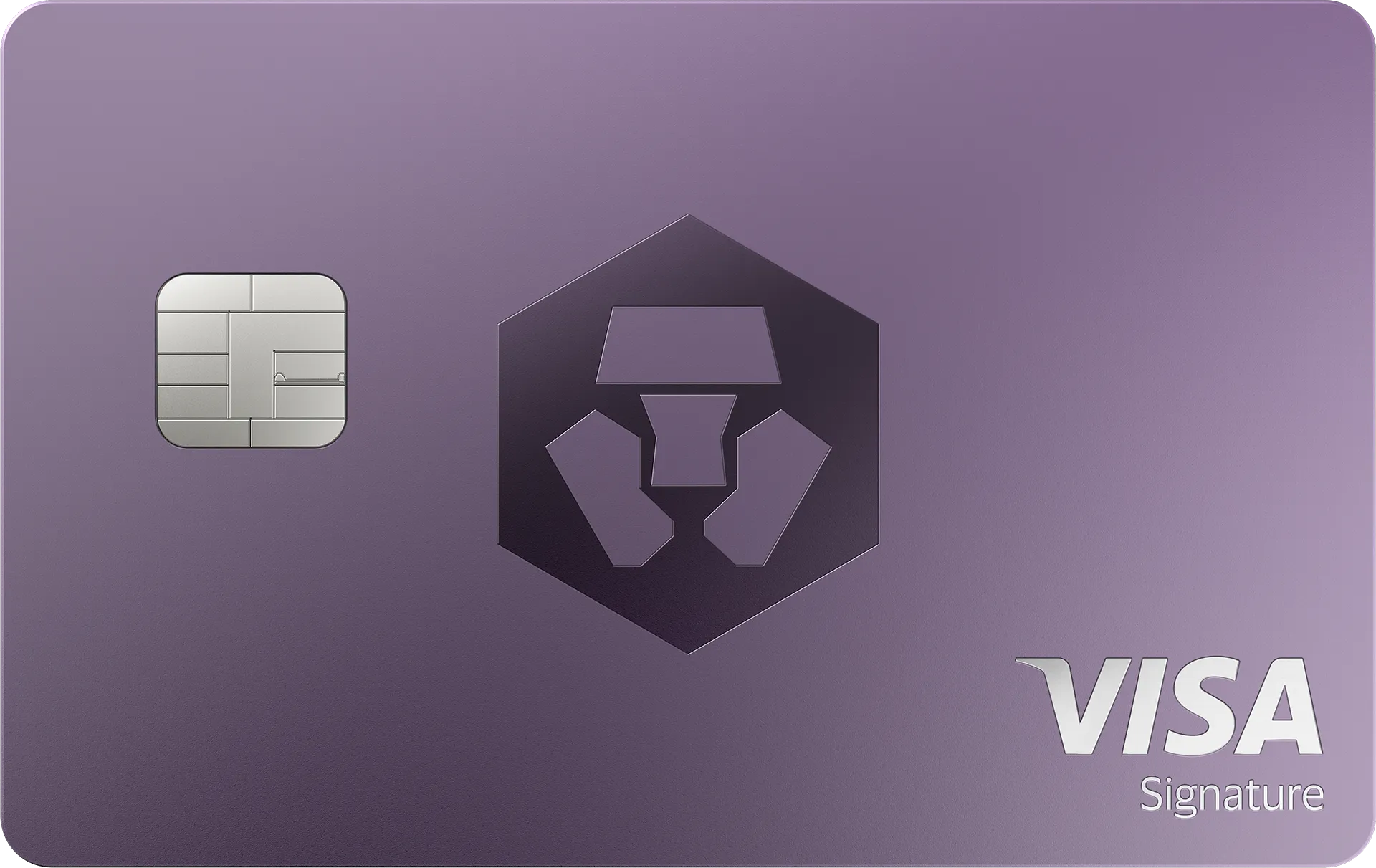
Crypto rewards credit cards are a relatively modern way for people to get rewarded in crypto currencies from their spending. The Crypto.com Visa Signature® Credit Card, subject to credit approval, lets users earn rewards through the Level Up* reward program. The program has tiers, which you can access either by subscription or by locking up your crypto.
Crypto.com customers can also access Bitcoin rewards up to 6% on purchases depending on card tier.The card also comes with a range of lifestyle perks including rebates on popular subscription services and lounge access.
The best rewards credit card for points isn’t necessarily the one that gets you the most points. It’s more about which credit card matches your existing spending habits without incentivizing you to chase rewards and overspend.
Some rewards programs are more flexible than others. Cashback is relatively flexible because it’s a rebate that indirectly reduces the cost of past purchases. Some programs offer better cashback reward rates on select categories, some offer a flat rate on all purchases. Either way, it’s similar to a discount on what you’ve spent.
Air miles are by definition less flexible than regular reward points because they are designed to be redeemed on travel purchases. Some programs allow you to convert them to regular reward points.
While cashback is relatively predictable, points programs can be a little more complex. But like cashback, they do have potential for maximizing rewards through tiered programs. You may also be able to access bonus rates and special redemption offers with selected partners.
Let’s explore some examples.
If you spend $1,000 on a cashback credit card with a 2% reward rate, you’ll earn $20 cashback. If you spend $1,000 on a credit card that gives 1 reward point per dollar spent, you’ll earn 1,000 points. Assuming the typical redemption rate of 1 cent for every point, that also gives you $10 worth of rewards.
However, if you’re willing to be more selective with where you earn and spend your rewards, it could look something like this:
Let’s say you can earn 2 rewards points for every dollar spent on groceries, but 5 points on every dollar spent on technology. You spend $500 on groceries in a month and buy a laptop worth $500. Your total spend is still $1,000 but you’ve earned 1,000 points on groceries and 2,500 points on technology purchases.
That’s a total of 3,500 points. With each point worth 1 cent, you’ve got rewards worth $35.
Welcome or sign-up bonuses can also boost the value of points. Let’s assume you’ve got a welcome bonus that gives you 60,000 reward points if you spend $5,000 in the first three months of card membership.
You spend $2,000 on gas, groceries and entertainment in month 1, the same in month 2 and $1,000 in month 3, you’ve met the threshold for bonus points. Your 60,000 points are worth $600, which you’ve earned from spending $5,000. So for every dollar spent, you earned 12 cents, or 12%.
Disclaimer: These examples are for illustrative purposes only. You should should go directly to the issuer for exact offerings.
For everyday spending, the best card is one that delivers predictable rewards on a broad range of purchase types. Cashback can be useful for everyday spending because you can earn rewards across a number of categories.
Cashback rewards work differently depending on the card issuer. Some offer flat rate rewards while others have tiered categories, with higher rates on certain types of purchase. Others offer rotating rewards, similar to tiered rewards but the categories change.
So on a flat rate cashback program, you’d earn the same percentage on all eligible purchases. On a tiered program, some purchases would earn you a higher cashback percentage. With rotating rewards, the tiers change seasonally.
Tiered and rotating programs may offer a higher cashback percentage on selected categories compared to a flat rate program and lower percentages compared to flat rate on all other purchases. So for example, a tired program might offer 5% on tech and 1% on all other purchases, while a flat rate offers 2% on all eligible categories.
Flat rate cashback cards can be useful if you want predictable rewards on all spending. For example, Wells Fargo offers a credit card with unlimited 2% cashback on all purchases without category restrictions plus the opportunity to earn $200 cashback when you spend $500 in purchases in the first 3 months.
Tiered cashback can make spending in certain categories or with certain retailers or partners more rewarding.
For example, Amazon’s Prime Visa card gives you the opportunity to earn up to 5% cashback on all Amazon.com purchases, Amazon Fresh shopping and Chase Travel spending with no caps or restrictions if you’re an Amazon Prime Member, which costs $139 a year as of October 2025. Without Prime membership you’ll earn 3% cashback.
With or without Prime membership, you can earn up to 2% unlimited cashback at gas stations, on dining out and selected transport, plus 1% unlimited on other eligible purchases.
So let’s assume you spent $1,000 on Amazon Fresh and Amazon.com purchases in a month. If you’re a Prime member, you’d earn $50 cashback, or $30 cashback if not.
It’s important when comparing any type of rewards program to also consider the interest rate on purchases and any card fees you may need to pay. Sometimes the fees can eat into the rewards you’ll realistically earn while keeping to your normal spending habits.
Avoid cards where the fee would motivate you to spend more than you normally would to earn enough rewards to compensate.
The best rewards card for travel is one that rewards you for the kind of travel spending you already do, while offering the chance to boost redemption value.
Travel rewards have evolved far beyond simple air miles. Many cards now offer travel reward points which you convert to a specific partner’s reward programme, for example Delta Sky Miles or American Airlines Advantage.
As well as redeemable points, you can earn rewards that convert to upgrades, hotels, baggage allowances and perks like lounge access.
For example, if you already spend a lot on travel, Chase bank’s Sapphire Preferred credit card offers 5x points on travel purchases. If you already spend in that category, this card may be suitable. The Capital One Venture Rewards card offers 2x points on travel plus 75,000 bonus points.
Most travel rewards work on a points system similar to traditional retail reward points. And in most cases, a point is worth between 1 cent and 3 cents. However, there are opportunities to boost the amount of points you earn by spending in the most rewarding categories.
The best card for points will reward you across a range of categories, with options to boost collection and redemption value.
Points programs can be flexible, but the typical trade off is that you earn more points per dollar spent when the categories are restricted. So for example, you may earn 1 point for every $1 on everyday purchases, but 2 points for every $1 spent on travel or entertainment with selected partners.
The redemption methods can also vary in flexibility. For example, you may get a better redemption rate when redeeming with selected partners in specific categories. Some reward points cards, like the American Express Gold card, have a wide range of spending categories with different reward rates.
Users can earn 4x points on restaurants and groceries, 3x points on air travel and hotels and 1x points on all other eligible purchases. So, if you spent $500 on dining out and groceries, $200 on air travel and hotels and $100 in other eligible categories, you’d earn a total of 2,700 points worth $27 from $800 spent.
While the spending categories and tiers of points based rewards can be similar to those of cashback, there are some fundamental differences between the two types of program. Cashback is effectively a rebate on a purchase you’ve already made. In some cases, you receive your cashback reward immediately.
Points are credits or discounts that you can put toward a future purchase. This necessarily means you need to spend again on your credit card. The potential downside here is that you can’t redeem your points without making further purchases. If this fits with your established spending habits, that might be fine. But in some cases it can incentivize ‘points chasing’.
It’s also important to compare the stability of your rewards. Cashback typically comes either as a direct deposit to your account or a credit against your balance. The cashback value is always stable relative to the dollar because it’s calculated in dollars. If you spent $100 and received 1% cashback, you will always get a dollar back, value potentially lost to inflation notwithstanding.
Points can be less stable. While they may always be worth the same in cash value terms, points partners can change without notice your redemption options, either making it harder to redeem your points or requiring more points for you to earn the same level of benefit on future spending. This is called ‘reward points devaluation’.
Cashback | Points | Air miles | Crypto | |
Typical value | Percentage of spend | 1 point = 1 cent | 1 point = 1 cent | Flat percentage of spend |
Redemption method | Rebate either deposited or credited against balance | To spend with selected partners | To spend on travel with selected partners | Credited to linked wallet |
Stability | As stable as cash | Can devalue slowly | Can devalue slowly | Can increase or decrease quickly |
The best rewards credit card is the one that rewards you for continuing to spend in the way you always do, perhaps with some slight optimizations or tweaks.
For example, if you’re already spending a lot on travel, switching to a travel credit card might be a useful way to get rewarded. Similarly, switching your everyday grocery spending to a cashback or points card could be a useful way to get rewards.
It’s essential to take account of interest and fees. If you’re not paying off your balance each month, you’ll likely end up paying interest on the carried balance. This could easily eat into or even outweigh any rewards you earn.
Here’s how to determine the best rewards credit card for you and your spending:
Be honest with yourself about your lifestyle spending and shortlist cards that reward you. Avoid cards that would need you to change how you spend, increase what you spend, or otherwise adjust your financial behavior in a significant way.
Look at the fees, including annual card fees and foreign transaction fees, as well as interest costs of suitable cards. Add them up based on the assumption that you will pay off your balance in full each month. Then calculate the likely rewards you’ll earn. If the value of the rewards seems lower than the cost of the fees, this might not be the right card for you.
It’s easy to be distracted by eye-catching headline offers. Look at the details, restrictions and exclusions that apply to each reward offer. For example, is 3% on travel worth your while if you need to switch from your preferred airline or airport to take advantage? Look at the reward structures side by side, examine the limits and how the tiers work.
Once you’ve narrowed down your shortlist of suitable reward credit cards, look at how you’re able to redeem your rewards. Some reward points and travel cards have restrictions on where you can use your rewards, when you can use them and they can even change value at short notice.
If you want predictable rewards without having to track what you’ve earned, a cashback rewards credit card might be suitable.
Spend strategically. Are there any regular expenses you pay for with a debit card that you could switch to a points-earning credit card? Do you have a large purchase coming up that you could use to earn points? Also consider how you redeem your points. Can you transfer some of your earned points to a specific redemption partner?
If you’re on the hunt for a new card, pay attention to sign-up bonuses. These can be a useful way of maximizing value and getting more points per dollar spent, provided you’re using the card on planned purchases. For example, if you’re planning a vacation, look out for a card that has a sign-up bonus on travel spending.
Keep one eye on promotional deals and partnerships. Some credit card providers work with retail and travel partners to offer promotions that let you maximize your points. And don’t overlook traditional sales and discount offers, like waiting until traditional discount events like Black Friday to redeem points
Another way to potentially maximize the value of your points is to think long-term. For example, if you’re planning a large purchase in a year’s time, saving up your points between now and then could potentially work in your favor. Especially if you’re paying off your bill every month and spending strategically on your card.
In most cases your rewards are not taxable, with some exceptions.
This depends entirely on your specific spending habits and needs. Some issuers worth considering include Wells Fargo for flat rate cashback, Amazon’s Prime credit card for retail spending points, American Express for travel and regular spending points and Chase and Capital One for travel points.
It depends entirely on your spending habits and preferences. For people interested in more immediate rewards on past spending, cashback may be suitable. And for people who are happy to track points, monitor spending categories and look out for partner offers, points may be suitable.
Not normally, because the interest you may pay on carried balances can often cost more to pay back than the rewards are worth. Always spend within your means, don’t chase points by overspending and always try to clear your balance in full to maximize reward points.
Look beyond the headline advertised rates and introductory offers and pay attention to annual fees, short-term low or no interest rate offers plus restrictions and exclusions. Aim to identify the reward program that you’ll get the most use out of for the lowest cost.
You may want to consider more modern reward programs too, like crypto rewards, where you get rewarded for spending in cryptocurrency. Here, we’ve covered the best crypto-linked debit and prepaid cards in the US in detail.
Crypto.com cards let you spend in fiat currency and get rewards in crypto. You may also qualify for additional perks like rebates on entertainment subscriptions and airport lounge access, depending on the card and the Level Up tier you’re on.
Level Up is Crypto.com’s reward program. It’s a tiered reward program and you can access it in one of two ways; pay a subscription, starting at $4.99 a month, or lock up some of your crypto. The amount you pay or lock up determines the level of rewards you receive.
Some people like this type of reward program because it lets them passively accumulate crypto assets. It’s a modern way of spending and suits people who understand the strengths and drawbacks of investing in crypto. One thing always worth remembering is that crypto can increase and decrease in value quickly.
Important information:
This is informational content sponsored by Crypto.com and should not be considered as financial or investment advice. Trading cryptocurrencies carries risks, such as price volatility and market risks. Before deciding to trade cryptocurrencies, consider your risk appetite.
Third-party information subject to change.
The Crypto.com Visa Signature® Credit Card accounts are issued by Comenity Capital Bank pursuant to a license from Visa U.S.A. Inc. Visa is a registered trademark of Visa International Service Association and used under license. The rewards program is provided by Crypto.com and its terms may change at any time. For full Rewards Terms and Conditions, please see https://crypto.com/document/us_credit_card. Offer is exclusive to Crypto.com Visa Signature® Credit Card holders enrolled in the Level Up program, click here for additional terms and conditions. Crypto.com calculates and awards the amount of CRO tokens earned based on the current market rate at the time of your purchase. The Crypto.com Visa Signature Credit Card is subject to credit approval.
*Offer is available to Level Up Rewards members that are in the 'Pro' and 'Private' tiers. Click here for terms and conditions. Priority Pass™ access is available to eligible crypto.com cardholders in 'Pro' and 'Private' Level Up tiers upon registration using a Unique Invitation Code (UIC), provided via the Crypto.com app. Registration requires entry of a Crypto.com Visa Signature® Credit Card. Lounge access is granted through the Priority Pass mobile app. For additional details visit https://help.crypto.com/en/articles/7733288-priority-pass-airport-lounge-access.