Stablecoins are a type of cryptocurrency designed to maintain a steady value, typically by being pegged to fiat currencies like the US Dollar. Our guide explores how stablecoins work, the different types available, and why they matter in the digital economy.

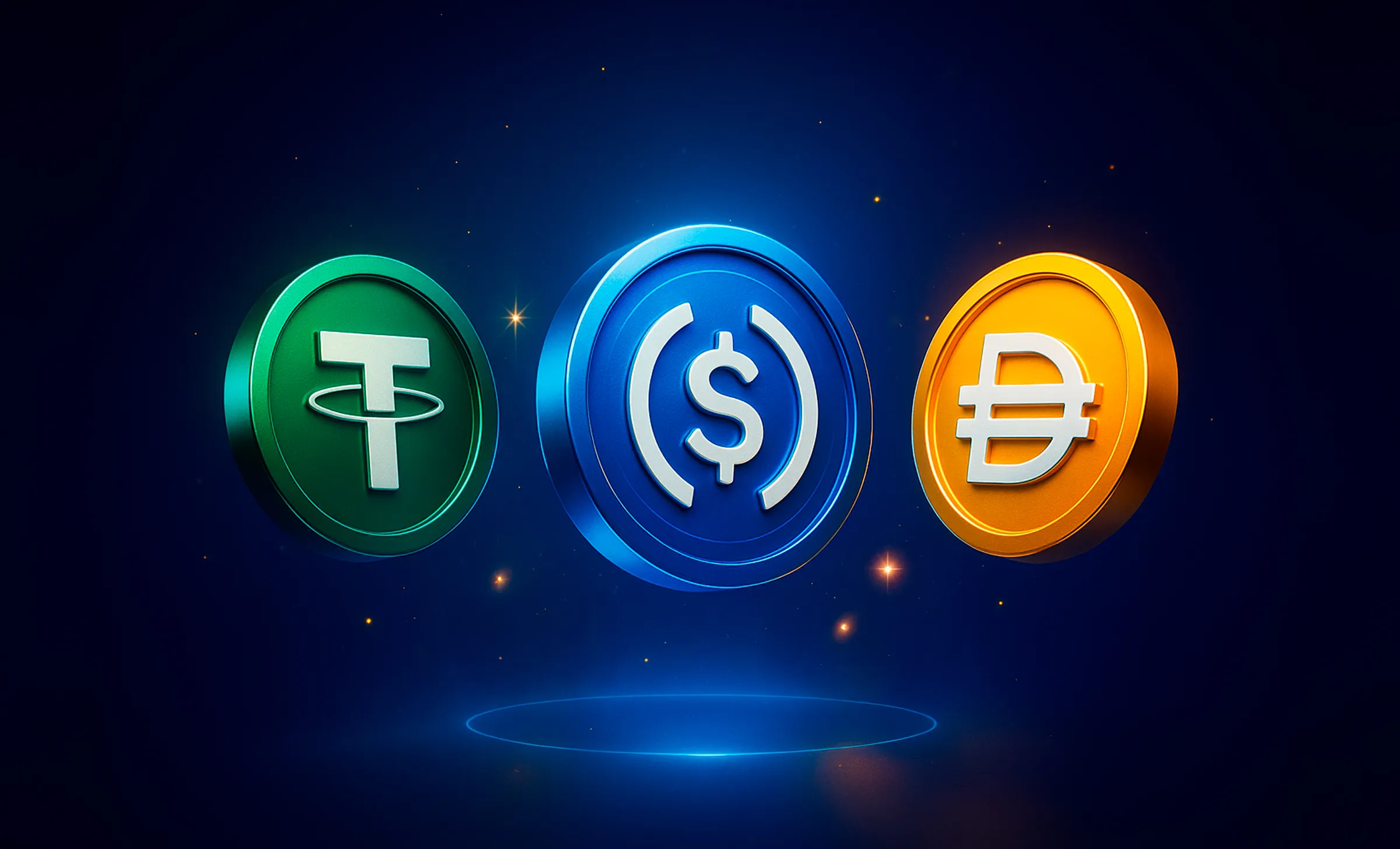
A stablecoin is a cryptocurrency named for its ability to maintain a stable value, typically by pegging its price to a reserve asset – for example, the US Dollar, gold, or a basket of physical assets. Stablecoins are specifically constructed to exhibit minimal volatility, making them more practical for everyday transactions, savings, and trading.
The most well-known stablecoins include:
Stablecoins are different from other crypto assets in that they aren’t designed for investment or speculative gains, but instead engineered to hold their value steadily, providing a bridge between traditional finance and digital currency.
The core purpose of maintaining this price stability is to allow for predictable pricing in the digital economy. This gives stablecoins a unique use case; they are used in cross-border payments, decentralized finance (DeFi), and crypto trading, both to hedge against volatility and to serve as a more reliable store of value within the blockchain ecosystem.
Stablecoins achieve their price stability through various mechanisms, including backing the token with real world assets, or relying on algorithmic controls. These mechanisms help the stablecoin maintain its peg, regardless of market fluctuations.
Reserve backed (or collateralized) stablecoins are supported by a pool of assets held in reserve. For example, USDC and USDT are backed 1:1 with fiat currency or equivalents, such as pure cash or Treasury bills, held in custodial accounts. This makes sure that each token issued is redeemable for an equivalent amount of fiat currency.
By contrast, algorithmic stablecoins like TerraUSD (now defunct) use smart contracts and supply-adjusting algorithms to maintain their peg. These systems automatically increase or decrease the circulating supply of the stablecoin based on market demand - such that if the price drops below $1, the algorithm burns tokens to reduce supply - and if it rises above $1, mints new tokens to increase supply.
However, this model carries higher risk, and as the collapse of TerraUSD shows, has historically been weaker than the reserve backed stablecoin mechanism, especially in times of economic stress.
While most stablecoins peg to fiat currencies (most commonly the US Dollar, given its status as the world’s reserve currency), others track commodities like gold, or even other cryptocurrencies. Peg maintenance can either be centralized via trusted custodians or decentralized using on-chain governance and collateral.
Stablecoins typically operate on a blockchain, using smart contracts to manage their issuance, redemption, and governance. In decentralized systems like DAI, smart contracts ensure transparency, collateralization ratios, and price feeds, removing the need for trusted intermediaries while still maintaining the peg.
Stablecoins offer a unique blend of features:
Stablecoins offer a range of benefits:
Unlike traditional cryptocurrencies, stablecoins are designed to maintain a steady value, helping users avoid the extreme volatility of better-known assets including Bitcoin or Ethereum.
Stablecoins run on blockchain networks that enable instant global transfers, with minimal fees compared to traditional banking systems. This is especially beneficial for sending money abroad, where delays and high transaction costs are common.
Stablecoins are essential to the DeFi ecosystem, because they allow users to lend and borrow without being exposed to more volatile crypto prices, by providing a trusted, liquid unit of account.
For individuals in countries with unstable currencies or limited banking infrastructure, stablecoins offer a secure and accessible way to send or receive money. They enable direct, peer-to-peer remittances, and can be used for everyday payments without requiring a bank account or card.
Many users use stablecoins to generate returns. On both centralized platforms and DeFi protocols, stablecoin holders are able to earn passive income through lending, liquidity provision, and other strategies.
Stablecoins maintain their value through different mechanisms, each designed to keep the token closely pegged to a target asset:
Arbitrage mechanics also contribute as a solution for when a stablecoin deviates from its peg also helps. As long as the token is properly backed, traders will buy it below $1 and redeem it for $1 worth of reserves, profiting while pushing the price back toward the peg. This self-correcting mechanism reinforces price stability in both centralized and decentralized models.
Of course, this only works if the trader is confident that the reserves are in place.
Buying stablecoins is straightforward with Crypto.com:
Download the Crypto.com app or create an account on our online platform. Then sign up by providing your email address and creating a secure password. This account will serve as your gateway to buying, storing, and managing stablecoins and other cryptocurrencies with us.
To comply with regulations, we require new users to complete identity verification checks (KYC). You’ll also need to upload a government-issued ID (typically a valid passport or driver’s license) and a quick selfie for facial recognition purposes. This process usually takes a few minutes.
Once verified, you will be able to deposit fiat currency into your Crypto.com account. You can link your bank account, use a credit or debit card, or transfer funds via wire transfer. Our app supports multiple fiat currencies, making it easy to fund your account.
After your deposit clears, navigate to the buy/sell section of the app. Select the stablecoin you want to buy, enter the amount, and then confirm your purchase. With stablecoins, the transaction is usually instant, and your new assets will appear after you buy crypto in your Crypto.com wallet.
You can hold your stablecoins within the Crypto.com wallet or transfer them to your own external wallet for more control.
Stablecoins come in many forms, though they are most commonly categorised as one of:
Fiat-backed stablecoins are by far the most common. These tokens are directly pegged to traditional fiat currencies, often the US Dollar, and are collateralized by reserves held in the form of cash, treasuries or other short-term investments.
Examples include USDT (Tether) and USDC (USD Coin). Users can redeem these stablecoins for an equivalent amount of fiat currency. Because they are generally centralized, users must rely on custodians and regular audits to ensure transparency.
Crypto-backed stablecoins are backed by other cryptocurrencies and are usually overcollateralized to mitigate the potential volatility of the underlying crypto assets.
For example, DAI is backed by Ethereum and other tokens, locked in smart contracts. If the collateral value drops below a certain threshold, automatic liquidation occurs to protect the system’s solvency. Unlike fiat-backed stablecoins, these are usually decentralized, relying on blockchain technology and governance by token holders to maintain the peg.
Algorithmic stablecoins innovatively don’t rely on any collateral, instead using a combination of smart contracts and algorithms to control supply and demand. When the stablecoin price moves above or below the peg, the protocol automatically expands or contracts the supply to bring the price back in line.
At times, these types of stablecoin have shown vulnerabilities during periods of market stress, leading to significant de-pegging events.
These stablecoins are pegged to physical assets such as gold, silver, or oil. Some tokens represent ownership of gold stored in physical vaults, offering a digital form of commodity investment (much like an exchange-traded commodity).
Commodity-backed stablecoins provide price stability linked to the value of tangible goods and are popular with investors seeking a bridge between physical assets and digital currencies.
Synthetic stablecoins are created using derivatives or financial contracts that replicate the price of an asset without owning it outright. These often combine various financial instruments on-chain to simulate stablecoin behavior.
They may offer greater flexibility and decentralized control but are very complicated to get to grips with, especially for beginners.
The primary difference between stablecoins and traditional cryptocurrencies is their respective price stability. Most cryptocurrencies, including Bitcoin or Ethereum, are highly volatile by traditional market standards, meaning that their prices swing dramatically over short periods of time. This volatility makes them attractive for investment and speculation but less practical for everyday transactions.
By contrast, stablecoins are specifically designed to maintain a stable value, usually by being pegged to a fiat currency. This stability reduces price fluctuations to a minimum, making stablecoins ideal for use cases that require predictability, such as cross-border payments, remittances, or even as a relative safe haven during market downturns.
Regarding digital use cases, most cryptocurrencies often serve as speculative assets, ‘digital gold,’ or platforms for decentralized applications (dApps) and smart contracts.
Stablecoins act as a reliable medium of exchange and unit of account within the crypto ecosystem. They are widely used in decentralized finance (DeFi) protocols for lending, borrowing, and trading without exposing users to price swings.
The key difference between stablecoins and Central Bank Digital Currencies (CBDCs) lies in their issuers and control mechanisms.
CBDCs are digital currencies issued and regulated by a country’s central bank or government. They represent a digital form of a nation’s fiat currency and are backed by the government. Stablecoins, however, are generally issued by private companies or decentralized organizations, and while they are often pegged to fiat currencies, they do not have official government backing.
CBDCs operate within a centralized framework, giving governments and their central banks full oversight over transactions. This allows for detailed tracking, regulatory enforcement, and potentially greater control over the country’s finances, for good or for ill, in particular with regard to privacy concerns.
Stablecoins operate with varying degrees of decentralization depending on the project. While many rely on private entities and custodians, some are decentralized and use blockchain technology to provide transparency and reduce centralized control. However, stablecoins are still subject to regulatory scrutiny and may require compliance with AML and KYC rules.
Bitcoin is primarily seen as a store of value and a speculative asset, often designated as ‘digital gold.’ Its supply is limited, and its price is highly volatile, as it’s driven by market demand, investor sentiment, and wider macroeconomic factors.
Bitcoin’s volatility has led to significant gains since its inception, but some have suffered substantial losses during its volatile moments, making it less practical for everyday transactions or as a stable unit of account.
On the other hand, stablecoins are designed to be a stable medium of exchange by maintaining a consistent value. They allow users to avoid the price swings common with Bitcoin, making them more practical for transactional purposes and for interacting with decentralized finance (DeFi) applications.
Stablecoins and memecoins differ significantly in terms of utility, volatility and fundamentals.
Stablecoins serve several clear functional purposes, including maintaining price stability and acting as a reliable digital representation of fiat currency. Their value is firmly backed by assets or algorithms, and they are widely used for payments, trading, and DeFi applications.
Memecoins, like Dogecoin or Shiba Inu, are cryptocurrencies often created as jokes (internet memes). Their value is highly speculative and driven mostly by social media hype, celebrity endorsements, and community sentiment rather than any intrinsic utility or strong fundamentals.
Memecoins tend to be extremely volatile and unpredictable, with price swings fueled by market speculation rather than any asset backing or real-world use cases. It is worth noting however that some coins created with a serious use case have in the past been co-opted into meme frenzies.
Stablecoin regulation is maturing worldwide as governments and regulators seek to balance the desire to be at the forefront of cryptocurrency innovation with financial stability and consumer protection. And because stablecoins operate at the intersection of traditional finance and digital assets, they naturally face increased scrutiny.
Global regulations vary but generally focus on ensuring transparency, financial soundness, and compliance with anti-money laundering (AML), know-your-customer (KYC) protocols, and counter-terrorism financing (CTF) laws. The United States and European Union are both continually developing frameworks to govern stablecoin issuance, reserves management, and operational oversight.
The twin points regulators continue to emphasize is that stablecoins should have fully backed reserves and clear redemption rights.
A significant legislative effort in the US is the GENIUS Act (Global Equity and National Innovation for a United States Act), which was passed in July 2025. It aims to create a comprehensive regulatory framework for all digital assets, clarifying the roles of federal agencies, establishing licensing requirements, and enforcing strict reserve backing and transparency standards to prevent systemic risks.
It remains to be seen how effective this legislation will be, though it has been cautiously welcomed by many in the space.
Licensing and reserve requirements are key components of most regulatory proposals elsewhere. Issuers may need to obtain special licenses similar to those for money transmitters or banks, are generally required to hold sufficient, liquid reserves to back every stablecoin issued, and are subject to regular audits.
The outlook for stablecoins appears strong, driven by the rapid growth in adoption and evolving use cases across both retail and institutional markets. As digital currencies gain mainstream acceptance, stablecoins are arguably becoming critical infrastructure for seamless, low-cost payments, decentralized finance (DeFi), and cross-border transactions.
The growth trajectory is expected to continue upward (with some bumps in the road) as more users seek stable, blockchain-based alternatives to traditional fiat currency. The expanding DeFi ecosystem, NFT marketplaces, and increasing integration with major payment platforms are fueling demand for stablecoins globally.
Further, institutional interest is rising as financial institutions explore the possibility of using stablecoins for treasury management, faster settlement, and liquidity solutions. Major banks and payment providers are collaborating with or developing their own stablecoin offerings, recognizing their potential to transform traditional finance.
On the technology front, new developments are incessantly improving stablecoin scalability, security, and interoperability. New models, including hybrid collateralization and improved algorithmic designs, are being designed to increase their resilience and reduce the risks, making them more reliable for everyday and institutional use.
More widely, as regulatory frameworks mature, stablecoins are likely to become more integrated with traditional finance, paving the way for broader adoption and a more connected digital economy.
Stablecoins have become essential tools within the broader cryptocurrency ecosystem, for a variety of use cases:
Stablecoins serve as a stable store of value regardless of wider crypto market volatility. Traders can use stablecoins like USDT or USDC to quickly move in and out of volatile assets without converting back to fiat currency, reducing transaction time and fees, and allowing seamless trading across exchanges and markets worldwide.
Stablecoins enable fast, low-cost cross-border payments that bypass traditional banking delays, checks, and fees. By pegging value to a stable asset like the US Dollar, stablecoins provide a predictable medium of exchange, which is especially useful for businesses with limited access banking infrastructure or relying on volatile local currencies.
Stablecoins act as crucial ‘on and off ramps’ between fiat and crypto. For example, users can easily convert fiat into stablecoins, without having to worry about any price volatility, before buying other cryptocurrencies with their new stablecoins.
Stablecoins underpin many decentralized finance (DeFi) protocols, enabling lending, borrowing, and liquidity provision with minimized price risk. Owners can use stablecoins as collateral, making them a cornerstone for building stable, scalable financial products on blockchain networks.
Start earning with DeFi.
As with all investments, stablecoins do come with some risk:
Patently, the biggest risk with any reserve-backed stablecoin is the reserves themselves. If issuers do not maintain full or transparent reserves, or if reserves are invested in illiquid or risky assets, the stablecoin may lack the backing to honor redemptions. This can lead to loss of confidence and potential collapse, so it’s critical to conduct due diligence into any project you choose to buy into.
For crypto-backed and algorithmic stablecoins, smart contract vulnerabilities can pose a significant risk. Flaws or exploits in the code can lead to a loss of funds, manipulation, or even failure of the peg mechanism. Since these systems often operate autonomously, bugs can cause significant consequences before developers can intervene.
Stablecoins face an uncertain regulatory environment globally. Governments may impose strict rules on issuance, reserve management, and user verification, or may even ban certain stablecoins altogether. Despite new rules like those imposed by the GENIUS Act, the reality is that stablecoins are still in their regulatory infancy.
Stablecoins are designed to maintain a stable value, but de-pegging events, where the stablecoin’s price diverges significantly from its peg, can occur due to market panic, reserve insolvency or algorithmic failure.
What exactly are stablecoins?
Stablecoins are cryptocurrencies designed to maintain a stable value by pegging to a reserve asset. They aim to combine the benefits of digital currencies with the price stability of traditional money.
What is the point of a stablecoin?
The main purpose of a stablecoin is to provide a reliable, stable medium of exchange and store of value within the crypto ecosystem. This stability helps users avoid the volatility common in most cryptocurrencies.
What’s an example of a stablecoin?
Popular examples of stablecoins include USDT (Tether), USDC (USD Coin), and DAI. Each maintains its value by different mechanisms such as fiat reserves or crypto collateral.
How does a stablecoin make money?
Stablecoin issuers typically earn revenue by investing the reserves backing the stablecoins or charging transaction and redemption fees. Some also generate income through lending linked to their tokens.
Is Bitcoin a stablecoin?
No, Bitcoin is not a stablecoin – it’s a decentralized cryptocurrency known for its price volatility and limited supply. BTC serves primarily as a store of value and speculative asset rather than a stable medium of exchange.
Do banks use stablecoins?
Some banks and financial institutions are beginning to explore stablecoins for faster payments, settlements, and liquidity management. However, widespread adoption is still in the very early stages.
What is the risk with stablecoins?
Risks include inadequate reserves, smart contract vulnerabilities, regulatory changes, and the potential loss of the stablecoin’s peg to its underlying asset.
How safe are stablecoins?
Stablecoins backed by fully audited reserves and up-to-date technology tend to be relatively safe, but no investment is without risk. Buyers should always assess the issuer’s transparency and regulatory compliance before use.
Can I earn a yield with stablecoins?
Yes, many decentralized finance (DeFi) platforms and centralized exchanges offer opportunities to earn yield by lending stablecoins.
What is pegging and de-pegging?
Pegging means maintaining a stablecoin’s price close to its target value, usually a fiat currency like the US Dollar. De-pegging occurs when the stablecoin’s value deviates from this target, causing instability and potential losses.
Who issues stablecoins?
Stablecoins are issued by private companies, decentralized organizations or consortiums, depending on their design and governance model. Examples include Tether Limited for USDT and the Centre consortium for USDC.
What happens if a stablecoin loses its peg?
If a stablecoin loses its peg, its value can fluctuate wildly, and there can sometimes be long-term financial losses for holders. Recovery depends on the issuer’s ability to restore trust and stability, but even one de-pegging event can be enough to cause permanent damage to the project.
Important information: This is informational content only and should not be considered as an investment recommendation. Trading cryptocurrencies carries risks, such as price volatility and market risks. Before deciding to trade cryptocurrencies, consider your risk appetite.