Bitcoin halving is an event that cuts the reward for mining new blocks in half roughly every four years. Discover how it works, why it’s crucial for scarcity and value and what it means for Bitcoin’s long-term price and supply.

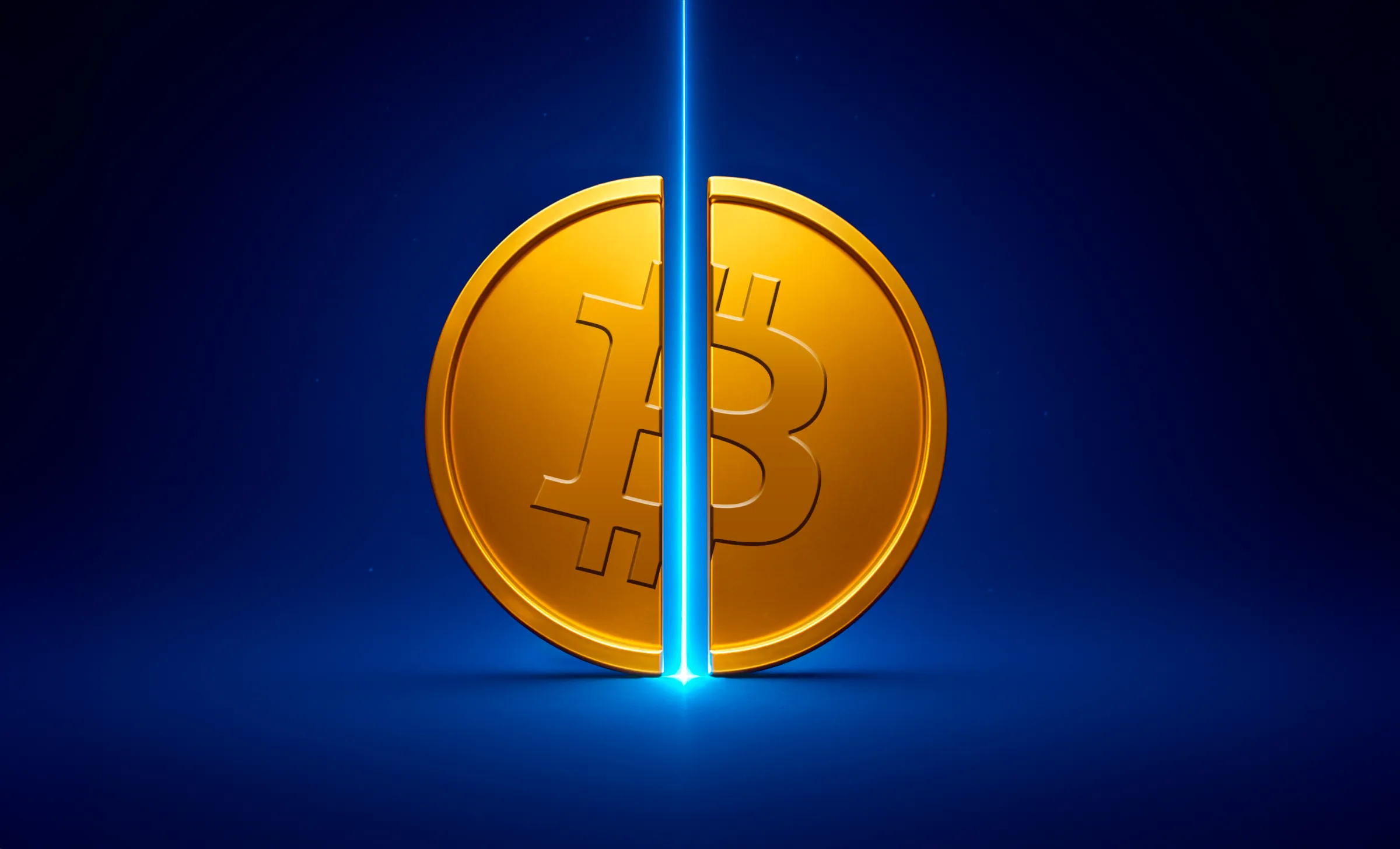
Bitcoin halving is a pre-programmed event within the Bitcoin protocol that occurs every 210,000 blocks (once approximately every four years) where the reward that miners receive for validating transactions and adding new blocks to the blockchain is cut in half.
This mechanism is built directly into Bitcoin's code and can’t be changed without consensus from the network, which is all but practically impossible because it would require overwhelming agreement from the vast majority of participants, miners, developers and node operators who have strong incentives to preserve Bitcoin’s monetary policy and security model.
The halving schedule follows a predictable pattern. For context, when Bitcoin launched in 2009, miners received 50 BTC for each block they successfully mined, and this reward has been systematically reduced through each halving: from 50 to 25 BTC in 2012, then to 12.5 BTC in 2016, 6.25 BTC in 2020 and most recently to 3.125 BTC in April 2024.
This process will continue until Bitcoin reaches its maximum supply of 21 million coins, establishing a fixed supply model that contrasts with traditional fiat currencies that can be issued without limit.
Bitcoin halving works through Bitcoin's Proof-of-Work (PoW) mechanism, where miners use specialized computer equipment to compete to solve complex mathematical puzzles to validate transactions and secure the network. When a miner successfully solves a block, they receive the current block reward plus any transaction fees included in that block.
The Bitcoin network is designed to produce a new block approximately every 10 minutes, regardless of how many miners are participating. This is achieved through an automatic difficulty adjustment that occurs every 2,016 blocks (roughly every two weeks).
When more miners join the network and blocks are found faster than the 10-minute target, the difficulty increases. Conversely, if miners stop mining and blocks take longer to find, the difficulty decreases, which maintains the equilibrium.
Because the halving is tied to block height rather than time, the actual date can vary slightly based on how quickly or slowly blocks are mined leading up to the event. However, the 210,000 block interval remains constant, making halvings predictable within a reasonable timeframe of around four years.
Bitcoin halving is central to Bitcoin's controlled supply mechanism and inflation reduction strategy. Unlike traditional currencies where central banks can increase money supply at will, Bitcoin's halving ensures a predictable and decreasing rate of new coin creation, which also engenders trust in the cryptocurrency.
This native scarcity mechanism also reinforces Bitcoin's claim to being ‘digital gold’. Just like gold becomes more valuable due to its limited supply and increasing difficulty of extraction, Bitcoin becomes scarcer with each halving event. And the reduced rate of new Bitcoin entering circulation creates supply pressure that, combined with steady or increasing demand, often leads to price appreciation.
Of course, past performance isn’t a guarantee of future returns.
For miners, halving events significantly impacts their economics and the network's security model. When block rewards are cut in half, miners with higher operational costs may find their operations unprofitable, potentially leading to some miners shutting down. However, this typically results in a difficulty adjustment that helps maintain the network's stability.
Historical evidence suggests a strong correlation between Bitcoin halvings and subsequent price rallies, though as ever, past performance doesn't guarantee future results. Each previous halving has been followed by significant price increases, though the timing and magnitude have varied.
The 2012 halving saw Bitcoin's price rise from around $12 to over $200 within a year. Following the 2016 halving, Bitcoin climbed from approximately $650 to nearly $20,000 by late 2017. The 2020 halving then saw Bitcoin surge from about $8,500 to an all-time high of nearly $69,000 in 2021. After the 2024 halving, Bitcoin has continued to show strength, reaching new heights of more than $110,000.
Several mechanisms contribute to these potential price impacts, perhaps most importantly the supply shock from reduced new Bitcoin creation that can create upward pressure on price if demand remains constant or increases.
There’s also a psychological element, as the market anticipates a rise post-halving, which can create a self-fulfilling prophecy as investors position themselves for potential gains. Further, the introduction of Bitcoin ETFs has also added new sources of institutional demand and liquidity to the market.
However, it's crucial to understand that halvings don't guarantee price increases. Market conditions, macroeconomic factors, regulatory developments and overall crypto sentiment have all played significant roles in Bitcoin's historical upwards price movement. Additionally, some analysts argue that halvings may become increasingly ‘priced in’ as the market matures and becomes more efficient.
Bitcoin has experienced four halving events since its inception, each marking a significant milestone in the cryptocurrency's evolution:
The next Bitcoin halving is expected to occur around April 2028 when the network reaches block 1,050,000, reducing the block reward from 3.125 BTC to 1.5625 BTC.
Bitcoin's final halving is projected to occur around the year 2140, when the network will have issued all 21 million bitcoins. At this point, the block reward will effectively reach zero, and miners will rely entirely on transaction fees for their income.
This transition will present both challenges and opportunities for the Bitcoin network. Clearly, without block rewards, transaction fees must be sufficient to incentive miners to continue securing the network. This could well lead to higher transaction fees, but it will also create a more mature fee market where users pay based on the urgency and value of their transactions.
The shift to a fee only model may also encourage the development of second layer solutions like the Lightning Network, which can process many transactions off-chain while settling periodically on the main Bitcoin blockchain. These solutions can help maintain reasonable transaction costs while preserving the security and decentralization of the base layer.
Given the technological pace of change though, any estimates at how Bitcoin will have changed over a century from now is at best an educated guess.
Bitcoin halvings significantly impact miner economics and overall network dynamics. When block rewards are cut in half, miners with higher operational costs including electricity and hardware expenses, may find that their operations are no longer profitable.
This economic pressure often leads to miner consolidation, where less efficient operations shut down, while more efficient miners gain a larger share of the network's hash rate. Mining farms with access to cheap, renewable energy sources and the latest ASIC hardware typically have competitive advantages during these transitions, which may go some way to solving Bitcoin’s environmentally damaging image.
Over time, transaction fees are expected to play an increasingly important role in miner payments. As Bitcoin adoption grows and the network processes more transactions, fee revenue should (in theory) gradually offset the declining block rewards. This transition will be crucial for maintaining network security as block rewards continue to diminish with each halving.
As noted above, the network's mining difficulty automatically adjusts to maintain the 10 minute block time target, helping to stabilize the system even as miners enter and exit the network. This self-regulating mechanism ensures that Bitcoin will continue to function reliably, regardless of short-term changes in mining participation.
Bitcoin halvings often have ripple effects throughout the broader cryptocurrency ecosystem. As it’s by some distance the largest and most established cryptocurrency, Bitcoin's price movements frequently influence altcoin markets and overall crypto sentiment.
During previous halving cycles, increased Bitcoin prices have often led to capital flowing into alternative cryptocurrencies, creating what many refer to as an ‘alt season’. This dynamic occurs because investors seek higher returns in tokens with smaller market capitalizations after Bitcoin's initial surge.
Beyond this, the introduction of spot Bitcoin ETFs has added new dimensions to halving cycles. These investment vehicles provide traditional investors with regulated exposure to Bitcoin, potentially amplifying the effects of supply scarcity created by halvings. Institutional inflows through ETFs can create sustained buying pressure that differs from previous cycles dominated primarily by retail investors.
Decentralized finance (DeFi) protocols and other blockchain applications also benefit from increased Bitcoin adoption and price appreciation, as higher BTC values often translate to increased total value locked in Bitcoin-backed DeFi applications and greater interest in blockchain technology overall.
While past halving cycles have shown consistent patterns of price appreciation, predicting future performance remains challenging due to evolving market conditions and increasing Bitcoin adoption.
It’s worth once again repeating that past performance is not a guarantee of future returns. Just because Bitcoin has continued to rise in the past does not mean this will continue to be the case going forwards.
For perspective, some analysts think that as Bitcoin matures and becomes more widely adopted, the price impact of halvings will diminish as markets become more efficient at pricing in these predictable events. Others argue that increasing institutional adoption and limited supply will continue to drive significant price movements.
Ongoing risk factors for future halvings include regulatory uncertainty, macroeconomic conditions, technological developments and competition from other cryptocurrencies. Additionally, the growing energy consumption debate surrounding Bitcoin mining could influence adoption and price dynamics, though this is becoming less concerning as green energy for cryptocurrency mining becomes more mainstream.
The key concept to understand is that halvings are just one factor among many that influence Bitcoin's long term value proposition.
Many online tools and resources are available for tracking Bitcoin halvings and monitoring the progress toward the next event. For example, countdown clocks show the estimated time remaining until the next halving based on current block production rates.
Popular monitoring tools include websites that display current block height, blocks remaining until the next halving, and estimated dates. These tools often update in real-time as new blocks are mined, providing accurate projections based on recent mining activity.
You can also easily find halving progress charts that visualize how close the network is to the next milestone. These charts typically show the percentage of blocks mined in the current halving cycle and can help you to plan your strategy accordingly.
For those actively trading around halving events, Crypto.com offers comprehensive price charts and tools to analyze Bitcoin's historical performance and current market conditions. Our platform provides real-time data and analysis to help users make informed decisions as halving events approach.
What exactly is Bitcoin halving?
Bitcoin halving is a pre-programmed event that occurs every 210,000 blocks (approximately every four years) where the reward miners receive for validating transactions is cut in half, reducing the rate at which new bitcoins enter circulation.
What happens when Bitcoin is halving?
During a halving event, the block reward for miners is immediately reduced by 50%. This decreases the rate of new Bitcoin creation, potentially creating supply pressure that can influence its price. Mining economics also change.
Does Bitcoin go up or down after halving?
Historically, Bitcoin's price has increased significantly in the months and years following each halving event. However, past performance doesn't guarantee future results, and various factors including market conditions, adoption and macroeconomic factors influence its price movements.
Should I invest in Bitcoin before or after halving?
Investment timing depends on individual circumstances, risk tolerance and market analysis. While historical data shows price appreciation after halvings, markets may increasingly price in these predictable events.
How many Bitcoin halvings are left?
Approximately 32 more halvings will occur before Bitcoin reaches its maximum supply of 21 million coins around 2140. Each halving reduces the block reward until it reaches zero, with the next halving expected around April 2028.
When will Bitcoin reach its maximum supply?
Bitcoin is projected to reach its maximum supply of 21 million coins around the year 2140, when the final satoshi (its smallest unit) will be mined. After this point, miners will earn income solely from transaction fees.
How do miners earn income after halving?
After each halving, miners receive reduced block rewards but continue earning transaction fees. As block rewards decrease over time, transaction fees are expected to become an increasingly important part of miner compensation.
Can halving impact Bitcoin transaction fees?
Yes, halvings can indirectly impact transaction fees. As block rewards decrease, miners may prioritize transactions with higher fees. Additionally, reduced mining participation due to lower rewards could temporarily affect network capacity.
Important information: This is informational content only and should not be considered as an investment recommendation. Trading cryptocurrencies carries risks, such as price volatility and market risks. Before deciding to trade cryptocurrencies, consider your risk appetite.


