RWA tokenisation technology is bridging the gap between Traditional Finance (TradFi) and Decentralised Finance (DeFi). But what is tokenisation at its core? This article explains how real-world assets live on the blockchain and how you can get price exposure to them.

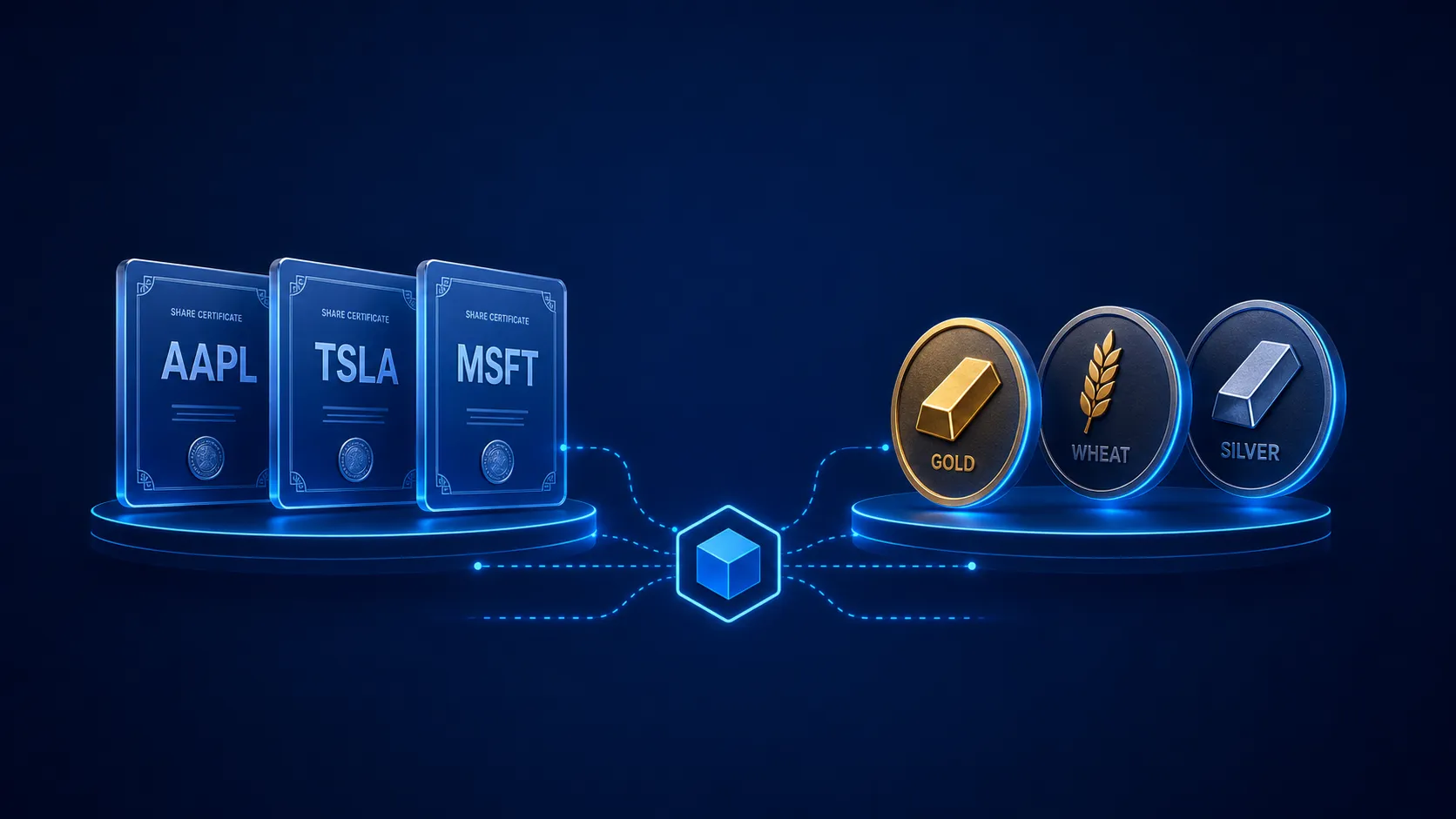
Real-World Asset (RWA) tokenisation is when technology is used to create a digital version of a physical or financial asset, like real estate or stock derivatives, on a blockchain. Instead of relying on traditional centralised databases, this technology records ownership or distribution rights of the asset directly onto a public ledger.
In practice, this shifts trust from traditional financial institutions to smart contracts and shared infrastructure. Smart contracts are self-executing digital agreements that automate processes like dividend adjustments and ownership transfers without requiring human intervention.
Three fundamental features distinguish tokenisation from traditional digitised systems:
Read our beginner’s guide to tokenised stocks
Looking back at RWA tokenisation history, the earliest models began with fiat-backed tokens (stablecoins), which served as the first prominent digital representations of real-world currencies. These early platforms proved that traditional money could live and move on digital networks. They set the stage for how we represent off-chain value on the blockchain today.
Around 2018 and 2019, early projects tried dividing real estate into digital shares. These trials showed that blockchain could record property ownership. However, growth was slow. Different local rules, low trading activity and a lack of standard tech made it hard for these early models to expand.
Between 2023 and 2026, institutional interest grew rapidly. Higher interest rates made people look for stable, on-chain yields. Digital versions of government debt and money market funds became the main drivers. By early 2026, the value of these assets on public blockchains had grown to billions of dollars.
For example, the Cayman Islands updated its laws in March 2026. This new framework made rules much simpler for digital funds, removing extra licensing roadblocks. Thanks to this, nine digital funds were conditionally registered by 29 April 2026.
Similarly, the Monetary Authority of Singapore launched Project Guardian in 2022. Policymakers and over 40 financial firms worked together to test asset tokenisation. They ran over 15 trials across six currencies, checking how digital funds and debt assets perform in real-world scenarios.
The tokenisation ecosystem has grown to include several diverse asset classes.
Traditional public shares can be converted into digital tokens on a blockchain. These tokenised derivatives give eligible holders fractional price exposure of global public companies. They work by mirroring the real stock price, allowing you to get exposure to a tiny fraction of a higher-priced share.
Because the blockchain operates 24/7, these assets are highly accessible outside traditional market hours. Globally, the on-chain distributed market value of tokenised public equities and Exchange-Traded Funds (ETFs) reached over US$1 billion by early April 2026.
Government bonds represent debt issued by a nation's treasury to fund public spending. Tokenising this debt brings more stable, traditional yield-bearing assets directly into the digital ecosystem. Issuers hold the physical bonds in reserve and mint tokens on a 1:1 basis, providing daily redemption options for on-chain holders.
Globally, tokenised government debt has grown rapidly as a lower-risk cash alternative. The tokenised US Treasury market was approximately US$12.98 billion by early April 2026. This growth shows how traditional debt instruments are scaling as liquid, on-chain assets.
Real estate tokenisation splits physical properties, like apartment buildings or commercial offices, into thousands of digital tokens. This allows you to gain exposure to a fraction of a property without buying the entire building. Under this model, rental income is distributed automatically to token holders' wallets using pre-programmed smart contracts.
Traditional real estate is highly illiquid, meaning properties are slow and expensive to buy or sell. Tokenisation addresses this by allowing digital shares to trade globally on secondary markets. While this remains a growing market representing a global size in the low hundreds of millions of dollars, it simplifies property diversification.
Physical commodities like gold, silver and fine art are highly suited for tokenisation. Each token represents direct ownership of a specific physical asset, such as a fraction of a gold bar. The physical reference assets are kept in secure, audited vaults, while the digital tokens trade freely on-chain.
This provides clear proof of ownership and a digital trail of the asset's history. Globally, the tokenised commodity market cap reached approximately US$7.37 billion by early April 2026. Gold-backed tokens represent over 70% of this segment, led by major on-chain gold reserves like Tether Gold and Paxos Gold.
To bring Real-World Assets onto a blockchain, issuers must choose between different tokenisation models. These models act as the bridge, deciding exactly how a digital token connects to its physical counterpart. The two primary options are the custodial-backed model and the synthetic model.
Under this model, a regulated company holds the actual physical asset in a secure vault or trust. It then issues digital tokens on a blockchain, where each token represents a direct, 1:1 claim on that physical asset. If you hold one token, you legally own that specific fraction of the asset.
A critical part of this model is the legal wrapper. Managers use official structures like a legal trust to ensure that your digital token carries the same rights and protections as traditional paper ownership.
The synthetic model doesn’t give you direct ownership of any physical asset. Instead, these tokens act as financial contracts that simply mirror the price of the real asset. They use automated data feeds, called oracles, to track and update the asset's real-time price on-chain.
With a synthetic token, you get exposure to the asset's price movements without needing a vault. This model is highly flexible, but it carries different risks. Because you don’t own the underlying physical asset, you must rely entirely on the issuer's ability to settle the contract.
Explore the top 10 tokenised stocks by market cap
Regardless of the model, bringing an asset on-chain typically follows four steps:
Key operational and financial advantages of RWA tokenisation include:
Find out how to choose a tokenised stocks platform
Converting real-world assets into digital formats can introduce several technical, operational and legal hurdles.
Beyond these operational hurdles, the International Monetary Fund (IMF) warns that instantaneous on-chain transactions carry organisational risks. Removing traditional settlement delays (like T+2 clearing) takes away critical shock absorbers. Without these buffers, central banks have less time to intervene during a market crisis. As a result, automated margin calls and algorithmic feedback loops could trigger panics that spread globally at machine speed.
The Financial Stability Board (FSB) also warns of severe liquidity and maturity mismatches. This occurs when a highly liquid digital token is backed by illiquid underlying assets. If unitholders panic and redeem their tokens rapidly, it can force a fire sale of physical assets, destabilising the broader financial market.
Foris DAX, Inc., and other affiliated Foris companies are separate entities from Foris Capital and do not engage in the securities business. Customer balances and crypto holdings held and transacted at Crypto.com and other entities outside of Foris Capital are not covered by SIPC insurance and are separate from securities transactions and holdings at Foris Capital. For further information about Foris Capital, please visit FINRA BrokerCheck. Clearing Services are offered by Apex Clearing, a member of FINRA, and SIPC.
All investments involve risk, and not all risks are suitable for every investor. The value of securities may fluctuate and as a result, clients may lose more than their original investment. Past performance does not guarantee future results.