Tokenised stocks are changing how market participants interact with the world’s biggest companies. By wrapping regular equity values into digital tokens, traders can get market exposure at any time of day or night. In this guide, we break down the top 10 tokenised stock derivatives by digital market cap and explain how they work.

Tokenised stocks are digital tokens on a blockchain that function as derivatives contracts, mirroring the price movements of traditional company stock. Unlike traditional financial records kept in a private bank database, these tokens live on a public digital ledger. This creates a digital representation of market value that can be moved and verified instantly.
Most tokenised asset models are structured to be backed 1:1 by real shares. So, for every digital token created, an underlying share of that company is typically held by an issuer with a safe, regulated custodian bank. This creates a bridge between traditional stock markets and the digital world.
All of this forms part of a broader trend known as 'real-world asset tokenisation'. By bringing price exposure to real assets like property or stocks onto digital platforms, market settlement and portfolio tracking become significantly more streamlined.
Tokenised stocks work by using shared digital ledgers (blockchains) and smart contracts. These contracts are self-running programs that allow a digital asset to act on its own. For example, they can automatically handle complex, administrative tasks like managing collateral or dividend adjustments without needing a person to do the work manually.
Most tokenised stocks use an ‘indirect’ structural model. This means the digital tokens are linked to underlying shares held through a specialised intermediary arrangement. While the original underlying equity remains secured in the traditional stock market, the tokens move around the blockchain to make trading more efficient.
Transactions involving these digital contracts usually involve stablecoins like USDC. Stablecoins act as a digital version of cash for these trades, enabling the instant exchange of value when tokens are minted or cashed in.
Unlike traditional shares, tokenised stocks settle almost instantly on blockchain rails. This allows holders to move value across different decentralised platforms without waiting for conventional, multi-day banking cycles. By tokenising these assets, the system removes many of the barriers and costs associated with traditional trading. In some cases, smart contracts automatically reinvest dividend values back into your token balance.
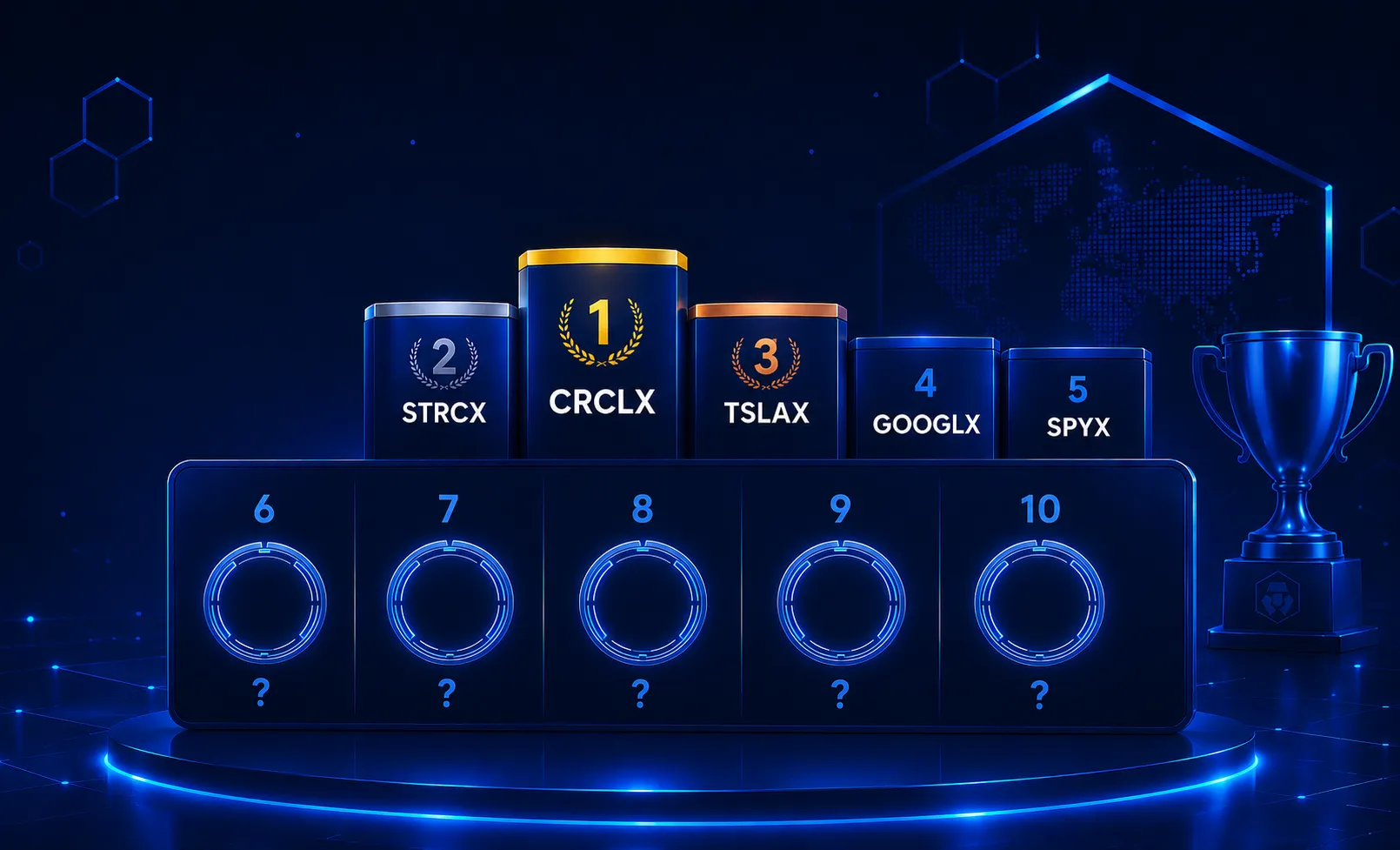
The following list shows the top blockchain-wrapped equity-tracking products based on their total digital market value, as at 8 May 2026. Note that market capitalisation is dynamic and changes frequently based on underlying share price movements and token supply.
Circle is the co-creator of the USDC stablecoin, acting as a vital bridge between traditional banking and digital finance. CRCLX gives investors blockchain-native exposure to a company central to the global payment network. As a leading digital asset, the tokenised version reflects Circle's role in scaling digital dollar adoption.
This asset acts as a proxy for Bitcoin exposure in traditional markets, making its tokenised contract highly attractive to blockchain-native investors. STRCX tracks a unique combination of enterprise software growth and significant digital asset holdings. The tokenised form is often used as a preferred equity instrument, drawing interest from institutional participants.
As a productive digital asset, it’s frequently integrated into decentralised finance protocols. This enables holders to use their tokens as collateral for lending or to generate yield. By putting this Bitcoin-heavy treasury on-chain, investors gain a versatile tool for advanced portfolio management.
Tesla is popular among traders due to the stock’s intrinsic volatility and its status as a globally resonant tech brand. The tokenised version, TSLAX, provides around-the-clock exposure to progress in electric vehicles and autonomous software. This 24/7 accessibility is a major advantage, as traditional markets close on weekends.
Through tokenisation, traders can get price exposure to small portions of these high-value shares. This democratises access, allowing more people to trade Tesla price movements. The tokens are backed by real shares, ensuring they accurately track the economic performance of the underlying car company.
Alphabet, the parent company of Google, offers a stable blue-chip tech option with deep exposure to cloud computing and artificial intelligence. GOOGLX tracks Alphabet Class A shares and operates on multiple high-speed blockchains. This ensures that the asset is highly mobile and can be transferred between digital wallets with ease.
The tokenised version is valued for its strong fundamentals and its role in the growing AI economy. Because it is backed by real shares held by regulated custodians, it mirrors the stock price while offering the benefits of blockchain technology. This includes faster settlement times and reduced reliance on traditional brokerage accounts.
Tokenised SPY tracks the S&P 500 index, a collection of the largest companies in the United States. As one of the pioneering tokenised products, SPYX has established itself as a leader in on-chain liquidity. It allows global investors to gain broad exposure to the American economy without needing a traditional brokerage account.
AMD holds a strong position in the semiconductor and AI processor market, making it popular among tech-focused blockchain traders. Its tokenised representation, AMDX, provides exposure to the rising demand for AI accelerator products. This enables investors to trade and track one of the leaders of the semiconductor industry directly from their digital wallets.
NVIDIA dominates the AI hardware sector, supplying the essential GPUs used to train large language models. NVDAX enables global investors to trade price exposure to this semiconductor leader on-chain. This is particularly useful for small-scale investors who want to access high-priced shares that might otherwise be out of reach in traditional markets.
Marvell Technology is a leading semiconductor firm focused on data infrastructure, including solutions for data centres and automotive networks. MRVLX, its tokenised form, gives investors a more seamless opportunity to follow the growth of solutions that enable data movement and security across global networks.
Tokenised Coinbase often appeals to crypto-focused investors who want equity exposure to the infrastructure builders of the digital economy. Coinbase has been central to the shift toward institutional prime services and stablecoin infrastructure.
Holding COINX provides indirect exposure to the exchange’s performance. The asset is popular among participants who want to hedge their crypto holdings with equity exposure in a regulated platform. By living on the blockchain, these tokens offer the same transparency and ease of transfer as the cryptocurrencies themselves.
VTX tracks a massive collection of stocks from both developed and emerging markets worldwide. Its tokenised version provides global investors with a simple way to achieve diversified portfolio exposure.
The tokenised form of the VTX ETF is designed to mirror the economic performance of the underlying fund. This includes the automation of corporate actions through smart contracts, ensuring that distributions are handled efficiently.
While this new system is efficient, it also brings new risks. Because everything is automated, flash crashes could happen where prices drop very quickly. The International Monetary Fund (IMF) warns that problems could spread faster in these systems, leaving regulators with less time to step in.
There is also a risk that the token price won't perfectly match the real stock price. This can happen if there aren't enough people trading on the blockchain. Also, if the entire market relies on one single digital ledger, any technical failure there could affect everyone at once.
Investors might also get confused about their rights. Some tokenised stocks follow the price but don't actually give you the right to vote in company meetings, because they’re derivative contracts.
Foris DAX, Inc., and other affiliated Foris companies are separate entities from Foris Capital and do not engage in the securities business. Customer balances and crypto holdings held and transacted at Crypto.com and other entities outside of Foris Capital are not covered by SIPC insurance and are separate from securities transactions and holdings at Foris Capital. For further information about Foris Capital, please visit FINRA BrokerCheck. Clearing Services are offered by Apex Clearing, a member of FINRA, and SIPC.
All investments involve risk, and not all risks are suitable for every investor. The value of securities may fluctuate and as a result, clients may lose more than their original investment. Past performance does not guarantee future results.