The global financial system in 2026 is experiencing a structural shift as traditional assets transition to blockchain networks. This migration is changing how capital is distributed, making stock markets around the world more accessible to global buyers. Find out how tokenised stocks have emerged as a leading trend in blockchain adoption.

Important information: This is informational content sponsored by Crypto.com and should not be considered as investment advice.
Tokenised stocks are blockchain-based derivative contracts or tracking assets that track the market price of real-world, publicly listed shares. They allow global buyers to gain price exposure to the underlying stocks.
These digital representations operate through distinct structural frameworks, and market participants should evaluate the origin, mechanism and future outlook of these assets before trading them.
Tokenised assets may provide 24/7 trading access and can lower barrier entries through fractional exposure. These benefits, however, remain conditional on platform liquidity and localised regulations.
There are two tokenisation models, which determine how you get price exposure to the tokenised stocks and how you receive benefits such as dividend equivalents.
Under the issuer-sponsored framework, the issuing public company directly participates in the digital representation. Two core models exist for recording these assets:
Think of yourself as having a diary with multiple entries. In this metaphor, your diary is the ledger and the entries are the records of who owns the shares.
You decide to transfer the entries into a digital format. With the integration method, the digital blockchain is the only official ‘diary’. With the notification method, the paper diary is still the official master record, and the digital token acts like a messenger telling you to update the paper version.
In contrast, third-party models operate without the direct backing or consent of the underlying public company. These structures carry distinct legal frameworks and counterparty risks.
There are two models within this category, which are:
Regulations vary by location, with tokenised derivatives being legal in some regions and illegal in others. Here are a few examples.
The European Securities and Markets Authority (ESMA) implemented guidelines on qualifying crypto-assets as financial instruments on 18 May 2025. These rules apply a technology-neutral approach under the Markets in Crypto-Assets Regulation (MiCA).
The use of distributed ledger technology (DLT) doesn’t exempt an asset from existing rules if it behaves like a traditional security. To qualify as transferable assets under MiFID II, tokens must cumulatively grant the same economic rights, be negotiable on capital markets and be fungible.
In the US, regulatory policy shifted toward structured market integration in early 2026. The SEC, led by Chair Paul Atkins, proposed a temporary ‘innovation exemption’ framework. This aims to allow select platforms to trade tokenised stocks under a lighter compliance model.
Additionally, the SEC approved rule changes for Nasdaq in March 2026 and the NYSE in April 2026. These approvals support trading tokenised equities within standard clearing infrastructure via the Depository Trust Company (DTC) pilot.
In Singapore, the Monetary Authority of Singapore (MAS) regulates tokenised real-world assets (RWAs) under the Securities and Futures Act (SFA). Under this framework, security tokens representing equity, debt or investment units are treated as capital markets products. In November 2025, MAS's Project Guardian co-published an operational guide detailing fund tokenisation governance and settlement finality.
In Hong Kong, the Securities and Futures Commission (SFC) launched a regulatory framework on 20 April 2026 to pilot 24/7 secondary trading of tokenised SFC-authorised investment products. This framework permits retail investors to trade tokenised open-ended money market funds on licensed virtual asset trading platforms (VATPs). Transactions settle around-the-clock using regulated stablecoins or tokenised deposits.
Trading tokenised assets carries risks, such as price volatility and market risks. Past performance may not indicate future results.
The global market for tokenised stocks was valued at close to US$16 million in March 2025. Comparing these platforms side-by-side helps clarify the structural differences and helps global buyers navigate regional availability, fee structures and product ranges.
Crypto.com is a digital asset platform trusted by over 150 million users globally. It provides an ecosystem to trade Bitcoin, Ethereum and over 400 other digital assets. We use institutional-grade security protocols and eligible users can also access zero-fee* deposits to fund their accounts.
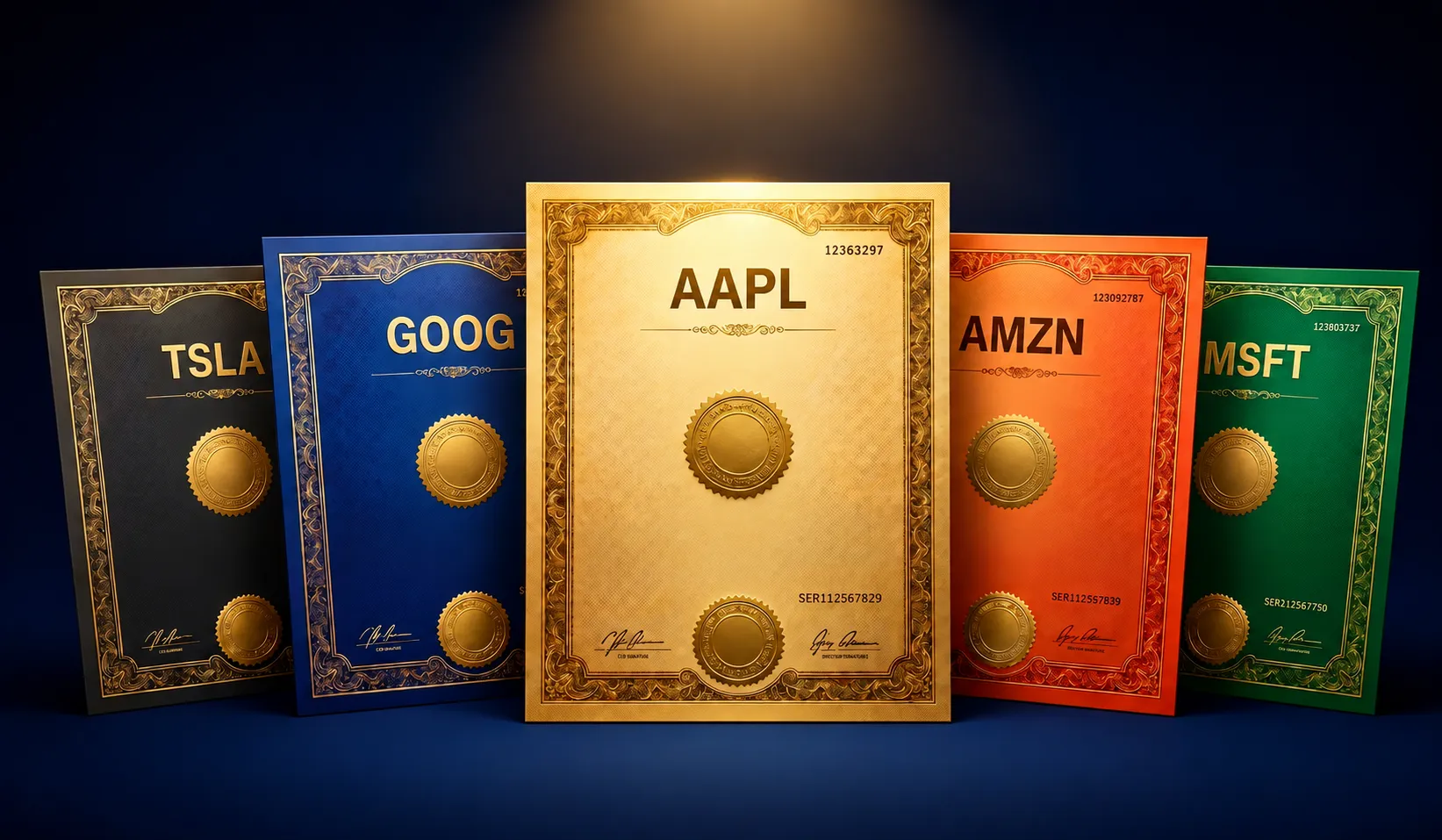
We offer 1,500+ tokenised assets, including 20 of the most popular tokenised US stocks, such as TSLA, NVDA, AAPL and AMZN, as well as ETFs, tracking positions 100% backed by real shares.
You can also earn up to 4% per annum in extra yield on popular stock tokens by staking your tokens, and have your dividends paid directly into your wallet. There's no minimum lock-up period – and you could even get returns on non-dividend stocks.
Robinhood introduced tokenised stock derivatives to the EU and EEA markets on 30 June 2025. The catalog expanded from 100 US equities and ETFs to over 1,000 available assets by the end of 2025.
These instruments are structured as derivative contracts under MiFID II. They don’t represent legal share ownership or carry counterparty risk – and they exclude voting rights.
The physical equities backing the derivative tokens are held by a licensed custodian in the US. They’re geofenced and remain strictly unavailable to residents of the UK and US.
Trading Robinhood Stock Tokens is commission-free. However, order executions are subject to a flat 0.1% foreign exchange fee when converting between euros and US dollars.
The platform passes through dividend equivalents as off-chain cash credits rather than on-chain token rebases.
Kraken launched its xStocks in June 2025 through a partnership with Backed Assets (JE) Limited. These tokens represent fractional US shares backed 1:1 by physical shares.
Rather than cash payouts, xStocks dividends are automatically reinvested on-chain. Balance values are updated via a rebasing multiplier, subject to a 30% US withholding tax.
Eligible international users can earn up to 1% annual rewards on their holdings by opting into Kraken's rewards programme, paid weekly in the same xStock asset.
xStocks are geofenced and are unavailable to residents of the US, UK, Canada and Australia.
Coinbase is expanding its presence in the real-world asset (RWA) space by using its Base Layer-2 network. The platform offers global buyers access to digital representations of traditional assets under strict non-US compliance frameworks.
Base acts as the settlement layer, while the Aerodrome decentralised protocol can serve as an automated market maker (AMM) liquidity option. This structure enables tokenised stocks to function as native on-chain collateral, supporting decentralised lending and margin utility.
Bitget Wallet integrated xStocks infrastructure in May 2026, offering over 130 tokenised equities to its 90 million users. The platform expands its total real-world asset (RWA) shelf to over 300 products.
This integration supports both Request-for-Quote (RFQ) and AMM liquidity models. This setup allows for gasless execution and zero fees while preserving self-custody.
Bybit partnered with Backed to list xStocks on its centralised spot trading market. The platform offers 24/7 trading of major equities like Apple (AAPLX) and Tesla (TSLAX), backed 1:1 by physical shares.
The platform also caps individual holding limits to prevent excessive concentration. Users are restricted to a maximum holding value of 300,000 USDT equivalent per token.
Bybit geofences its tokenised stocks, excluding institutional users, market makers and residents of Japan, Australia and the EEA.
BitMart is a global digital asset exchange that lists emerging RWA tokens for Web3-native demographics. The platform collaborates on industry research, tracking the growth of on-chain assets.
Its research publications highlight operational hurdles, such as custody gaps and liquidity fragmentation. The exchange advocates for standardised infrastructure to bridge traditional capital and decentralised networks.
Bitpanda operates a retail brokerage in Europe and provides business-to-business infrastructure to institutional partners. In March 2026, the company introduced Vision Chain, an Ethereum Layer 2 network that uses the Optimism stack.
Vision Chain offers a standardised, compliant environment for banks to issue and manage tokenised stocks and bonds. The network aligns with MiCAR, MiFID II and DORA requirements, using regulated euro stablecoins for transaction fees.
InvestaX provides licensed tokenisation and digital asset services within major Asian hubs. The platform focuses on the regulatory issuance, lifecycle management and secondary trading of tokenised equities.
By establishing compliant corporate rails, the platform supports asset managers migrating private equity onto public networks. This structure lowers administrative costs and shortens settlement timelines.
Platform | Asset-backing structure | Geographic availability | Dividend distribution |
Crypto.com | 1:1 physically backed | EEA, Saudi Arabia, Philippines and more | Cash payout |
Robinhood | Derivative contracts | EU/EEA (Excludes US/UK) | Cash equivalent credit |
Kraken | 1:1 physically backed | Excludes US/UK/CA/AU | Rebasing multiplier |
Coinbase | Native on-chain collateral | Excludes US | DeFi yield dependent |
Bitget Wallet | 1:1 physically backed | Excludes US/UK | Pass-through |
Bybit | 1:1 physically backed | Excludes US/JA/AU/EEA | Reinvested |
BitMart | RWA/equity representation | Global (180+ countries) | Issuer dependent |
Bitpanda | Vision chain tokens | European focus | Issuer dependent |
InvestaX | Security tokens | Asian hubs | Issuer dependent |
Foris DAX, Inc., and other affiliated Foris companies are separate entities from Foris Capital and do not engage in the securities business. Customer balances and crypto holdings held and transacted at Crypto.com and other entities outside of Foris Capital are not covered by SIPC insurance and are separate from securities transactions and holdings at Foris Capital. For further information about Foris Capital, please visit FINRA BrokerCheck. Clearing Services are offered by Apex Clearing, a member of FINRA, and SIPC.
All investments involve risk, and not all risks are suitable for every investor. The value of securities may fluctuate and as a result, clients may lose more than their original investment. Past performance does not guarantee future results.