'Tokenised stocks' are digital representations of equities on a blockchain, whereas traditional stocks rely on brokerages. This structural shift underpins how modern market participants interact with, trade and track financial assets. Let’s look at the differences between tokenised and traditional stocks in detail.

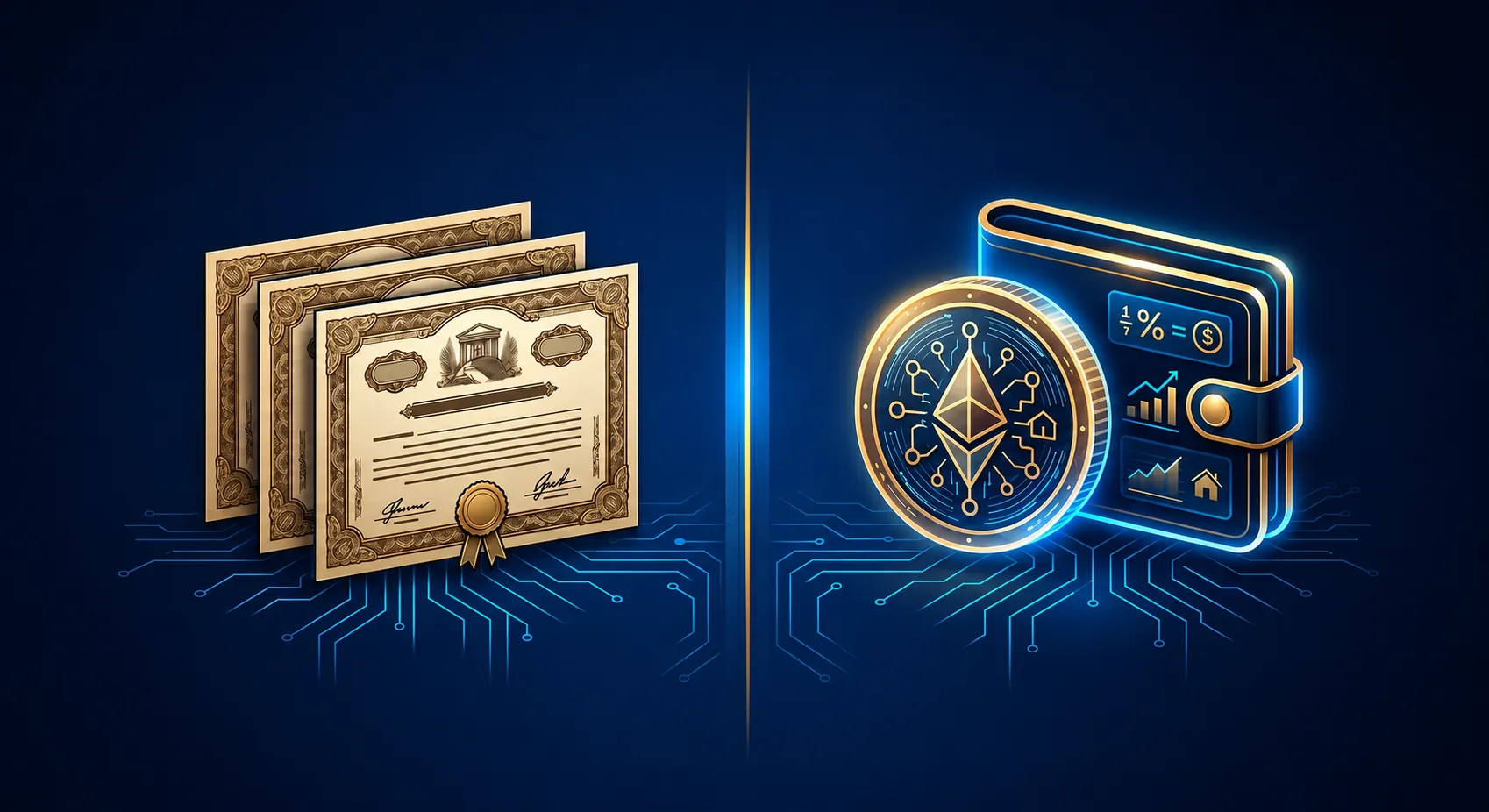
Tokenised stocks are digital certificates on a blockchain that function as derivatives contracts to track real company shares. Normally, they work on a 1:1 basis, meaning one digital token represents exactly one regular share. To make this work, a regulated partner holds the actual physical shares in a secure vault. A digital platform then creates a matching token on a blockchain that mirrors the stock's real-world price and potential benefits.
In some cases, the digital contract tracking the shares can be created directly on the blockchain without any traditional paperwork. While this direct digital-only method is still in its infancy, it shows how future financial markets are likely to evolve.
Read our comprehensive guide on tokenised stocks and how they work
Traditional and tokenised stocks both let you track a company’s performance, but they run on completely different technology. Traditional stocks use old-school, private databases, while tokenised alternatives run on highly efficient shared blockchain networks.
Normally, traditional shares are recorded in central, offline lists kept by transfer agents. To bring price exposure to these shares onto a blockchain, financial platforms place them into special legal structures. This protects the owner's legal rights while letting the digital version trade securely on a public ledger.
Traditional stock markets only open during set daytime hours on weekdays and trades take time to complete. Blockchain networks, however, run constantly. This allows 24/7 trading without waiting for a market to open.
Tokenised stock transactions settle almost instantly using an automated process where cash and tokens swap simultaneously, called ‘atomic settlement’. This setup removes the risk of one party backing out and frees up funds immediately.
High share prices can prevent many buyers from participating in the stock market. While some traditional brokers let you buy fractions of a share, they manage this on their own private databases.
In contrast, blockchain equities support fractional exposure by design. Since digital tokens are highly divisible, they can easily be split into tiny decimals on the blockchain (‘on-chain’). This allows you to buy exact cash amounts of higher-priced shares and move them freely across compatible digital systems.
Buying traditional shares involves a long list of middlemen, including brokers, clearinghouses and central depositories, to update registries and verify trades. This complex structure makes the system slower and requires heavy manual work to ensure everyone's records match.
Tokenisation replaces much of this back-office work with automated smart contracts. These self-executing digital agreements process transactions automatically, which increases transparency. It also creates a clear, permanent and public audit trail directly on the blockchain.
Learn how to invest in tokenised stocks
Traditional stocks | Tokenised stocks | |
Trading hours | Fixed exchange schedules | Continuous 24/7 trading |
Settlement cycle | Standard T+1 or T+2 cycle | Near-instant T+0 atomic |
Asset custody | Centralised depositories | Key-based digital wallets |
Intermediaries | Multiple brokers and clearinghouses | Automated smart contracts |
Understanding why people trade tokenised stocks comes down to two main things: Speed and global reach. Replacing slow paperwork with automated, self-executing software code removes major delays.
One of the biggest benefits of tokenised stocks is that they could make trading cheaper by narrowing the gap between buying and selling prices (known as the market spread). For example, a study by the Hong Kong Monetary Authority showed that tokenisation cut these spreads by 5.3% for large institutional trades. For everyday traders, this saving doubled to 10.8%. This means less money is lost to transaction costs.
Another key reason why people seek exposure to tokenised stocks is how easily they fit into the broader blockchain ecosystem. Because these digital assets are built on open networks, they can connect directly with Decentralised Finance (DeFi) applications.
Finally, shared ledgers make global trading much simpler. Traditional trading usually requires slow brokerage setups and expensive currency exchanges. Blockchain platforms bypass these barriers. This allows people in different countries to trade digital assets directly with each other, with fewer administrative delays.
Find out where and how to buy tokenised stocks
While blockchain trading can offer certain benefits, it carries distinct risks. A major concern is that regulations vary widely across different countries.
How tokenised assets are held also affects your ownership rights. Many tokens issued by third parties only track share price performance without giving you true ownership. In these cases, you might miss out on shareholder voting rights, dividend distributions and more.
Managing your own digital wallet also introduces cyber risks. If you lose your private keys, you face the risk of losing access to your assets permanently. On-chain systems don’t have customer support helplines to reset passwords, shifting the full safekeeping responsibility onto you.
Lastly, smart contracts are still software programmes – they can contain hidden bugs or be targeted by hackers. While using audited, open-source standards helps limit these dangers, it doesn’t completely eliminate code-level operational risks.
Foris DAX, Inc., and other affiliated Foris companies are separate entities from Foris Capital and do not engage in the securities business. Customer balances and crypto holdings held and transacted at Crypto.com and other entities outside of Foris Capital are not covered by SIPC insurance and are separate from securities transactions and holdings at Foris Capital. For further information about Foris Capital, please visit FINRA BrokerCheck. Clearing Services are offered by Apex Clearing, a member of FINRA, and SIPC.
All investments involve risk, and not all risks are suitable for every investor. The value of securities may fluctuate and as a result, clients may lose more than their original investment. Past performance does not guarantee future results.