Compare the core differences between XRP and Solana in this guide, including speed, fees, technology and real-world usages.

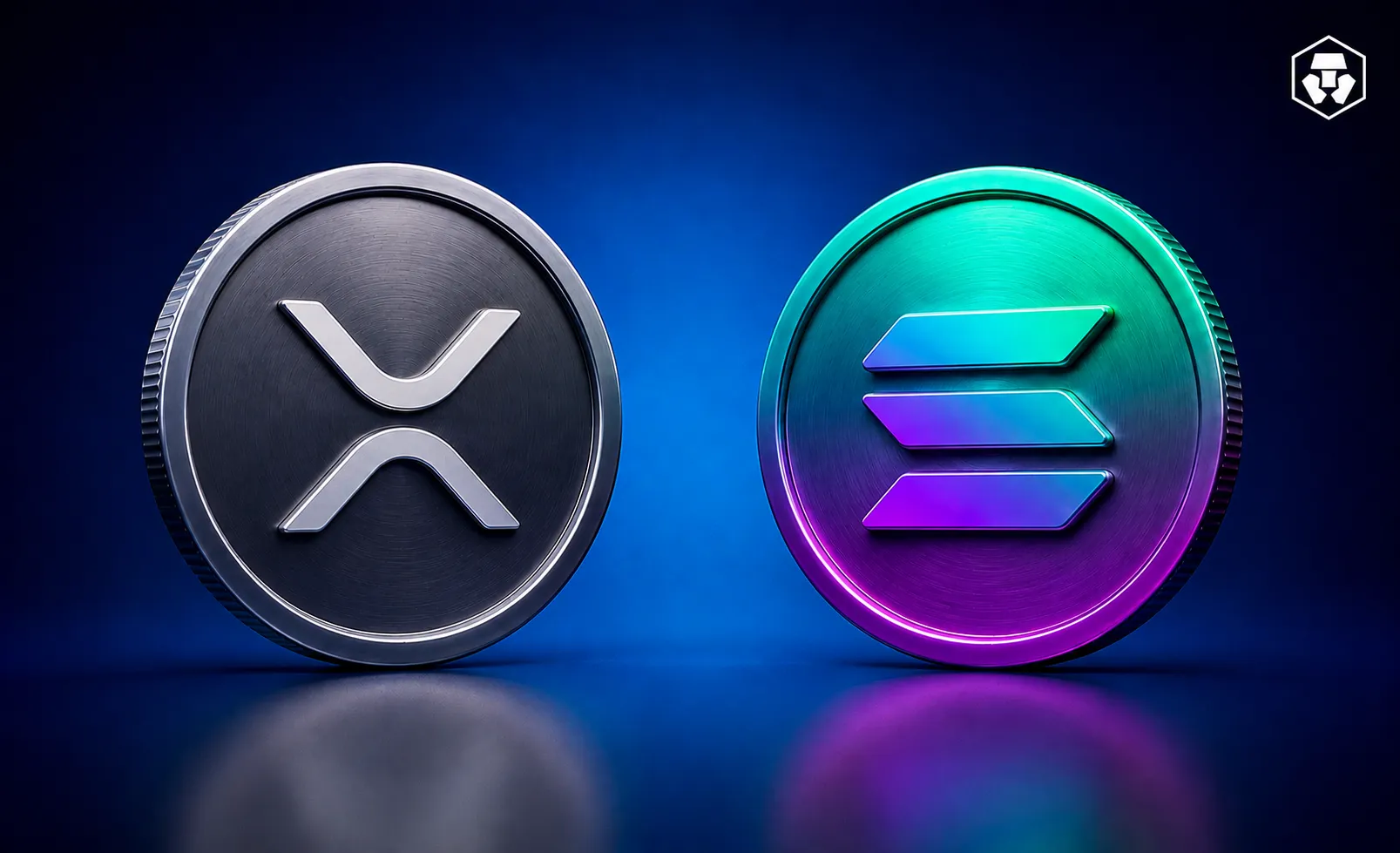
XRP against Solana is one of the more interesting match-ups in crypto, since both networks were built for speed but targeted at almost opposite audiences.
XRP is the native token of the XRP Ledger (XRPL), a blockchain built around cross-border payments and institutional settlement.
Solana, on the other hand, is a general-purpose network built to power decentralised applications (dapps), NFTs and DeFi at consumer scale.
The difference between XRP and Solana (sometimes searched as ‘solana vs xrp’ or ‘ripple vs solana’) comes down to specialisation: one is a payments rail, the other is a developer's playground.
The XRPL relies on the Ripple Protocol Consensus Algorithm (RPCA), where a curated list of trusted validators, known as a unique node list (UNL), agrees on transaction validity. Once roughly eighty percent of these validators sign off, the transaction is added to the ledger without mining.
Ripple, the company behind much of the XRPL's early development, doesn't own the network outright. Ripple and the XRPL Foundation both publish similar default UNLs that most validators tend to follow, which keeps consensus fast, though it does mean validator selection is more centralised than on fully permissionless networks.
XRP has a hard cap of 100 billion tokens, set at launch. Ripple holds a large portion in escrow and releases it monthly, returning unused amounts to escrow to keep supply predictable. Every XRPL transaction also burns a small fee, gradually chipping away at total supply.
That fee-burning mechanic creates a deflationary pull that sits in direct contrast to Solana's inflation model.
The XRPL has grown well past payments alone. Institutional features live on mainnet, including Permissioned Domains for credentialed access, Multi-Purpose Tokens (MPTs) for representing bonds and structured products and a lending protocol built for institutional credit. The RLUSD stablecoin also settles natively on XRPL, with XRP as the bridge asset.
Solana is a Layer-1 blockchain built to scale without leaning on Layer-2 networks. Its signature innovation is Proof-of-History (PoH), a way of cryptographically timestamping transactions before they even reach consensus, so validators don't need constant back-and-forth to agree on transaction order.
PoH works alongside a Proof-of-Stake (PoS) mechanism, where SOL holders can delegate tokens to validators to help secure the network. In return, delegators may earn rewards, and validators that misbehave can be penalised. Together, this is what lets Solana process transactions in parallel instead of one at a time.
Unlike XRP, SOL has no maximum supply. Instead, it follows a disinflationary emissions schedule: the inflation rate first started at around eight percent annually and is designed to taper off toward a long-term target near 1.5%. New SOL enters circulation mainly through validator and delegator rewards.
Solana's ecosystem has grown well beyond simple transfers; it supports thousands of dapps, an active DeFi sector, NFT marketplaces and consumer tools like Solana Pay.
A major 2026 development is Alpenglow, a consensus upgrade targetting a cut in transaction finality from roughly thirteen seconds down to as little as 150 milliseconds.
Both networks crossed a major threshold in 2025: regulated ETF access. Solana got there first, with US spot ETFs going live in October 2025, several offering built-in lock-up rewards passed through to shareholders.
XRP followed in March 2026, when the SEC approved several spot XRP ETFs after years of regulatory back-and-forth involving Ripple.
For everyday investors, it opens up exposure to both tokens through a standard brokerage account, without needing a crypto exchange or a wallet. It's also a signal, of sorts: regulators treating both assets as mature enough for mainstream investment products, even if their underlying use cases remain worlds apart.
Curious how these two are trading right now? You can track xrp and solana prices directly through the Crypto.com App, alongside hundreds of other digital assets. |
Both networks are built for high throughput, but they get there differently. XRP is reported to handle up to roughly 1,500 transactions per second (TPS), with settlement finality in three to five seconds.
Solana's real-world throughput is reported at up to several thousand TPS, with a far higher theoretical ceiling.
Metric | XRP Ledger | Solana |
|---|---|---|
Consensus mechanism | RPCA (curated validator agreement) | Proof-of-History + Proof-of-Stake |
Native token | XRP | SOL |
Max supply | 100 billion (fixed) | No max supply (disinflationary) |
Transaction time | 3 to 5 seconds | Under 1 second, reported |
Network fee | Fraction of a cent | Fraction of a cent |
This is where the TPS comparisons get interesting. Solana's real-world numbers have historically swung with network load and the network has seen past outages during periods of extreme demand.
Alpenglow (rolling out through 2026) seeks to shore up both finality speed and resilience.
XRP's throughput has stayed comparatively steady over time, since RPCA isn't competing for block space the way a busy dapp ecosystem does. That trade-off says a lot about each network's priorities: XRP is built for predictable settlement, Solana for raw ecosystem scale.
XRP's main job is facilitating fast, low-cost cross-border payments and liquidity for financial institutions, payment providers, and exchanges. The rise of RLUSD and ongoing institutional DeFi development have extended XRP's role as a bridge asset connecting stablecoins, FX pairs and tokenised real-world assets on XRPL.
Solana, meanwhile, powers a broad consumer and developer ecosystem. It hosts NFT marketplaces, decentralised exchanges, gaming platforms and mobile-first Web3 applications. Its low fees and quick confirmations make it a natural fit for high-frequency use cases like trading and in-app payments through Solana Pay.
Neither network is inherently ‘better’ here. They're built for different jobs. XRP may suit institutions and payment corridors that value settlement certainty, while Solana may suit developers and users chasing a fast, flexible platform for building and using applications.
Now that all the comparisons have made it easier to decide which one fits your needs, whether that's payments, dapps or diversifying a portfolio, here's how to get started:
Is XRP faster than Solana?
Not necessarily. XRP settles transactions in three to five seconds, while Solana's confirmation times are reported at under one second under normal network conditions. ‘Faster’ depends heavily on network load, since both figures can shift.
What are the transaction fees on Solana vs. Ripple?
Both networks are known for low fees, usually a fraction of a cent per transaction. Solana's median fee tends to run slightly lower than XRP's, though both stay inexpensive compared to many other blockchains.
Can I use XRP for decentralised applications?
XRPL supports some smart contract functionality through sidechains and newer features like MPTs and a lending protocol, but it isn't built as a general-purpose dapp platform the way Solana is.
Does Solana have a limited supply like XRP?
No. XRP has a fixed maximum supply of 100 billion tokens. SOL has no maximum supply, though its inflation rate is designed to decrease over time and settle at a low, ongoing rate.
How do the rewards for locking up tokens differ between these chains?
Solana lets SOL holders delegate tokens to validators and potentially earn rewards for helping secure the network. XRP has no equivalent lock-up rewards system, since RPCA doesn't rely on delegated tokens to reach consensus.
Important information:
This article is for informational purposes only and should not be construed as financial or investment advice. Trading cryptocurrencies involves risks, including price volatility and market risk. Past performance may not indicate future results. There is no assurance of future profitability. Before deciding to trade cryptocurrencies, consider your risk tolerance.
Services, features, and other benefits referenced in this article may be subject to eligibility requirements and may not be available in all markets. They may also be subject to change at the discretion of Crypto.com.