





Don’t invest unless you’re prepared to lose all the money you invest. This is a high-risk investment and you should not expect to be protected if something goes wrong. Take 2 mins to learn more.
Don’t invest unless you’re prepared to lose all the money you invest. This is a high-risk investment and you should not expect to be protected if something goes wrong. Take 2 mins to learn more.
What's inside the pack? With online card ripping, you can find out without opening a physical pack yourself. Discover how digital card openings work, when real trading cards are involved, and what happens after the reveal.

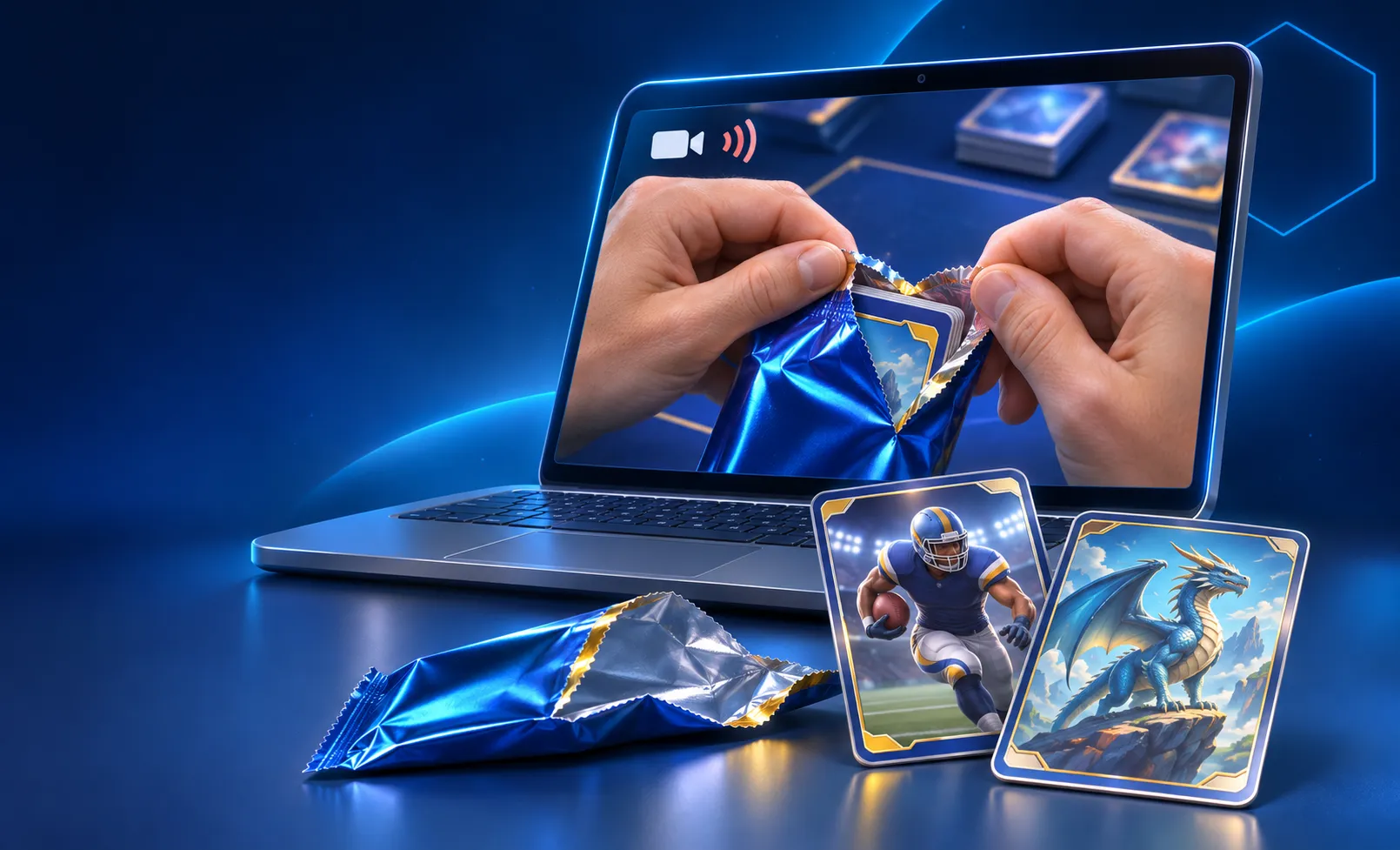
Card ripping is the process of opening a sealed pack of trading cards, whether you're doing it yourself or watching someone open it for you. This is a popular hobby among collectors of sports cards like NFL and NBA or card games like Pokémon.
The excitement comes from not knowing what you’re going to find inside. It can be anything from common cards to rare or limited-edition collectibles.
Another popular format is ‘box breaking’ (or simply ‘breaking’). Instead of buying an entire box of cards, you pay for a share of it, someone opens the packs and then they distribute the cards according to the break's rules.
Online card ripping takes this collecting experience into the digital world. Some platforms let you watch physical packs being opened on a livestream, while others offer an interactive digital card pack opening experience.
What to look for in a card ripping app
In online card ripping, the cards revealed are either virtual cards or actual, physical collectibles. You can use digital card packs for things like games and online collections. With real cards, you normally have two options: have them delivered to you or keep them in the platform’s storage vault.
What you’re opening and how you store or receive them depends on the platform. Make sure you understand exactly what you’re buying.
A digital card pack simulator recreates the experience of opening trading cards on a screen. For example, you might see a pack-opening animation followed by a selection of virtual cards. These won’t have corresponding physical cards.
A live card break involves a host opening real packs or boxes on camera. The ripping happens in a scheduled broadcast and the whole point is that it happens in real time. There are rules that determine your participation and which cards you get from the box.
Some online platforms offer more of a ‘hybrid’ approach, where you open digital packs but they’re linked to physical trading cards already held in inventory. So, instead of opening a sealed foil pack on camera, you’d initiate a reveal through an app or website. The system then assigns physical cards based on a set of allocation rules.
The revealed cards are usually already authenticated, graded and stored in a vault. Depending on the service you’re using, you could request delivery of the physical cards, keep them in storage or even exchange them for platform-specific credit.
You might also come across ‘tokenised’ trading cards, where a blockchain token represents certain rights to a physical collectible. Before you buy a token, it's worth checking whether it gives you ownership of the actual card, though.
Card collectibles have taken off as hobbyists and first-timers alike amass their collections or flip it for gains.
Try your hand at the Rips experience and get your first 5 packs free of charge. Find out more details. Explore Crypto.com Rips
*Availability may vary by jurisdiction.
Digital simulator | Live card breaks | Physical-backed digital ripping | |
Underlying item | Virtual card or game item | Physical cards from sealed packs | Physical cards allocated from an inventory |
Opening experience | Digital animation | Livestream of a physical opening | Interactive digital reveal |
Timing | On demand | Scheduled | On demand |
Verification | Based on game or platform rules | Video footage and break records | Inventory records and allocation controls |
What you receive | Digital item | Allocated physical cards | Rights to an allocated physical card, subject to the platform’s terms |
Delivery options | Digital only | Physical shipping | May include shipping, vaulting or exchanging for platform credits |
Here’s how physically backed online card opening works. Every platform will have a different interface.
Start by browsing available card packs or collections on the website. Some organise their offerings by price or card rarity, while others might display possible cards and their respective probabilities. Check if the card pool and chances of receiving a specific card are disclosed before you decide.
Tip: Make sure that the service ships to your location.
Once you've chosen a pack, the next step is payment. This could be by way of credit card, debit card, account balances/platform credits or supported cryptocurrencies. Again, this depends on the platform.
Before paying, confirm the final price and any additional fees, especially if the service uses its own credits or tokens. Also confirm if credits can be withdrawn or refunded: a platform balance isn't necessarily equivalent to cash.
This is where the actual ripping happens. On an on-demand platform, you might select an ‘Open pack’ button, for example, and watch an animation reveal the card. In a live break, you watch a host open physical packs and identify which cards belong to each participant.
With digital card ripping, the result is determined by the platform's specific allocation system. Some use random number generators (RNGs), while others may have additional verification steps before allocating cards.
After the reveal, the platform often records the allocated card in your digital inventory. This might include:
Once the card appears in your collection, check what you can do with it. Look at any fees, withdrawal restrictions and processing times before making a decision. You don't necessarily have to decide straight away, but some platforms may have deadlines or storage conditions to consider.
Most platforms offer the following options.
If you request delivery, the provider will retrieve your card from storage, package it and arrange shipping to your address. In some cases, there could be a minimum withdrawal requirement (e.g., you need a minimum number of cards before you can request delivery).
Professionally graded cards normally arrive in protective plastic holders called slabs. Ungraded cards might not come in slabs, but will also be packaged to help prevent damage in transit.
‘Vaulting’ means leaving the physical cards with a storage provider. Some collectors use this option to avoid handling valuable or delicate cards. It could also make future transfers easier if the platform supports card trading. Just be sure to check whether storage fees apply if you go with this option.
Vault custody comes with its own pros and cons. You’re not only relying on the provider to protect your cards, but to return them to you at some point and keep accurate records.
Some vaults carry insurance, but coverage varies and insurance doesn't eliminate every potential risk associated with storage or custody.
Some platforms offer to buy back certain cards after they're revealed, either for cash or platform-specific credit.
The offer may be lower than the card's estimated resale value, depending on the provider's pricing model and the costs associated with reselling it. The value displayed for a card isn't necessarily what you'll get.
Card ripping on the internet requires more trust in the provider because the allocation process and physical inventory may be outside your direct control. Here are a few things that could help you evaluate a platform’s claims:
Some platforms publish the possible cards in a pack and the chances of receiving each one. These probabilities are called ‘drop rates’.
For example, if a pack has a 5% chance of containing a rare card, you'd have a five-in-100 chance of getting one each time you open a pack. But opening 20 packs doesn't mean you'll get a rare card; each opening has the same 5% chance, assuming the odds don't change.
Published odds can be helpful, but there's no assurance the platform follows them. Always choose a reputable platform that explains how its odds are calculated and how the results can be verified.
Some physical-backed platforms hold cards that’ve already been examined by third-party grading companies. These can include Professional Sports Authenticator (PSA), Beckett Grading Services (BGS) or Certified Guaranty Company (CGC).
These grading services assess cards under their own standards. Authenticated, encapsulated cards receive protective holders and identifying information that you can use to verify your card’s details.
Note: A certification number alone doesn't mean a card is genuine. It’s still worth checking the physical card itself and making sure the platform has reliable records of where it's stored.
Some platforms use random number generators to decide which cards you get. Blockchain-based platforms may take this a step further with something called a verifiable random function (VRF). This lets others check that the random result was generated correctly, making it harder for the platform to manipulate the selection.
Some platforms link physical trading cards to blockchain tokens. This is called real-world asset (RWA) tokenisation, where a digital token represents certain rights to a physical item. For example, a trading card might be kept in a vault, while a blockchain records transfers of the token linked to it.
Owning the token doesn't always mean you legally own the card. Ask the provider what rights the token gives you, including whether you can request the physical card from them.
The price of a digital pack isn't necessarily what the cards inside are worth. Their rarity and resale value can vary considerably. So, you could end up spending considerably more on ripping card packs than you'd get back if you sold them.
For instance, a pack that costs £50 might reveal a card worth around only £15 on the secondary market. Another opening could produce a more valuable card, but there's no assurance of that.
Check the platform's fee schedule before buying so that you know what your online card ripping experience could cost beyond the pack price. You may encounter the following extra costs:
You might be wondering what happens to your cards if the platform storing them shuts down or runs into financial trouble? Before choosing a service, check whether your cards are held separately from the company's own inventory and whether you can still claim them if the business closes, or if your cards are lost or damaged.
You can request physical delivery of your cards or accept a sell-back offer to your fiat wallet. You have up to 48 hours to decide before an automatic sale happens, with the sell-back quote locked in during that period. |
Visit the Rips Learn Hub to read more about digital pack openings.
Online card ripping means opening trading card packs through a website or app, either live or on demand. Depending on the platform, collectors may receive virtual cards or real physical collectibles.
Yes, some online card pack opening services provide physical trading cards. These may be opened during a livestream or allocated from existing inventory through a digital platform.
Platforms may use random number generators (RNGs) to select cards based on predefined probabilities. Some publish these odds and offer ways to verify the results.
Some platforms let you exchange cards for cash or account credit, although the amount offered may differ from their estimated resale value.
That depends on what you enjoy about collecting. Online ripping lets you open packs without handling them yourself, but the cards you receive may be worth less than what you paid. There's no assurance you'll recover the cost through resale.
Important information: This article is for informational purposes only and should not be construed as financial or investment advice.
The Crypto.com Rips service is provided by Foris Inc. subject to the Crypto.com Rips Terms and Conditions and the Crypto.com App Terms and Conditions. You must be 18+.