The derivatives market is a dynamic space for anyone looking to get exposure to stocks, commodities and the like. If you're exploring futures, understanding certain trading strategies is an important step toward navigating these markets. Let’s analyse 10 popular futures trading strategies and how they work.

‘Futures’ describes the broad market where people trade agreements, or contracts, based on the future price of an asset. This ‘futures contract’ is the actual legal agreement to buy or sell that asset at a fixed price on a specific date.
A big part of this market is leverage. Think of leverage as a tool that lets you control a large position with a small amount of money. This is done through something called margin, which is a percentage of the trade value and acts as a good-faith deposit.
There are two kinds of futures: Traditional and perpetual. Traditional futures have fixed end dates, while perpetual futures never expire. The latter allows you to keep your positions open for as long as you want – if you keep enough money in your account.
Futures trading participants generally fall into two groups:
Many futures traders focus on clear patterns and big trends. These foundational methods can help you stay disciplined while navigating volatility. Here are the most common futures trading strategies for beginners.
Trend trading in futures is about identifying and riding an asset's dominant momentum. Unlike stocks, trend followers in futures must also account for the shape of the price curve. A long-only trend trade may benefit from positive roll yield if the market remains in backwardation.
Traders often use specific signals, like moving averages, to see where the trend is heading. The goal is to stay with the move as long as the market structure remains intact. This strategy is popular because futures markets often move in long, sustained cycles driven by economic data.
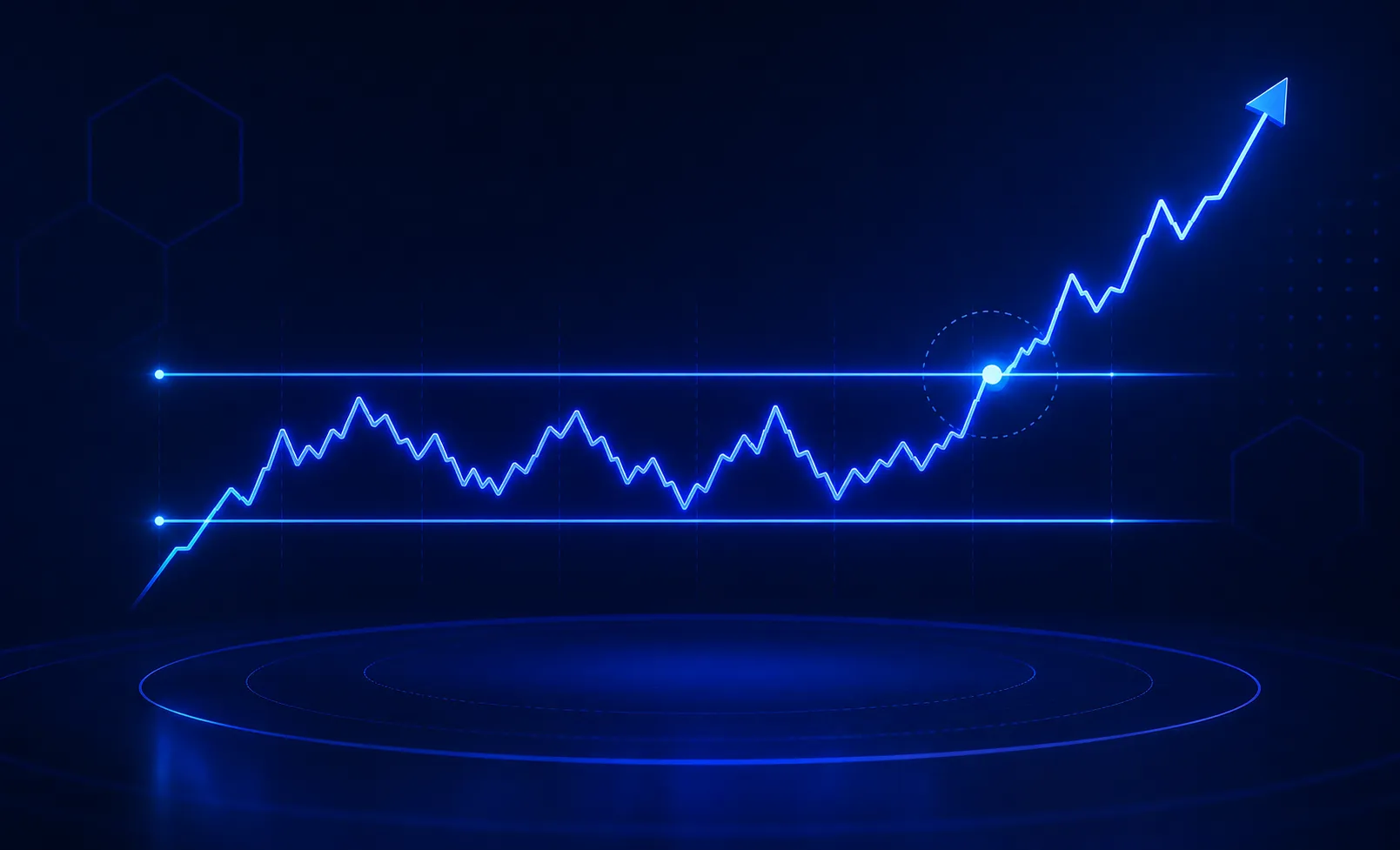
In breakout trading, you wait for the price to move out of a tight range. When the price breaks out, it suggests other participants are entering with high conviction. Because of leverage, a successful breakout can result in rapid equity growth, but false breakouts can trigger fast margin calls.
Traders often look for volume spikes to confirm a breakout. If the price pushes through an invisible support or resistance level, some traders may be forced to close their positions, adding more fuel to the move.
Pullback trading is a way to join an existing trend after a temporary dip in price. For futures traders, this offers a more margin-efficient entry point than chasing a price at its peak. You essentially wait for the market to take a ‘breather’ and enter when it reaches a key technical level.
Common tools for this strategy include Fibonacci retracements or key moving averages. The risk is that the small dip could be the start of a full reversal. To manage this, traders often set strict stop-losses just beyond the recent swing low to protect their account from sudden shifts.
Swing trading focuses on capturing market waves that last several days or weeks. This strategy is often used in commodities like oil or gold, which move based on intermediate supply and demand trends. It allows you to potentially capture larger moves than day trading.
However, swing traders face ‘gap risk’ because they hold positions overnight. If major news breaks while the market is closed, the next morning's price could jump far beyond your stop-loss level. You also need to maintain enough account equity to cover overnight margin requirements.
Ready for more? Once you have more experience, you might explore more complex futures trading strategies that require faster moves or advanced risk management.
The golden rule of day trading is that all positions must be closed before the market day ends. This eliminates the risk of overnight gaps. In futures, day traders focus on ‘tick value’ to determine their dollar risk for every minute-by-minute move.
This approach requires constant monitoring and quick decision-making. While it avoids overnight news risk, day traders must be aware of daily mark-to-market settlements, where the clearinghouse updates your balance based on the current price. Success depends on serious discipline and managing frequent transaction costs.
Scalping is an ultra-fast strategy where you try to profit from tiny price changes. Scalpers might hold a position for only a few seconds, aiming for just a few ‘ticks’ of profit at a time. This strategy is highly dependent on fast technology and tight bid-ask spreads.
Because the potential profit on each trade is small, a single large loss can erase dozens of wins. Therefore, stop-losses become very important. This strategy is generally more suited to highly liquid contracts, such as major stock index futures, where you can enter and exit with minimal slippage.
Momentum trading is about jumping on a price that is picking up speed. Traders look for signs that a move is accelerating, such as sharp price jumps combined with volume spikes. In futures, leverage can turn a fast momentum move into a significant return in a short time.
Traders use technical oscillators to identify assets that are heating up. While trend trading lasts for weeks, momentum trades are often shorter and more impulsive. The main risk is that the momentum can dry up suddenly, leading to a fast reversal that can catch over-leveraged traders off guard.
The mean reversion strategy assumes that if a price moves too far away from its average, it’ll eventually snap back. You identify markets that look ‘overstretched’ and bet that they will return to their normal range. This is often effective in sideways markets.
Tools like Bollinger Bands are used to find where the price has pushed beyond its standard deviation. However, the risk is that the mean itself can move during a strong trend. In futures, entering a reversion trade too early can lead to a margin call if the price continues to stretch.
Spread trading is unique to futures and involves buying and selling related contracts at the same time. Instead of betting on where the whole market goes, you bet on the price difference between them. Common spreads include:
The fade strategy is a contrarian approach where you trade against the prevailing crowd. When a price reaches an extreme high and looks exhausted, you ‘fade’ it by taking the opposite side. This targets markets that are beginning to consolidate after a major run.
This method requires high discipline and fast execution. The primary risk is that an extreme move might actually be the start of a much larger trend. Traders often watch for volume to drop off at a key level as a signal that the move is losing steam.
Think of indicators as filters that help you cut through market noise and confirm your entries. Using a combination of these tools allows you to build a more comprehensive view of market dynamics.
Your journey starts with learning the basics, specifically how leverage and margin work. It’s vital to remember that while leverage can increase potential gains, it also amplifies potential losses. You should also get to know tick values – the minimum price increment a contract can move.
Before you step into a position, you’ll need a directional bias. Are you bullish or bearish? This assumption often starts with looking at the ‘forward curve’, which is a chart showing the prices of contracts for different future dates.
The shape of this curve provides key clues about the market's current supply and demand. ‘Contango’ is where future prices are higher than the current price, creating an upward slope. ‘Backwardation’ happens when future prices are lower than the current price, creating a downward slope.
You can apply your assumptions using Crypto.com Exchange’s perpetual futures. These are USD-settled contracts traded directly within existing derivatives accounts. The platform provides access to several major markets, such as:
Risk management is the most critical part of any plan. Because futures are highly leveraged, even small price moves can lead to substantial gains or losses. Here are some of the tools you could use to manage your trading risk:
If you want to access perpetual futures contracts, you have to use a regulated venue like Crypto.com Exchange. Here’s how you can start trading perps with us.
What is the best futures trading strategy for beginners?
While there’s no single ‘best’ futures trading strategy, many beginners use trend trading and breakout trading as starting points. These strategies rely on clear directional signals and established market structures, making them easier to identify than complex multi-leg spreads.
How do futures work in day trading?
In day trading, futures act as leveraged tools to capture intraday price swings. Traders often use the high liquidity of indices like the S&P 500 to enter and exit quickly, ensuring all positions are closed before the market session ends.
What is the difference between scalping and swing trading?
Scalping is about very short-term micro-moves, often lasting only seconds, and requires high frequency. Swing trading targets medium-term moves over several days or weeks and involves holding positions overnight.
How do support and resistance levels impact breakout trading?
These levels mark the boundaries of a price range. Breakout trading happens when the price successfully breaches resistance or drops below support, which often signals that a potential new trend is starting.
What are moving averages used for in trend trading?
Moving averages help smooth out price data so you can see the dominant trend more clearly. Traders often use them to confirm an entry signal or as a dynamic level for trailing stop-loss orders.
How do perpetual futures differ from standard futures contracts?
Standard futures have a fixed expiration date and converge with the spot price at maturity. Perpetual futures don’t expire and use a periodic funding rate to keep the contract price aligned with the underlying spot market.
Can I trade US indices via perpetual futures?
Yes, you can trade perpetual contracts linked to major US indices, such as the S&P 500 and NASDAQ-100 on Crypto.com Exchange.
What does ‘trading the pullback’ mean?
This means entering a trade after a temporary reversal in the prevailing trend. It allows you to enter a long position at a lower price during an uptrend or a short position at a higher price during a downtrend.
How does leverage affect risk in futures trading?
Leverage lets you control a large contract value with a small amount of capital. This amplifies both potential profits and losses, which is why strict position sizing and stop-loss management are essential.
Important information: This article is provided by Crypto.com for informational and educational purposes only. Nothing contained in this article constitutes, or is intended to constitute, financial advice, investment advice, trading advice, legal advice, tax advice, or any other form of professional advice or recommendation. The information presented herein should not be relied upon as a basis for making any financial, investment, or trading decisions.
Trading perpetual contracts, futures, options, and other derivatives—including the use of margin and leverage—involves a high level of risk and may not be suitable for all users. You may lose all or more than your initial margin, and losses can occur rapidly due to volatility, leverage, or adverse market conditions. The use of leverage amplifies both potential gains and potential losses, and you should not trade with capital you cannot afford to lose. Liquidation may occur if maintenance margin requirements are not met, and funding rates, settlement mechanisms, expiry conditions, or pricing mechanisms may vary between instruments and trading sessions. Past performance is not indicative of future results, and no representation or warranty is made regarding future performance.
Readers should conduct their own independent research and due diligence and consult with qualified financial, legal, or other professional advisors before making any trading or investment decisions. You are solely responsible for evaluating the merits and risks associated with the use of any information, product, or service described in this article.
Cryptocurrency and derivative markets are subject to high volatility, regulatory uncertainty, and operational risks including, but not limited to, exchange outages, smart contract vulnerabilities, counterparty risk, and changes in applicable law or regulation. Product availability and leverage limits are subject to jurisdictional restrictions and applicable Terms and Risk Disclosures. Services, features, and other benefits referenced in this article may be subject to eligibility requirements and may change at the discretion of Crypto.com.
Crypto.com, its affiliates, directors, officers, employees, and agents make no representations or warranties, express or implied, as to the accuracy, completeness, timeliness, or reliability of the information contained in this article and disclaim all liability for any loss or damage arising from reliance on such information.