Explore the mechanics of leverage and how it gives you amplified exposure on your positions. This beginner-friendly guide breaks down the practical steps to trade crypto with leverage while navigating risks and costs.

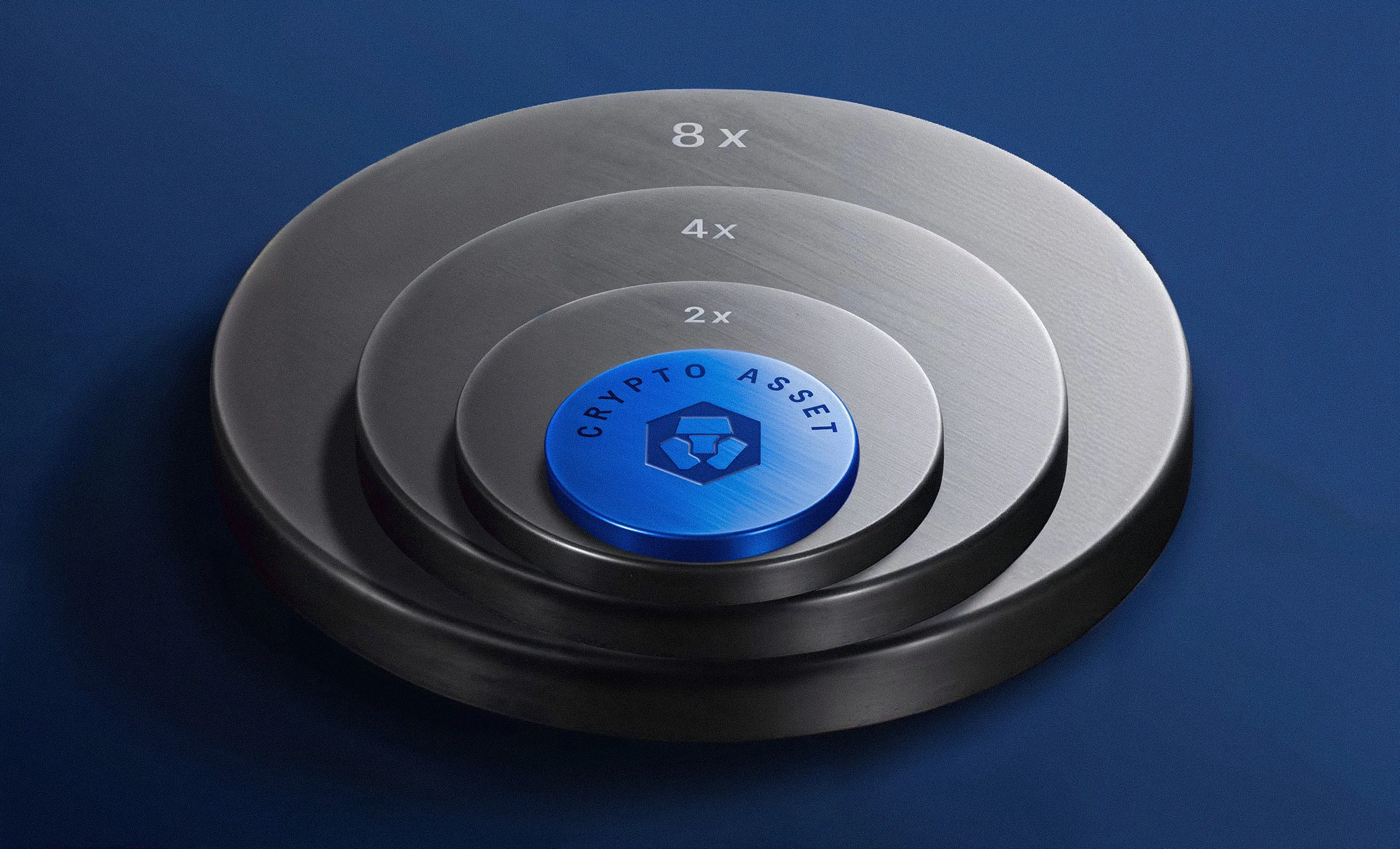
Leverage in crypto is a tool that allows you to control a much larger position than the amount of money you actually have in your account. It’s a way for investors to increase their market exposure by using borrowed funds provided by their trading platform or other users.
Think of it as a financial ‘multiplier’. For example, if you use 5x leverage, you’re effectively controlling $5,000 worth of cryptocurrency with only $1,000 of your own capital. While this might sound like a shortcut to growth, it’s a double-edged sword. Leverage amplifies both gains and losses equally.
So, if the market moves in your favor, your profit is based on the full $5,000 position. However, if the price drops, your $1,000 collateral can disappear five times faster than it would in a standard spot trade.
One of the key concepts any beginner should understand is liquidation. Unlike traditional spot trading, where you can hold an asset indefinitely even if its price drops, leveraged trades can be closed by the exchange if your loss amount approaches the value of your collateral.
This risk-first framing is very important because it’s possible to lose your entire initial investment in a very short period.
To understand how leverage works in crypto, you need to look at the relationship between your position size and your collateral. When you open a leveraged trade, you aren't just buying an asset; you’re entering a contract where your capital acts as a deposit.
Key terms to know:
Because the position size is larger than the margin, even small price moves have an outsized impact on your equity. For example, if you’re using 10x leverage, a mere 10% move in the market price against your position would result in a 100% loss of your initial margin.
This sensitivity is why leverage requires constant monitoring. While a spot trader might ignore a 2% daily fluctuation, a highly leveraged trader must account for every tick of the price, as their equity buffer is much thinner.
There are few different ways to engage in leveraged crypto trading, each with different mechanics and cost structures.
Margin trading is the most direct form of leverage. You borrow funds, typically from the exchange, to buy more of an asset than you can afford. Because you’re borrowing actual assets, you will usually pay ‘borrow interest’ (also known as carry) for as long as the position remains open.
Futures are derivative products, meaning you aren't necessarily holding the actual crypto. Instead, you’re trading a contract that tracks the asset's price.
Crypto trading options also provide leverage. They’re generally more complex as they involve premiums and strike prices, making them a different category than standard margin or futures.
Read our introduction to options trading
When you start trading crypto with leverage, you must navigate two specific hurdles:
Liquidation is a safety mechanism used by exchanges to ensure that a trader's losses don’t exceed their collateral. If the market moves against you and your equity drops below the maintenance margin level, the exchange will automatically close your position to prevent further losses.
In this context, the margin is ‘ring-fenced’ for a specific trade. If you put $100 into an isolated BTC trade, the maximum you can lose on that trade is $100. Even if you have more funds in your account, they won't be touched to save that specific position.
Here, your entire account balance is used as collateral for all open positions. While this gives you a much larger buffer against liquidation, it also means that one bad trade could theoretically wipe out your entire account balance.
The costs of leveraged trading can quickly turn a winning trade into a losing one if you don’t manage them well enough. Here are the fees that can impact your position:
Decide if you want to use futures trading or margin trading. Advanced traders might prefer options trading. Next, decide which asset you want to trade, e.g., Bitcoin (BTC).
Choose between isolated or cross margin. If you’re choosing isolated margin, decide how much of your total capital you’re willing to risk on this single trade.
Leverage is a multiplier (e.g., 2x, 5x, 10x). While some platforms offer up to 100x, beginners should start very low to understand the mechanics without risking immediate liquidation.
Always use a stop-loss order. This is an automated instruction to close your trade if it hits a certain price, protecting you from losing your entire margin.
Choose between a limit order (buys at a specific price) or a market order (buys immediately at the current price). Limit orders can also offer more control over costs.
Once the trade is live, track your crypto prices and margin levels. Have a clear plan for when to take profits or cut losses.
Rather than viewing leverage as a way to go all in, seasoned traders often use it to keep more of their capital in a flexible or liquid state. Position sizing involves limiting the amount of your total account equity allocated to any single trade.
By keeping individual positions small relative to your total collateral, a single unsuccessful trade or a sudden price swing doesn't automatically result in a huge loss for your entire portfolio.
The distance between your entry price and your liquidation price is your safety net. Because markets can experience flash crashes or sudden spikes, running a position too close to the maintenance margin leaves very little room for error.
Maintaining a substantial buffer – meaning your equity remains well above the minimum required to keep the position open – can help you stay in the trade during a temporary price fluctuation.
Crypto markets often react sharply to external economic data, such as central bank interest rate announcements or regulatory news. These events can trigger extreme volatility and widened spreads, which may lead to liquidation even if the price eventually returns to your target.
Monitoring market events helps you identify periods where the risk of unpredictable price movement is higher than usual.
A leveraged trade should never be open-ended. An effective exit strategy identifies specific price points where you will close the position, regardless of your emotions at the time.
Deciding on a take-profit level could help you realise gains before a trend reverses. On the other hand, you may choose to set a stop-loss, which is an automated instruction to exit the trade and preserve your remaining margin if the market moves against your position.
Even for those with experience, these common mistakes often stem from a misunderstanding of how quickly leverage can diminish a trader's margin.
The allure of using high leverage is often driven by the potential for high returns. However, this ignores the reality that at a very high leverage, a fractional price move against your position could result in total liquidation.
High multipliers leave almost zero room for natural market fluctuations, making it difficult to stay in a trade long enough for a thesis to play out.
Many traders focus solely on the entry and exit price, but trading crypto with leverage involves recurring expenses. Whether it is the borrow interest in a margin account or the funding fees in perpetual futures, these costs are continuously deducted from your equity.
Over weeks or months, these fees can significantly lower your liquidation price and eat into your potential profits.
Platforms often have a default setting for margin modes. Leaving your settings on cross margin means your entire account balance is used to support every open position. While this can prevent immediate liquidation in one trade, an unexpected market crash could result in the loss of all assets held in that wallet, rather than just the funds allocated to a specific trade.
One of the most dangerous habits is hoping for a market reversal. Without a pre-set stop-loss, a trader might watch their equity edge closer to the maintenance margin without a plan to exit. In the fast-moving crypto market, relying on manual exits is risky, as price spikes can trigger liquidation faster than most users can react manually.
What is leverage in crypto?
Leverage is a tool that lets you trade with more money than you have by borrowing funds from an exchange.
How does leverage work in crypto?
Leverage uses your deposit (margin) as collateral to open a larger position. Any potential profits and losses are calculated based on the total position size.
Is margin trading the same as futures?
No, margin trading involves borrowing actual assets for spot trades, while futures are contracts that track the price of an asset without you necessarily owning it.
What is liquidation in leverage trading?
Liquidation is the automatic closing of your position by the exchange because your losses have reached a point where you no longer have enough collateral to keep the trade open.
What's a simple leverage trading crypto example?
If you have $100 and use 10x leverage, you can buy $1,000 worth of Bitcoin. If the price of BTC goes up by 5%, your $1,000 position would now be worth $1,050. You’ll make $50 profit – a 50% return on your original $100.
Important information: This content is for informational purposes only and should not be considered investment advice. Trading cryptocurrencies involves risks, including price volatility and market risk. Past performance may not indicate future results. There is no assurance of future profitability. Before deciding to trade cryptocurrencies, consider your risk tolerance.
Services, features and other benefits referenced in this article may be subject to eligibility requirements, token holdings, and may change at the discretion of Crypto.com.




