Discover what an Initial Public Offering (IPO) is, how the process works and the potential benefits and risks of investing in IPOs. Learn how to participate in IPOs through Crypto.com’s Stocks platform.

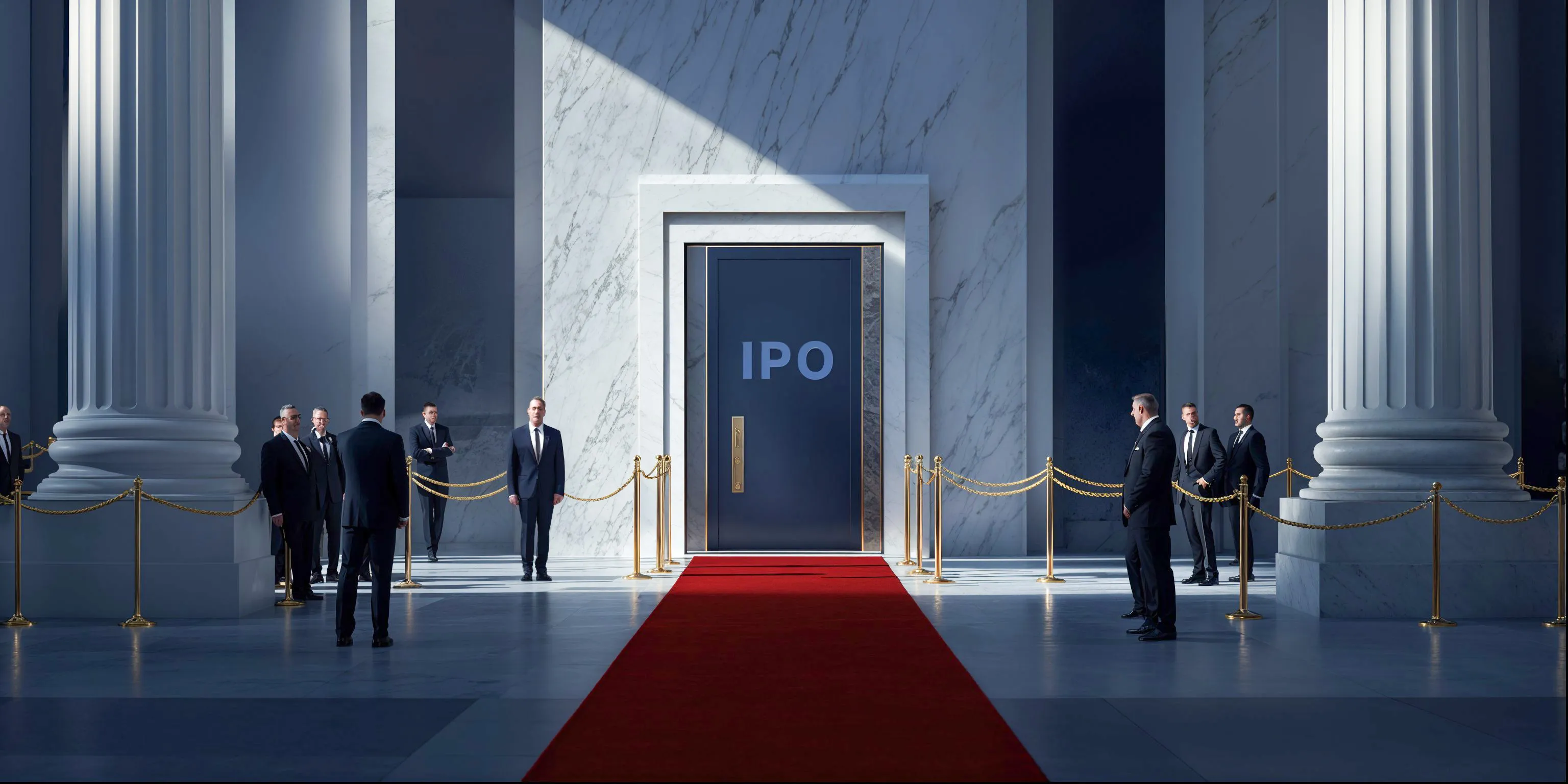
An Initial Public Offering (IPO) is when a private company offers its shares to the public for the first time on a stock exchange. This milestone marks the company’s transition from private to public ownership, allowing anyone, not just early investors or insiders, to buy and sell its stock. It’s a significant step that helps companies raise capital, increase visibility and expand their investor base.
Before an IPO, a company is privately held, meaning its ownership rests with founders, employees, and a small group of private investors such as venture capital or private equity firms. Once the company goes public, its shares become publicly traded, which means they can be freely bought and sold on an exchange such as the Nasdaq or New York Stock Exchange (NYSE). It opens the door for everyday investors to take part in the company’s next growth chapter.
An IPO can serve several purposes, from funding expansion to rewarding early backers and enhancing credibility in the market. For instance, when Airbnb went public in 2020, it was one of the most anticipated IPOs of the decade. The debut signalled the company’s recovery from pandemic-era challenges and showcased how a well-known brand could use an IPO to strengthen its global presence and financial stability.
For investors, IPOs can be exciting opportunities to participate early in a company’s public journey. However, they also carry risks, as share prices can be volatile in the early days of trading.
Understanding what an IPO is – and why companies choose this path – is the first step to deciding whether IPO investing fits your financial goals and risk tolerance.
Understanding how an IPO works starts with knowing a few key terms. These concepts form the foundation of the IPO process and help explain how a private company transitions to the public market.
a) Underwriter
An underwriter is typically an investment bank that guides the company through the IPO process. They help set the share price, buy the shares from the company, and then sell them to investors. The underwriter also assists with meeting regulatory requirements and managing investor demand.
b) Valuation
Valuation refers to determining how much the company is worth before it lists on a stock exchange. It’s based on factors such as financial performance, market conditions, growth potential, and comparable companies already trading publicly. A company’s valuation influences its share price during the IPO.
c) Prospectus
The prospectus is a detailed legal document filed with regulators such as the U.S. Securities and Exchange Commission (SEC). It outlines the company’s business model, financials, management team, potential risks and how it plans to use the funds raised through the IPO. Investors review this document before deciding whether to participate.
d) Lock-up period
This is a set timeframe – typically 90 to 180 days after the IPO – during which company insiders, including executives and early investors, are restricted from selling their shares. The lock-up period helps stabilize the stock price immediately after the public listing.
e) Market capitalisation (market cap)
Once a company is public, its total market value is measured by multiplying the share price by the number of shares outstanding. Market capitalisation helps investors understand the company’s relative size compared to others in the market.
The allure of IPOs lies in the possibility of early growth. Buying at the start can mean catching a company before it scales further. Some IPOs deliver the famed ‘day one pop’ in share price. Others stumble out of the gate, leaving latecomers to miss catching the wave.
In 2025, the IPO market threw a few fireworks. Take Figma: It priced at US$33 but closed its first trading day at $115.50, a jaw-dropping 250% pop.
Or consider USDC issuer Circle, which priced its shares at $31 and saw them soar to $83.23, marking a 168% first-day return.
Further back in history, think of the queues of Tesla fans who clamoured for shares when the company went public in 2010. IPOs have become somewhat of a financial celebration as much as a cultural one, even if the outcomes are unpredictable and returns not guaranteed.
Traditionally, IPO allocations are reserved for large institutions, hedge funds and the top-tier clients of investment banks. This leaves the everyday investor in a ‘FOMO’ state.
Even though the newer wave of retail-focused IPO products has been significant in un-gating entries for the retail crowd, there may still be restrictions to contend with, depending on the exchange or platform. Allocations still may not be guaranteed, and some impose a minimum holding period in which users cannot sell their allocated shares.
The playing field is changing. Some brokers now allow retail clients to participate more directly. However, allocations are usually either limited or oversubscribed, especially for highly sought after public listings.
This is where Crypto.com’s IPO Early Bird comes in: A way for retail investors to prepare in advance and pre-set limit orders, instead of scrambling at the opening bell.
IPO Early Bird, available on the Crypto.com App in the US, is designed to make IPO participation simple and readily accessible. Here’s how it operates:
It’s important to note that IPO Early Bird doesn’t provide access to allocations before trading begins.
Instead, it automates the process so retail investors can set their strategy in advance, then step away knowing their orders will trigger once trading opens. However, following the pre-set limit order, note that execution is not guaranteed.
If the market anticipates an IPO will trade towards the top of its expected range, a common strategy among users is to set a higher limit above the expected range.
For more guidance on how Early Bird IPO works, check out our full FAQ.
For many retail investors, the draw is simple: it’s a chance to participate in an event that was once the preserve of Wall Street insiders, without the complexity or exclusivity.
Here’s how you can invest in IPOs with Crypto.com Stocks.
Tip: Instead of manually monitoring Crypto.com Early Bird IPO list for new IPO additions, you can choose to get alerted whenever it happens. |
|---|
Here’s how you can switch on Early Bird IPO notifications:
Once subscribed to notifications, you’ll receive notifications when new IPOs are open for order placements (up to three weeks ahead of IPO date) or when they start trading.
Benefits | Risks |
Exposure to a company’s public debut | IPOs are inherently volatile, with large price swings on day one |
Simplified process through pre-IPO orders, also known as the ‘set it and forget it’ strategy for busy traders | Orders may not fill if the stock surges past a user’s limit price |
Protection against overpaying via limit prices | No guarantee of long-term performance or profitability |
Democratisation of access beyond institutions | Retail investors still don’t receive true allocation at the offering price |
As with any investment, enthusiasm should be balanced with caution.
Notes: Crypto.com Stocks provides an estimated price based on preliminary SEC filings, but this is not a guarantee of market value. Additionally, IPO stocks may not begin trading exactly at market open; delays are common as exchanges process orders. There is no guarantee your order will be filled, even if your limit price matches the displayed price. Newly public stocks are highly volatile, with prices that can swing quickly and may decline soon after execution. IPO investing is speculative and may not be suitable for all investors.
All investing involves risk, and losses may exceed the amount of principal invested. Past performance does not guarantee future results.
Foris Capital US LLC (FCUL) is a broker-dealer registered with the U.S. Securities and Exchange Commission (SEC) and a Member of the Financial Industry Regulatory Authority (FINRA) and the Securities Investor Protection Corporation (SIPC). For further information about FCUL, please visit FINRA BrokerCheck.
FCUL is a subsidiary of Crypto.com. FCUL is a separate entity from Crypto.com, Foris DAX, Inc., and other affiliated Foris companies. FCUL does not engage in the sale, transfer or custody of crypto currencies or digital assets. Crypto.com is a separate entity from FCUL and does not engage in the securities business. Customer balances and crypto holdings held and transacted at Crypto.com and other entities outside of FCUL are not covered by SIPC insurance and are separate from securities transactions and holdings at FCUL.
The content contained on FCUL’s website is for educational purposes only and is not and should not be considered a recommendation or solicitation to buy, hold or sell securities or to engage in any specific investment strategy. The information contained on this website is general in nature and has been prepared without consideration for customers’ investment objectives, risk tolerance, financial situations or other relevant considerations.