Learn how to read Riftbound rarities, from gem shapes and frames to collector printings, and why a card's rarity and its price are separate things.

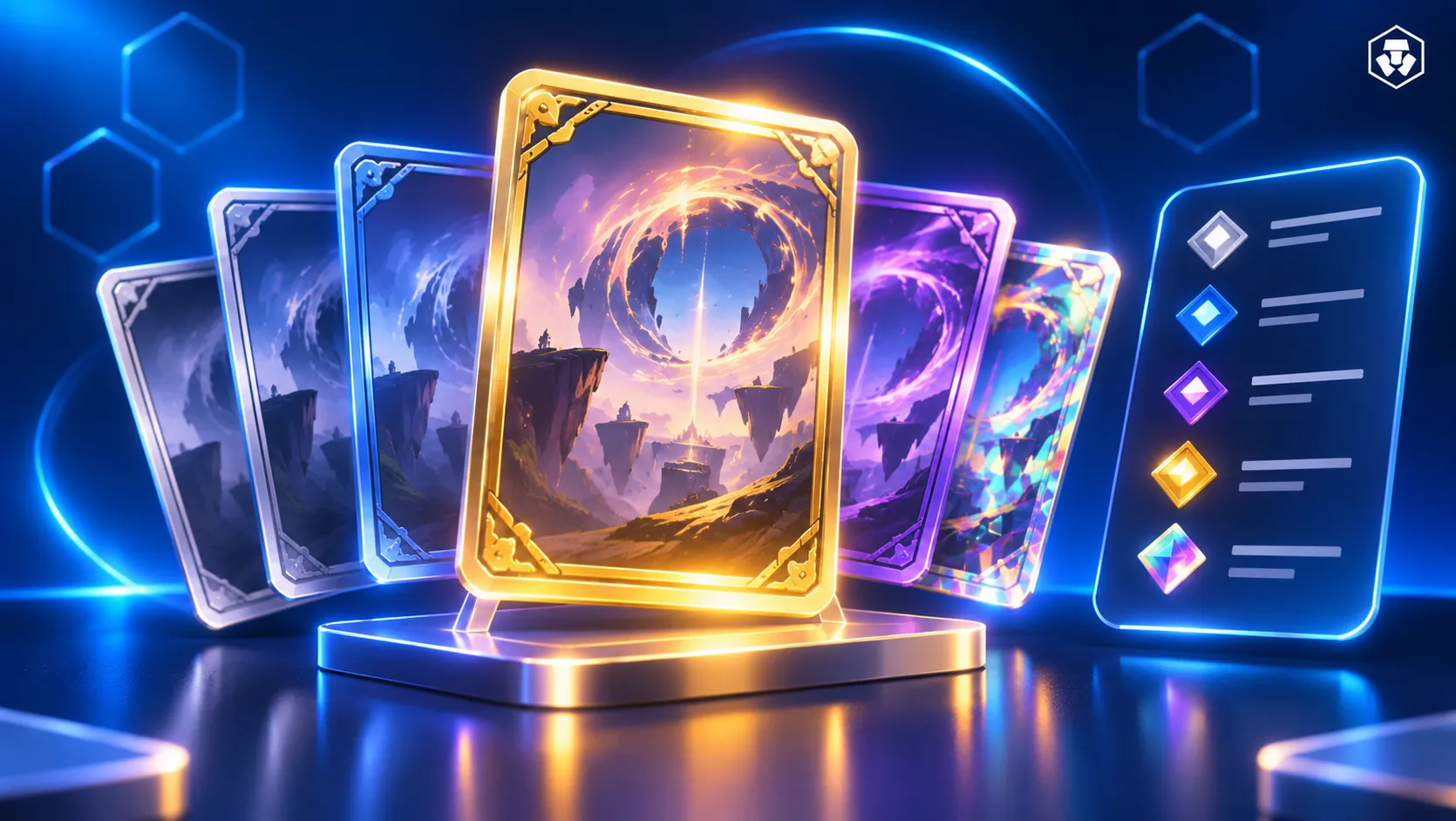
Every Riftbound card carries a small gem that says a lot. Its shape marks the card's rarity, from a round Common to a pentagonal Epic. A hexagon points to collector art. Here's how to read each symbol, what it tells you about a pull and why rarity doesn't set a price.
Riftbound rarities are the tiers Riot Games uses to sort the cards in its League of Legends trading card game. There are four standard tiers: Common, Uncommon, Rare and Epic. Collector printings sit alongside them.
Riot calls the four tiers functional rarities. They describe how a card fits into a pack and how complex it may be to play. A Common isn't necessarily a weak card. Collectors who also follow Pokémon will find that its Pokémon rarity symbols work differently, using circles, diamonds and stars.
Look at the gem at the bottom of the card, then check the frame around the art. Riftbound rarity symbols work as a pair:
According to Riot, every Rare and Epic is foil. Each pack also has a foil slot, which is usually filled by a foil Common or Uncommon but may hold a Rare or Epic. A shiny finish alone therefore doesn't tell you a card's rarity, so check the gem first.
A hexagonal gem sets a card apart from the four standard tiers. Riot uses it for alternate art cards and other collector printings sit outside the standard tiers too. Riftbound card rarity therefore has two layers: the functional tier and the collector printing.
The collector number is a quick tell. A card such as Poro Herder is numbered 061/298, while an overnumbered card shows a number higher than 298.
Card collectibles have taken off as hobbyists and first-timers alike amass their collections or flip it for gains.
Try your hand at the Rips experience and get 5 online card packs free of charge. Find out more details.
Pack contents change from set to set. An Origins booster pack holds seven Commons, three Uncommons, two Rare-or-better slots, one foil slot, one token or rune slot and an information insert.
Riot says an Epic appears in about one in four Origins packs and takes the place of a Rare, so a pack may hold two. Radiance packs add a flexible slot that can hold a Rare, Epic, Alt Art, Special Alt, Overnumber or Ultimate Rare. Riot puts the Ultimate Rare at about 0.025% of Radiance packs, with at most one per pack. Riot also says these rates are averages across a print run and don't guarantee any pull.
No. Rarity describes how a card is printed and how often it appears in packs. It doesn't set a price.
Art, variant, condition and demand may all influence what buyers pay, and prices move over time. Collectors sometimes call the most sought-after pulls in a set chase cards, yet a rarer gem doesn't promise a higher price. A grade from a third-party company is an assessment of condition and doesn't guarantee a sale price.
Use this quick Riftbound rarity guide on any card you pull:
These cues show a card's printed rarity. They don't show its condition or confirm that it's authentic.
Once you can read a gem, you may wonder where the cards come from. Many collectors open sealed packs in person. Others try online card ripping, where you open trading card packs through an app instead of tearing one open yourself.
Some platforms use virtual cards, while others use real, physical ones. Rarity cues like the ones above are one reason collectors study a game before they open anything: knowing what the tiers mean helps you read a reveal. Before you open a pack, you can compare ripping apps and look at:
Every pull is random and a buyback price may be lower than what you paid for the pack.
One option is Crypto.com Rips, a feature of the Crypto.com App for eligible users in supported regions. After you open a pack, you can sell the card back at the buyback price or keep it. A kept card may be shipped or held for a limited time, after which it sells automatically at the buyback price shown when you chose to keep it.
Follow these steps to get started.
They are Common, Uncommon, Rare and Epic. A round, triangular, square or pentagonal gem at the bottom of the card shows which one you have.
Riot uses the hexagonal gem for alternate art cards, which sit alongside the four standard tiers as collector printings.
An overnumbered card has a collector number above the set total. In Origins, which has 298 cards, overnumbered cards start at 299.
Look for a hexagonal gem and the same champion in a different League of Legends skin, with a more intricate foil. Match the card against a card list to confirm it.
According to Riot, yes. Commons and Uncommons are foil when they land in a pack's foil slot.
Riot says about one in four Origins booster packs holds an Epic. Rates vary by set and are averages across a print run, so they don't guarantee any pull.
An Ultimate Rare is a special rarity that first appeared in the Unleashed set. For Radiance, Riot puts it at about 0.025% of packs, with at most one per pack.
Not necessarily. Rarity describes how a card is printed and how often it appears. Art, variant, condition and demand may also influence what buyers pay.
Important information: This article is for informational purposes only and should not be construed as financial or investment advice. Trading cryptocurrencies involves risks, including price volatility and market risk. Past performance may not indicate future results. There is no assurance of future profitability. Before deciding to trade cryptocurrencies, consider your risk tolerance.
Services, features, and other benefits referenced in this article may be subject to eligibility requirements and may not be available in all markets. They may also be subject to change at the discretion of Crypto.com.
The Crypto.com Rips service is provided by Foris Inc. subject to the Crypto.com Rips Terms and Conditions, eligibility, and jurisdictional limits.