From prized rookie cards to rare autographs, some sports cards deserve a closer look. Learn how to get your American football, basketball or baseball cards graded, what the process involves and how special card features can affect your submission.

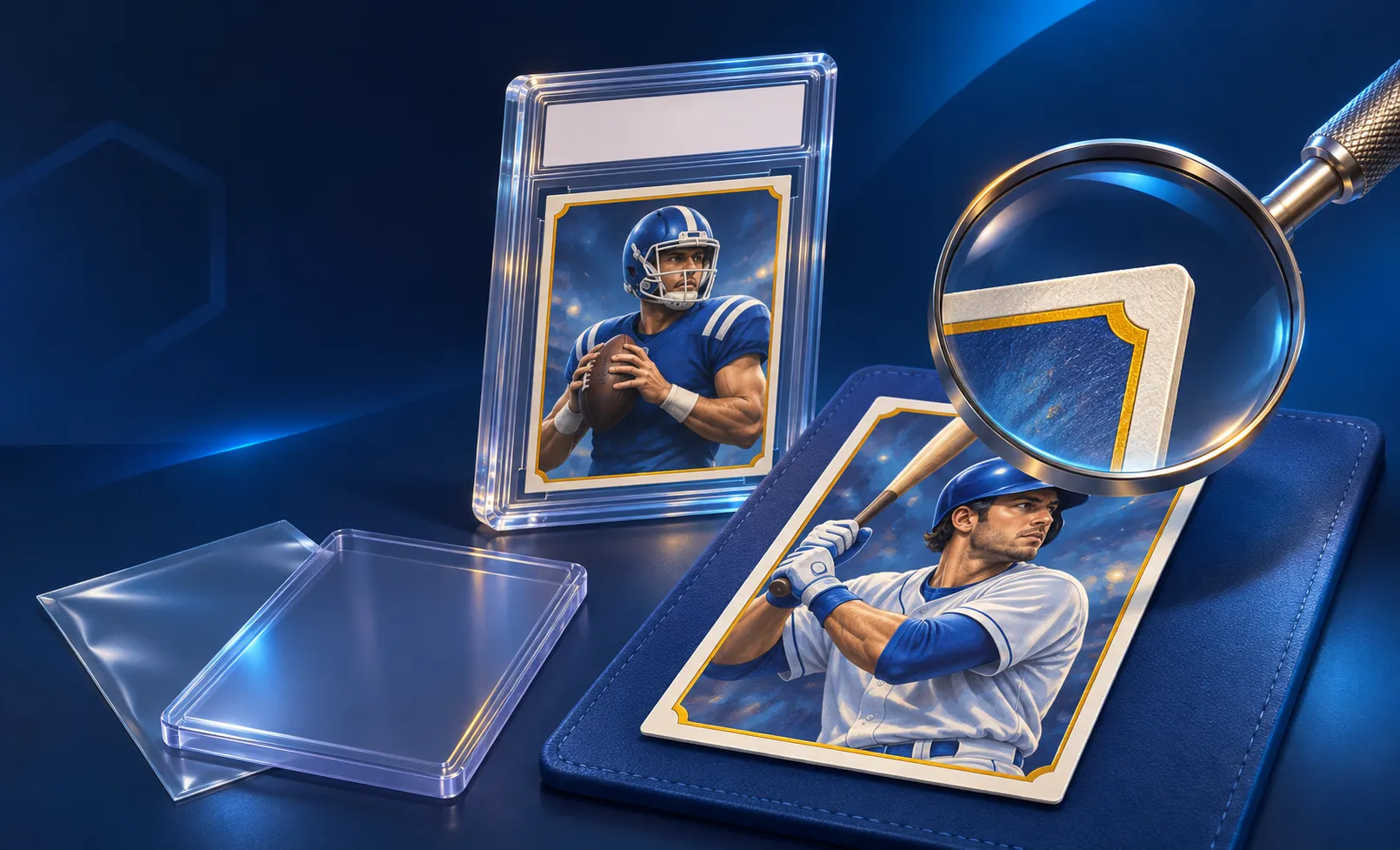
Sports card grading is a service where a third-party company checks a card's authenticity, assesses its condition and assigns a grade. The card is then sealed in a protective, tamper-evident plastic holder, commonly called a slab.
Graders assess four areas: centering, corners, edges and surface. They look for signs of wear or damage that could affect the card's condition, although grading standards differ between companies.
A grade represents a professional assessment rather than an exact measurement. At some companies, at least two graders review each card and must agree on the grade.
You might be interested in these reads next:
It can be, when a graded card is likely to sell for enough more than the same card ungraded to cover every cost. Nothing guarantees a high grade and the fee still applies if a card comes back with a lower grade than you hoped.
Consider these costs before you decide:
PSA suggests searching recent sold listings by year, manufacturer, set, player, card number and parallel, then adding the grade you expect. Looking back three to six months shows what that grade has sold for.
For lower-value modern cards, grading fees may exceed any potential increase in resale value. Rare parallels or limited-edition cards may warrant a closer look, while some vintage cards can remain valuable even in lower grades.
Resale value isn't the only consideration, either. Grading can also appeal to collectors who want to authenticate a rare card or preserve a sentimental favourite in a protective holder.
You can't assign an official grade at home, but you can check the same four areas graders use. A careful look helps you decide which cards to send. It can't predict the final grade, since graders also weigh eye appeal.
Check each card under good light, front and back:
Note: Don't apply any polish, sprays or tape to the cards. PSA lists things like cleaning, trimming and restoration among the reasons a card can come back with no numeric grade – and the full fee still applies.
PSA, Beckett (BGS), SGC and CGC are four major sports card grading companies. Each has its own grading scale, holder design, fees and submission requirements. Because grading scales differ, the same numerical grade doesn't necessarily represent the same condition across companies.
Here's how they compare:
Here's how to get sports cards graded from start to finish. The process is similar at every major company.
Check the grading company's current rules for your card type before you submit, since it varies.
At PSA, autographed cards dated before 1998, or not certified directly by the manufacturer, go through the Card and Autograph Dual Service. PSA authenticates the card and the autograph, and the label shows separate 1 to 10 grades for each.
Manufacturer-certified autographed cards dated 1998 to the present can go through regular service levels. Under those levels, only the card is evaluated. PSA can't assign a grade to an autograph it finds enhanced or restored.
At PSA, cards from 25 to 40-point cardstock go in thinner holders and cards above 40 points go in thick slabs. PSA chooses the holder size and doesn't accept holder requests.
Inserts and variations are most often thicker than base cards. CGC lets submitters select a thick holder on its online form. Packing guidance for thick cards differs by company, so check the current instructions before you pack.
Serial numbers usually appear on parallels, for example 5/10. List the parallel name on the form and add the serial number if the form asks for it. Accurate entries help the grading company identify the card and a wrong parallel may lead to an incorrect label.
Sports card grading fees depend on the company, the service level you choose and the card's declared value. Higher-value cards may require a more expensive service level, while faster turnaround options also tend to cost more.
Membership can affect the price, too. PSA offers member-only grading tiers and promotional rates, while CGC Cards offers discounts through certain paid memberships. However, membership fees should be factored into the overall cost.
The price quoted when you submit isn't always the final amount. If a grading company determines that your card exceeds the maximum value allowed for your chosen service level, you may be charged an additional fee to move it to a higher tier.
Remember to account for shipping and insurance, which can add to the total cost. Turnaround times also vary by service level and are estimates rather than guarantees. Check the grading company's current fees and processing times before submitting your cards.
Online card ripping lets collectors open card packs virtually. Depending on the platform, these may contain digital collectibles or cards backed by real physical inventory. Some services let you take delivery of the cards, then you can have them professionally graded afterward.
Here's how online card ripping works:
For collectors interested in grading, the distinction between purely digital cards and physically backed cards is worth checking. A virtual collectible can't be submitted to a traditional sports card grading company.
Crypto.com Rips brings the card-opening experience to the Crypto.com App, with digital packs linked to real collectible cards. After opening a pack, you can see the cards and their details, along with a quoted sell-back price that's valid for 48 hours only.
If you don't want to sell the card, you have to request physical delivery before the 48-hour deadline has passed, to avoid it being sold automatically.
Card collectibles have taken off as hobbyists and first-timers alike amass their collections or flip it for gains.
Try your hand at the Rips experience and get your first 5 packs free of charge.
Get all the details on Crypto.com Rips
* Availability may vary by jurisdiction.
Choose a grading company and service level, then create an online submission listing each card. Pack your cards according to the company's instructions and ship them with the required paperwork. You can track your order until the graded cards are returned.
It depends on the grading company and service level. Faster services may cost more, and published turnaround times are estimates rather than guarantees. Check whether the estimate includes shipping time.
Yes, PSA accepts submissions at certain card shows and events, although availability varies. Check its official show schedule and submission requirements before attending.
It can be, especially if you want to authenticate or protect a card with sentimental value. However, grading fees and shipping costs may exceed any increase in resale value, particularly for lower-value cards.
A card that's been trimmed, recoloured or restored may not qualify for a numeric grade. PSA may still charge the grading fee, so check the company's policies before submitting a card you suspect has been altered.
Enter the certification number printed on the holder's label into the grading company's online verification tool. Check that the card details match, but remember that a valid certification number alone doesn't guarantee a card or holder is genuine.
Important information: This article is for informational purposes only and should not be construed as financial or investment advice.
The Crypto.com Rips service is provided by Foris Inc. subject to the Crypto.com Rips Terms and Conditions and the Crypto.com App Terms and Conditions. You must be 18+.